세례자 요한 Saint John the Baptist
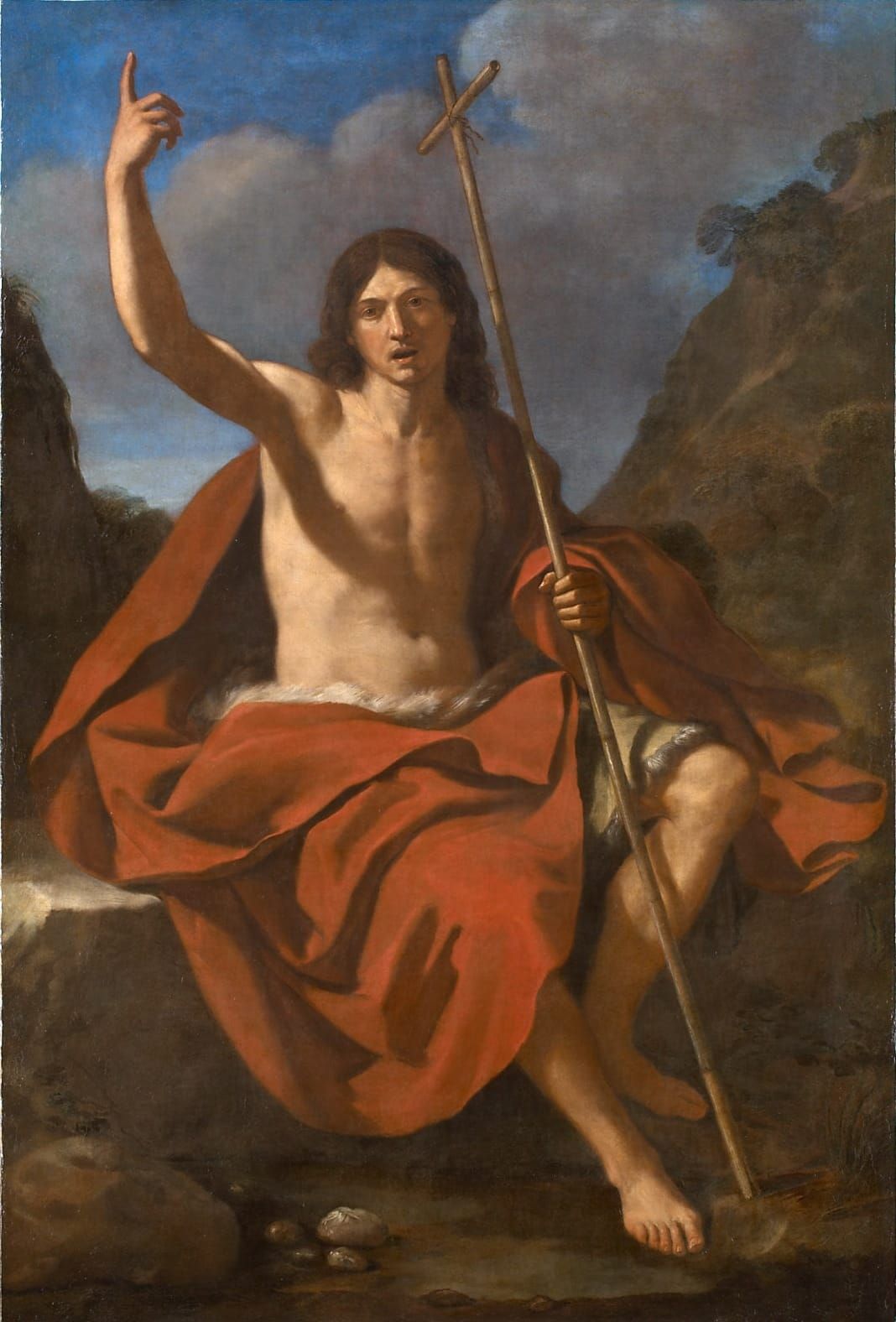
17세기 이탈리아 바로크 회화의 거장 조반니 프란체스코 바르비에리, 널리 귀에르치노(Guercino, 1591–1666)로 불리는 화가가 1650년경 완성한 제단화 대작 유화 세례자 요한(Saint John the Baptist in the Wilderness, 이탈리아어: San Giovanni Battista)은 321.0 cm × 196.0 cm 크기의 거대한 캔버스에 유채로 그린 대표적인 종교화 최고 걸작입니다. 현재 이탈리아 첸토의 일 귀에르치노 시립미술관(Civica Pinacoteca il Guercino, Cento)에 소장되어 있습니다.
로자리오 성당과 가문의 자부심, 리돌피니 형제의 제단화 주문
귀에르치노가 꼼꼼히 기록하던 작업 장부인 계정록에는 1650년 6월 18일 체사레 리돌피니와 조반니 바티스타 리돌피니 형제로부터 이 거대한 제단화의 대금으로 42개 반의 이탈리아 금화를 최종 지급받았다는 기록이 남아 있습니다. 이 제단화는 귀에르치노의 고향 첸토에 있는 산티시모 로자리오 성당(Chiesa del Santissimo Rosario)에 걸리기 위해 제작되었습니다. 로자리오 성당은 화가에게 단순한 예배당이 아니었습니다. 몇 년 전 귀에르치노는 평생의 동반자이자 화실 재정을 도맡아주었던 동생 파올로 안토니오 바르비에리와 함께 가문 전용 예배당을 직접 꾸몄던 곳이었기에, 고향 사람들과 가문의 이름을 걸고 최고의 걸작을 완성해야 한다는 깊은 책임감과 예술적 자존심이 걸려 있었습니다.
당시 예순에 가까운 나이에 접어든 귀에르치노는 광야에서 메시아의 오심을 외치던 세례자 요한을 그리기 위해 깊은 조형적 고뇌에 빠졌습니다. 라파엘로가 남긴 세례자 요한의 고전적 구도를 연구하면서도, 지나치게 이상화된 모습 대신 척박한 바위산과 맑은 시냇가에서 거친 낙타털 옷을 입고 하느님의 음성을 전하는 예언자의 생생한 육체성을 담아내고자 했습니다. 화가는 오른손 검지를 하늘 높이 치켜들어 회개와 천국을 선포하는 세례자의 웅변적인 손짓을 완성하고, 왼손에는 가느다란 갈대 십자가를 쥐여주었습니다. 허리와 무릎을 덮고 있는 선명한 주홍빛 붉은 망토는 회색빛 바위 절벽과 푸른 하늘 사이에서 강렬한 시각적 무게를 지탱하며 성자의 순교와 거룩한 열정을 웅변합니다.
하늘을 가리키는 손끝에서 설교하는 입술과 광야의 붉은 망토로, 시선의 심리적 여정
그림을 마주하는 순간 관람객의 무의식적 시선은 화면 왼쪽 위 푸른 하늘을 향해 높이 솟아오른 세례자 요한의 곧게 뻗은 오른팔과 하늘을 가리키는 검지손가락으로 가장 먼저 빨려 들어갑니다. 곧 닥쳐올 메시아의 시대와 천국을 향해 모든 이들의 시선을 이끄는 단호한 손짓은 보는 이에게 깊은 시각적 충격과 함께 마음을 깨우는 영적 긴장감을 선사합니다.
이어 시선은 손가락 끝에서 팔의 탄탄한 근육선을 따라 내려와, 살짝 벌어진 입술로 광야의 군중들을 향해 말씀을 선포하는 세례자 요한의 진지한 얼굴과 깊은 눈매로 이동합니다. 험난한 광야 생활 속에서도 맑고 단호함을 잃지 않는 성자의 눈빛과 어깨를 살짝 덮은 짙은 갈색 머리칼을 확인하는 순간, 관람객은 광야의 서늘한 바람 속에서 홀로 울려 퍼지는 예언자의 거룩한 외침 속으로 온몸이 빨려 들어가게 됩니다.
마지막으로 시선은 성자의 왼손에 가볍게 들려 있는 갈대 십자가의 가느다란 마디를 지나, 하체를 웅장하게 감싸며 바위 아래로 흘러내리는 강렬한 다홍빛 망토의 두터운 주름과 발밑 시냇가의 둥근 조약돌들에 멈춥니다. 척박한 바위산을 뚫고 솟아오른 맑은 시냇물과 묵직한 붉은 옷자락의 온기를 마주하며, 관람객은 세속의 어둠을 밝히는 진실한 신념의 가치와 귀에르치노가 건네는 묵직한 영혼의 위로를 가슴 깊이 마주하게 됩니다.
17세기 볼로냐 제단화의 정점과 고전적 사실주의, 미술계의 평가
미술계는 세례자 요한을 귀에르치노가 볼로냐 르네상스의 이상적인 인체 비례와 바로크 특유의 살아 있는 명암법을 가장 완벽한 척도로 조화시킨 대표적인 제단화 명작으로 평가합니다.
단독 인물상임에도 불구하고 높이 3미터가 넘는 거대한 공간을 압도하는 영웅적인 신체 구조, 바위산과 하늘이 빚어내는 서정적인 광야 풍경, 그리고 붉은 천의 풍성한 음영을 극도로 정교한 명암법으로 완벽하게 구현했기 때문입니다. 고향 첸토를 향한 각별한 애정과 성경 속 예언자의 숭고한 사명을 장엄한 시각 언어로 완성해 낸 귀에르치노의 이 기념비적인 화폭은, 오늘날까지도 전 세계 수많은 감상자들에게 깊은 감동과 잊을 수 없는 시각적 전율을 전해주는 불멸의 명작으로 손꼽히고 있습니다.
Saint John the Baptist
Painted around 1650 in Cento by the preeminent Italian Baroque master Giovanni Francesco Barbieri, universally celebrated as Guercino (1591–1666), Saint John the Baptist in the Wilderness (Italian: San Giovanni Battista) is a monumental altarpiece executed in oil on canvas measuring 321.0 cm × 196.0 cm (126.4 in × 77.2 in), preserved in the permanent collection of the Civica Pinacoteca il Guercino in Cento, Italy.
The Ridolfini Commission, the Church of the Rosary, and Family Pride
According to Guercino’s studio account book, the Libro dei Conti, a final payment of forty-two and a half gold dubloons was recorded on June 18, 1650, from the brothers Cesare and Giovanni Battista Ridolfini for this monumental altarpiece. The painting was commissioned for the Church of the Santissimo Rosario in Cento, a sacred place of profound personal significance for the master. Only a few years earlier, Guercino had decorated the Barbieri family chapel in the same church alongside his beloved brother and workshop manager, Paolo Antonio Barbieri. Producing an altarpiece for his hometown church represented both a personal tribute and a demonstration of his artistic supremacy before his fellow citizens.
Approaching sixty years of age, Guercino sought to balance classical monumentality with naturalistic truth in portraying the Prophet in the wilderness. Drawing inspiration from classical models, including the Bolognese copy of Raphael’s Saint John the Baptist, Guercino anchored the composition in palpable physical reality. The saint sits upon a rugged stone shelf, wearing a camel-hair tunic and a voluminous scarlet mantle that provides a warm, chromatic foundation against the cool grey cliffs and azure sky. His raised right arm points upward to proclaim the arrival of the Messiah, while his left hand loosely clasps the slender reed cross tied with twine.
Subconscious Trajectory of the Gaze: From Prophetic Gesture to the Flowing Mantle
The observer's subconscious gaze is immediately magnetized by the upper-left register, drawn to the powerful upward gesture of the Baptist’s raised right arm and pointing index finger silhouetted against the open sky. This authoritative oratorical gesture serves as an instant focal point, directing the viewer toward the divine source of prophetic revelation.
The visual path then descends along his muscular shoulder to his expressive face, taking in his parted lips, dark cascading curls, and earnest gaze directed toward the viewer. Observing his intense concentration as he preaches the coming of Christ, the spectator directly experiences the vocal energy and spiritual urgency of the Baptist's message echoing through the wilderness.
Finally, the visual trajectory sweeps across the slender reed cross held in his left hand, cascading through the voluminous, sculptural folds of the vermilion cloak that envelopes his lap before resting upon the small stream and smooth pebbles at his feet. Observing the harmonious equilibrium between monumental anatomical modeling, rich directional light, and naturalistic landscape, the viewer perceives the enduring dignity of sacred faith and the profound aesthetic solace Guercino embedded within the monumental canvas.
The Monument of Bolognese Altarpiece Realism: Critical Legacy
Art historians celebrate this monumental Saint John the Baptist as a supreme pinnacle of Guercino’s mature career, illustrating his synthesis of dynamic naturalism with the balanced clarity of the Bolognese classical school.
By commanding a colossal composition over three meters high with a single heroic figure and rendering rich textural distinctions between sunlit flesh, coarse animal skin, billowing wool, and rough stone, Guercino elevated a traditional devotional subject into an extraordinary spatial monument. This magnificent altarpiece endures as a testament to the master's technical prowess, celebrating the noble spirit of sacred prophecy and the transformative power of living art.
본 컨텐트의 저작권은 팔렛트제주에 있습니다. 허가없는 무단전제를 금지합니다.
Copyright © Palette Jeju. All rights reserved. Unauthorized reproduction or redistribution is strictly prohibited.