성가족
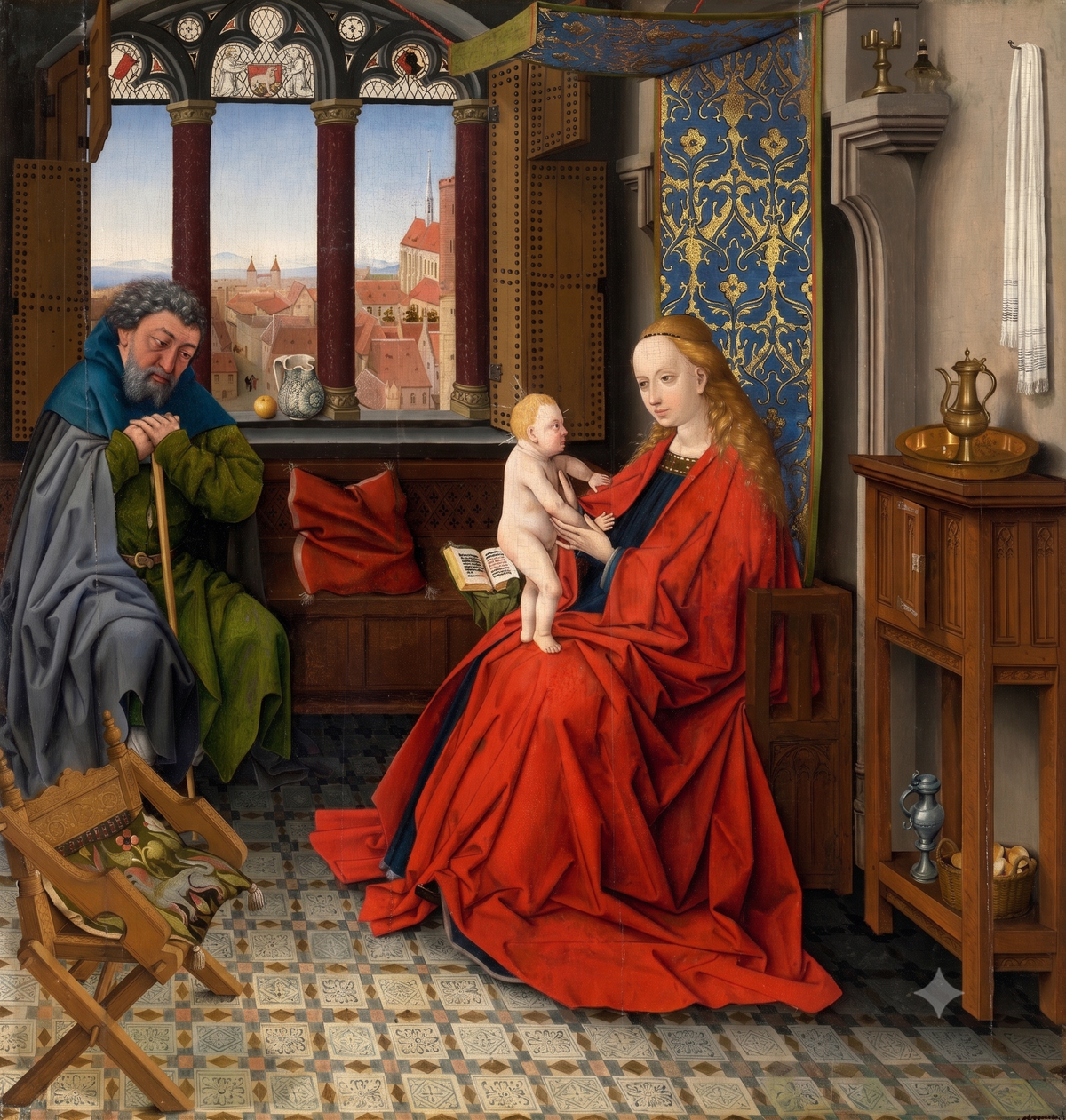
The infant Jesus, illuminated by earthly sunlight upon the knee of the Virgin Mary—who gracefully wears a draped red robe—alongside Saint Joseph leaning quietly on his staff as he gazes upon his family, fills the entire space with warm intimacy. Beyond the window lies a meticulously detailed Gothic cityscape, while indoors, charming wooden furniture and intricate patterns on the floor tiles catch the passing light; these delicate play of shadows elevate an ordinary everyday room into a sacred, poetic sanctuary. Within the crisp, refined brushwork characteristic of 15th-century Flemish oil painting, serene peace and cozy family affection are exquisitely woven, gently comforting the heart of the viewer.
Completed around 1430, this canvas stands as a representative masterpiece of Flemish oil painting created by Robert Campin, a pioneer of the Northern Renaissance and master of Tournai. In the early 15th century, when medieval symbolism still held strong sway, Campin brought sacred biblical figures down from distant heavens and placed them directly inside the familiar, everyday space of a contemporary Flemish home. Realistically rendered domestic items—such as a pitcher, a basin, and a folding chair—alongside delicately textured fabrics achieved an aesthetic innovation that conveys divine nobility and earthly intimacy simultaneously.
The fascinating backstory behind this work lies in Robert Campin’s innovative use of symbolism, which bridged the gap between the sacred and the profane. The clean white towel and water pitcher hanging on the right side of the canvas appear to be simple household props, yet they serve as sophisticated allegories symbolizing Mary's purity and virginity. Furthermore, details like the fruit on the window sill and the small folding stool on the floor were all calculated devices meticulously arranged by the artist to transform a secular space into a holy shrine. Viewers of that era were deeply moved to discover sacred meanings embedded within the everyday furniture and utensils they used daily; Campin's ingenious direction—infusing even the most minute objects with spiritual life—became a foundational source of inspiration for generations of Northern European oil masters to come.
Together with Jan van Eyck and Rogier van der Weyden, Robert Campin established the foundation of Flemish oil painting and opened new horizons for painterly realism. Leading the Painters' Guild of Tournai while spending a lifetime researching the harmonious balance between fine pigments and oils, he displayed genius in observing and capturing surface textures and light reflections with extreme precision. His relentless pursuit of realism and warm humanity at the dawn of Renaissance realism became enduring pillars of Western art history for centuries.
본 리뷰에서 작품을 제외한 컨텐츠의 저작권은 팔렛트제주에 있습니다.
"퍼블릭도메인 고전명화"를 제외한 모든 창작 콘텐츠는 저작권법 제4조 및 제10조에 의거하여 보호됩니다. 무단 도용시 저작권법 제136조(벌칙)에 의거, 당사의 사전 서면 승인 없는 저작권 침해 행위를 금지합니다.