성가족 Sainte Famille
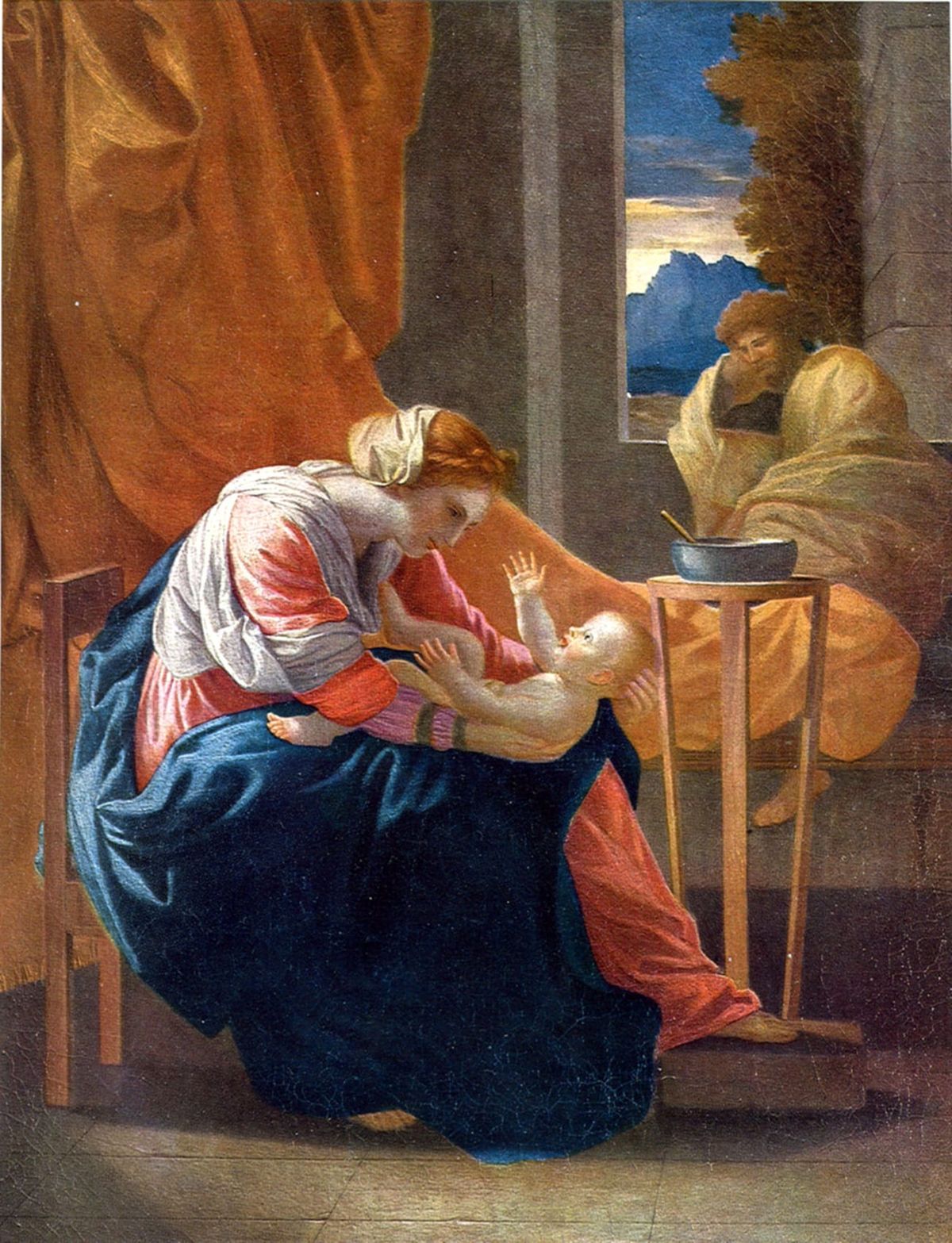
17세기 프랑스 고전주의 회화의 시조이자 서양 미술사 불멸의 거장 니콜라 푸생(Nicolas Poussin, 1594–1665)이 1641년에서 1642년경 완성한 기념비적 성가족 유화 성가족(The Holy Family, 프랑스어: La Sainte Famille, 소장품 번호: 54.2)은 68.6 cm × 50.8 cm 크기의 세로형 캔버스에 유채로 그린 대표적인 기독교 신약성화 최고 걸작입니다.
현재 미국 미시간주 디트로이트의 디트로이트 미술관(Detroit Institute of Arts, Detroit)에 소장되어 있습니다.
파리 궁정의 번잡함을 벗어나 성가족의 고요한 침묵을 향한 화가의 고뇌
1640년 프랑스 국왕 루이 13세와 리슐리외 추기경의 강력한 부름을 받고 파리로 귀국했던 푸생은, 궁정 화가들 간의 시기와 치열한 파벌 다툼, 그리고 거대한 루브르 갤러리 장식 작업에 따른 극심한 피로감으로 깊은 회의에 빠져 있었습니다.
화가는 화려하지만 소란스러운 궁정 예술 대신, 고요한 일상 속에서 신성한 사랑과 숭고한 질서가 깃든 성가족의 침묵을 화폭에 담는 데서 마음의 평안을 찾고자 했습니다.
그는 르네상스 거장 라파엘로의 성모자화가 지닌 순수한 기하학적 비례와 고대 로마 건축의 엄격한 균형을 바탕으로, 구원자를 품에 안은 어머니의 따뜻한 모성애와 묵묵히 가족을 지키는 요셉의 인간적 고뇌를 깊이 사색했습니다.
화가는 소박한 석조 실내 공간에서 아기 예수를 정성스레 씻기고 돌보는 성모 마리아와 뒤편에서 깊은 생각에 잠긴 성 요셉의 모습을 화폭에 담았습니다.
화면 전면에는 머리에 단정한 흰 수건을 두르고 붉은 옷과 푸른 겉옷을 입은 성모 마리아가 의자에 앉아, 무릎 위의 발가벗은 아기 예수를 두 손으로 조심스럽게 받쳐 들고 있습니다.
어머니를 올려다보며 작은 두 손을 허공으로 뻗는 아기 예수의 천진난만한 눈망울과, 그 곁에 놓인 세 발 달린 탁자 위의 세숫대야와 수프 그릇은 소박한 일상의 정갈한 온기를 더해줍니다.
화면 오른쪽 뒤편 창가 그늘 아래에서는 턱을 괸 채 묵묵히 생각에 잠긴 성 요셉이 자리 잡고 있으며, 창밖으로 펼쳐진 푸른 산맥의 고요한 하늘은 인류 구원이라는 거룩한 운명을 품은 성가족의 성스러운 평온을 손에 잡힐 듯 생생하게 웅변합니다.
무릎 위 아기 예수의 손짓에서 자애로운 성모의 눈빛과 고요한 요셉으로, 시선의 심리적 여정
그림을 마주하는 순간 관람객의 무의식적 시선은 화면 중앙에서 따스한 햇살을 받아 뽀얗게 빛나는 아기 예수의 포동포동한 나체와 어머니를 향해 번쩍 들어 올린 작은 두 손으로 가장 먼저 빨려 들어갑니다.
어머니와 눈을 맞추며 버둥거리는 아기의 생동감 넘치는 몸짓과 순진무구한 표정은 보는 이에게 깊은 시각적 온기와 함께 인간으로 태어난 구원자의 순수한 사랑을 선사합니다.
이어 시선은 아기를 감싸 안고 있는 성모 마리아의 우아한 옷자락을 따라 이동하여, 부드러운 분홍빛 소매와 짙은 청색 치마의 묵직한 주름을 지나 성모의 단아하고 자애로운 옆얼굴로 옮겨갑니다.
아들을 내려다보며 은은한 미소를 짓는 성모의 눈가에 스민 잔잔한 모성애를 확인하는 순간, 관람객은 거룩한 신성 속에 피어난 가장 순수한 가족애의 감동 한복판 속으로 온몸이 빨려 들어가게 됩니다.
마지막으로 시선은 화면 오른쪽 세 발 나무 탁자 위에 놓인 세숫대야를 지나, 창가에 앉아 턱을 괴고 모자를 그윽하게 바라보는 성 요셉의 묵직한 고뇌와 저 멀리 창밖의 푸른 바위산 풍경에 멈춥니다.
배경의 황금빛 커튼과 견고한 석조 기둥이 만들어내는 완벽한 기하학적 안정감을 마주하며, 관람객은 평범한 일상을 성스러운 묵상으로 바꾸는 고전주의 예술의 거룩한 가치와 거장 푸생이 건네는 묵직한 영혼의 위로를 가슴 깊이 마주하게 됩니다.
17세기 프랑스 고전주의 종교 성화의 정점과 조형미, 미술계의 평가
미술계는 디트로이트 미술관의 성가족을 푸생이 라파엘로의 고전적 이상미와 고대 건축의 엄격한 원근법을 완벽하게 융합해 낸 가장 서정적이고 완성도 높은 성가족 성화 걸작으로 평가합니다.
어머니와 아기의 대각선 시선 축과 요셉의 수평적 시선을 절묘한 기하학적 삼각형 구도 속에 배치했을 뿐만 아니라, 성모의 붉은 튜닉과 푸른 망토의 고결한 색채 대비, 황금빛 휘장의 질감, 돌바닥과 대야의 촉각적 물질감을 극도로 섬세한 명암법으로 완벽하게 구현했기 때문입니다.
가장 소박한 가정의 온기를 가장 품격 높은 고전주의 시각 교향곡으로 완성해 낸 푸생의 이 걸작 화폭은, 오늘날까지도 전 세계 수많은 감상자들에게 깊은 감탄과 잊을 수 없는 시각적 안식을 전해주는 불멸의 명작으로 손꼽히고 있습니다.
The Holy Family
Painted between 1641 and 1642 by the founder of French classicism and immortal master Nicolas Poussin (1594–1665), The Holy Family (French: La Sainte Famille, Accession No. 54.2) is a devotional masterpiece in oil on canvas measuring 68.6 cm × 50.8 cm (27.0 in × 20.0 in).
It is preserved in the distinguished permanent collection of the Detroit Institute of Arts in Detroit, Michigan, United States.
The Parisian Court Intrigues, Raphael's Harmony, and the Solace of Sacred Domesticity
During his reluctant stay in Paris between 1640 and 1642 under the summons of King Louis XIII and Cardinal Richelieu, Nicolas Poussin felt overwhelmed by political court rivalries and the relentless demand for grand decorative cycles.
Seeking intellectual peace and spiritual purity, the master turned to private devotional easel paintings, meditating upon the intimate domestic grace and divine destiny of the Holy Family.
Drawing upon the geometric equilibrium of Raphael’s classic Madonnas and the solemn architectural logic of ancient Roman design, Poussin reflected on maternal tenderness and the silent paternal vigilance of Saint Joseph.
The composition captures an intimate domestic scene where the Virgin Mary tends to the infant Christ inside a tranquil stone interior.
Seated upon a wooden chair in the foreground, Mary wears a crisp white linen headscarf, a rose-colored gown, and a rich ultramarine mantle, cradling the naked infant Jesus across her lap with maternal tenderness.
The Christ Child looks upward with joyful energy, stretching his tiny arms toward his mother as a basin and broth bowl rest atop a three-legged wooden stand beside them.
In the shaded background to the right, Saint Joseph rests his head upon his hand in contemplative silence, framed by an open stone window that reveals the serene blue peaks of a distant landscape.
Subconscious Trajectory of the Gaze: From the Infant Christ to the Pensive Saint Joseph
The observer's subconscious gaze is immediately magnetized by the central register, drawn to the luminous, sunlit flesh and dynamic posture of the infant Jesus resting upon Mary’s lap.
His upturned profile, innocent gaze, and outstretched arms reaching toward his mother establish an instant focal point of youthful vitality, divine incarnation, and purest filial love.
The visual path then follows the protective embrace of Mary’s arms upward to her serene, downward-glancing profile and the soft modeling of her white headdress.
Taking in the rich cascade of her lapis lazuli mantle and the warm rose hues of her sleeves, the viewer directly experiences the tender emotional gravity and quiet maternal devotion binding mother and child.
Finally, the visual trajectory moves past the simple wooden washstand toward the quiet figure of Saint Joseph leaning against the window sill in the upper right, before sweeping outward to the sun-bleached mountains and blue sky beyond.
Observing the harmonious equilibrium between the golden-ochre drapery, classical stone architecture, and rigorous Raphael-inspired draftsmanship, the spectator perceives the timeless nobility of domestic peace and the profound aesthetic solace Poussin embedded within the canvas.
The Monument of French Classical Devotion: Critical Legacy
Art historians revere the Detroit Holy Family as one of Poussin’s most refined and contemplative religious achievements, illustrating his complete mastery of psychological intimacy within an ordered spatial architecture.
By orchestrating delicate textural contrasts between sunlit marble skin, heavy woolen draperies, golden damask curtains, and plain earthenware vessels within a unified geometric scheme, Poussin elevated a traditional devotional subject into an exquisite aesthetic treatise on sacred grace and familial love.
This intimate historical canvas endures as an inspiring testament to the master's creative fortitude, celebrating the triumph of domestic tranquility and the transformative grace of living art.
본 컨텐트의 저작권은 팔렛트제주에 있습니다. 허가없는 무단전제를 금지합니다.
Copyright © Palette Jeju. All rights reserved. Unauthorized reproduction or redistribution is strictly prohibited.