성 세실리아 Sainte Cécile
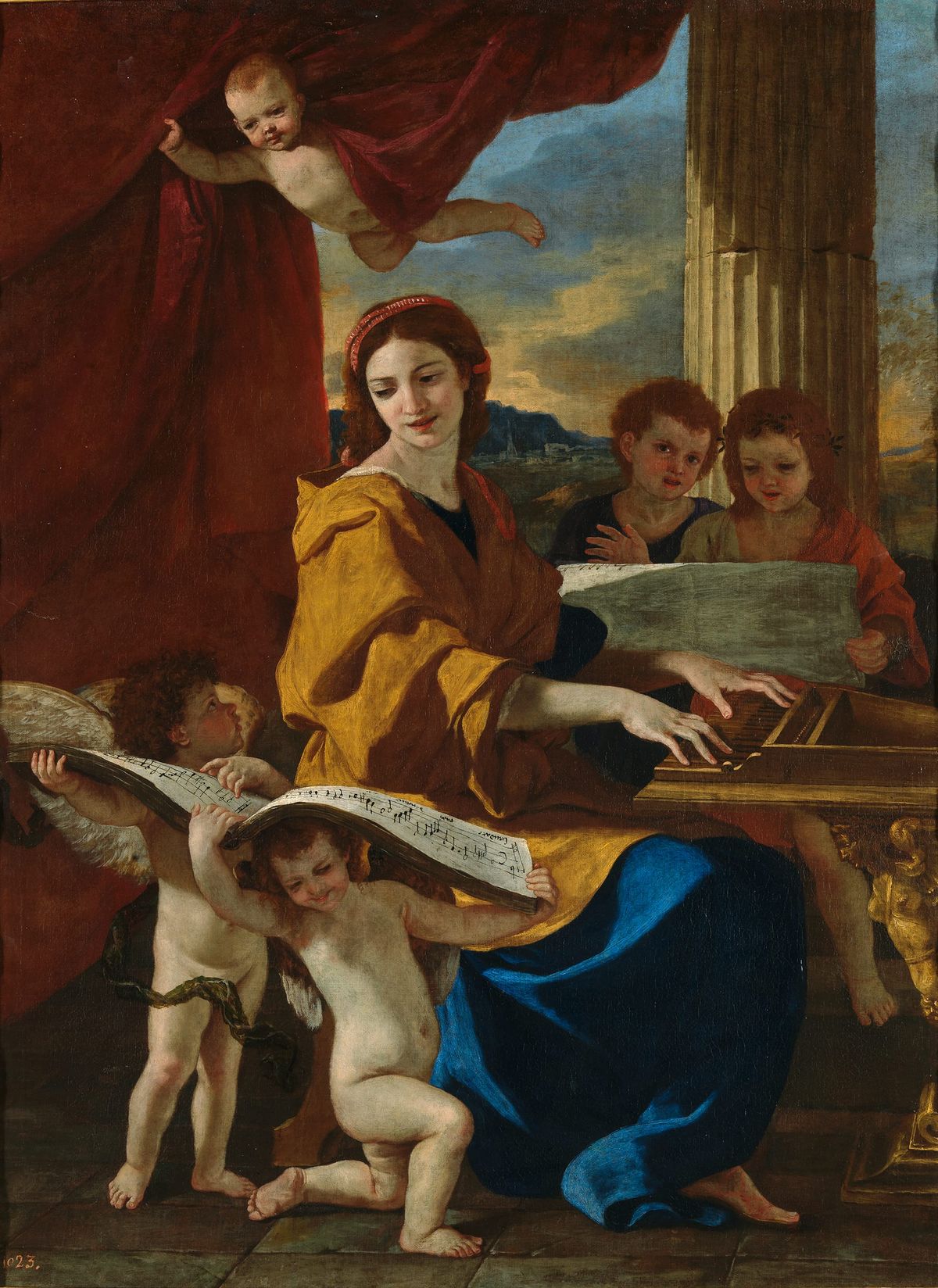
17세기 프랑스 고전주의 회화의 시조이자 서양 미술사 불멸의 거장 니콜라 푸생(Nicolas Poussin, 1594–1665)이 1627년에서 1628년경 로마에서 완성한 대표적인 종교 서사화 유화 성 세실리아(Saint Cecilia, 프랑스어: Sainte Cécile, 스페인어: Santa Cecilia, 소장품 번호: P002305)는 118.0 cm × 88.0 cm 크기의 세로형 캔버스에 유채로 그린 대표적인 음악과 신앙의 알레고리 최고 걸작입니다.
현재 스페인 마드리드의 프라도 미술관(Museo del Prado, Madrid)에 소장되어 있습니다.
로마 초기 가난과 질병 속에서 마주한 천상의 선율과 화가의 고뇌
1624년 서른 살의 늦은 나이로 염원하던 로마에 도착한 푸생은, 일정한 후원자가 없어 극심한 생활고를 겪었으며 매독과 같은 치명적인 질병까지 겹쳐 생사의 갈림길에 서 있었습니다.
비참한 현실 속에서도 화가는 르네상스 대가 라파엘로의 성 세실리아의 황홀경과 티치아노의 따스한 베네치아풍 색채를 깊이 연구하며, 음악적 선율과 거룩한 신앙심이 빚어내는 영혼의 평온을 화폭에 담고자 치열하게 번민했습니다.
음악가들의 수호성인인 성 세실리아는 고대 로마 귀족 가문의 여인으로, 원치 않는 결혼식 날에도 마음속으로 오직 신만을 찬양하는 거룩한 노래를 불렀다고 전해집니다.
화가는 세실리아가 하프시코드(또는 작은 건반 악기)를 연주하며 천상의 음악에 깊이 몰입하는 성스러운 순간을 화폭에 담았습니다.
화면 중앙의 세실리아는 붉은 머리띠를 두르고 황금빛 겉옷과 푸른 치마를 우아하게 늘어뜨린 채, 부드러운 손길로 건반을 누르고 있습니다.
그녀의 발치에서는 통통하고 귀여운 아기 천사 둘이 무릎을 꿇고 무거운 악보를 소중하게 펼쳐 들고 있으며, 공중에서는 또 다른 천사가 붉은 천막을 걷어 올리며 천상의 빛을 비춥니다.
뒤편에서 악보를 보며 맑은 목소리로 노래하는 어린 합창단 소년들의 순수한 모습과 고대 로마식 석조 기둥은, 거룩한 음악이 인간의 영혼을 구원으로 이끄는 힘을 손에 잡힐 듯 생생하게 웅변합니다.
건반 위의 섬세한 손길에서 악보를 든 아기 천사와 붉은 휘장으로, 시선의 심리적 여정
그림을 마주하는 순간 관람객의 무의식적 시선은 화면 중앙 황금빛 겉옷을 입고 단아한 미소를 머금은 채 건반 위에 부드럽게 손가락을 얹고 있는 성 세실리아의 우아한 옆얼굴과 손끝으로 가장 먼저 빨려 들어갑니다.
마치 살아 숨 쉬는 음악을 연주하듯 건반을 짚고 있는 성녀의 고결한 자태와 차분한 눈빛은 보는 이에게 깊은 시각적 평온함과 함께 귓가에 맑은 멜로디가 울려 퍼지는 듯한 서정적 감동을 선사합니다.
이어 시선은 세실리아의 푸른 치마폭을 따라 화면 왼쪽 아래로 이동하여, 통통한 몸으로 커다란 오선지 악보를 번쩍 들고 있는 사랑스러운 아기 천사들의 귀여운 몸짓으로 옮겨갑니다.
악보에 정교하게 그려진 음표들을 확인하며 천진난만하게 웃음 짓는 천사들의 앙증맞은 발끝을 확인하는 순간, 관람객은 천상의 화음이 가득 울려 퍼지는 거룩한 연주회 한복판 속으로 온몸이 빨려 들어가게 됩니다.
마지막으로 시선은 화면 오른쪽 뒤에서 입을 벌려 노래를 부르는 소년 성가대원들의 맑은 눈망울과 웅장한 석조 기둥을 지나, 화면 상단에서 붉은 비단 커튼을 걷어 올리며 날아오르는 공중의 아기 천사에 멈춥니다.
황금빛과 짙은 파란색, 그리고 붉은 휘장이 이루는 완벽한 고전적 색채 대비를 마주하며, 관람객은 지상과 천상이 하나로 어우러지는 영원한 예술의 거룩한 가치와 젊은 거장 푸생이 건네는 묵직한 영혼의 위로를 가슴 깊이 마주하게 됩니다.
17세기 프랑스 고전주의 종교 음악화의 정점과 조형미, 미술계의 평가
미술계는 프라도 미술관의 성 세실리아를 푸생이 청년 시절 라파엘로의 고전적 이상미와 티치아노의 풍부한 베네치아 색채를 완벽하게 조화시켜 완성한 초기 최고의 종교 음악화 걸작으로 평가합니다.
단순한 성인 초상을 넘어 음악의 알레고리를 한 편의 아름다운 실내악 연주 장면처럼 질서정연하게 조직했을 뿐만 아니라, 황금빛 의복의 부드러운 주름, 건반 악기의 나무 질감, 붉은 벨벳 커튼의 묵직한 양감을 극도로 섬세한 명암법으로 완벽하게 구현했기 때문입니다.
인간의 영혼을 울리는 신성한 음악을 품격 높은 시각 교향곡으로 승화시킨 푸생의 이 걸작 화폭은, 오늘날까지도 전 세계 수많은 감상자들에게 깊은 감탄과 잊을 수 없는 시각적 안식을 전해주는 불멸의 명작으로 손꼽히고 있습니다.
Saint Cecilia
Painted between 1627 and 1628 in Rome by the founder of French classicism and immortal master Nicolas Poussin (1594–1665), Saint Cecilia (French: Sainte Cécile, Spanish: Santa Cecilia, Inventory No. P002305) is a devotional oil on canvas measuring 118.0 cm × 88.0 cm (46.5 in × 34.6 in).
It is preserved in the distinguished permanent collection of the Museo del Prado in Madrid, Spain.
Early Roman Hardships, the Patroness of Music, and Celestial Harmonies
Arriving in Rome in 1624 at age thirty, Nicolas Poussin endured crushing poverty and debilitating illness while striving to establish his artistic identity.
Surrounded by the rich artistic heritage of the Eternal City, the master studied Raphael’s famous Ecstasy of Saint Cecilia in Bologna alongside the radiant colorism of Titian, seeking to capture the divine solace of sacred music within a disciplined classical framework.
Saint Cecilia, the revered patroness of musicians, was an early Christian Roman noblewoman who sang praise to God in her heart even during her forced secular wedding ceremonies.
Poussin captured the holy maiden playing a delicate keyboard instrument (virginal or organetto), completely absorbed in celestial harmony.
Seated centrally in classical attire comprising a golden-ochre robe and deep blue drapery, Cecilia’s graceful fingers glide effortlessly across the keyboard.
In the lower foreground, two charming putti kneel to support a heavy open musical score, while an airborne cherub parts a heavy crimson curtain above to let divine radiance illuminate the scene.
Behind her, two singing chorister boys holding sheets of music fill the air with melody beside a fluted Roman column, transforming a devotional subject into an inspiring visual tribute to the spiritual power of music.
Subconscious Trajectory of the Gaze: From Keyboard Fingers to the Score-Bearing Putti
The observer's subconscious gaze is immediately magnetized by the central register, drawn to the radiant, serene countenance of Saint Cecilia and her delicate hands resting upon the keys.
Her classical profile, refined reddish headband, and the sculptural folds of her golden drapery establish an instant focal point of sacred devotion, inner harmony, and classical poise.
The visual path then follows the cascade of her blue mantle downward to the two winged cherubs kneeling in the lower-left foreground.
Taking in the chubby anatomy of the putti struggling delightfully beneath the weight of the musical manuscript and the distinct musical notation across the open sheet, the viewer directly experiences the melodic atmosphere and joyful warmth of a sacred recital.
Finally, the visual trajectory sweeps past the two youthful singers standing behind the instrument toward the fluted marble column, before ascending to the airborne putto drawing back the luxurious crimson canopy against the evening sky.
Observing the harmonious equilibrium between balanced primary colors, delicate chiaroscuro, and Raphael-inspired draftsmanship, the spectator perceives the timeless nobility of sacred art and the profound aesthetic solace Poussin embedded within the canvas.
The Monument of Early French Classical Devotion: Critical Legacy
Art historians revere the Prado Saint Cecilia as a supreme pinnacle of Poussin’s early Roman maturity, illustrating his seamless synthesis of antique balance, Raphael’s grace, and Venetian chromatic warmth.
By orchestrating delicate textural contrasts between polished marble skin, heavy woolen draperies, resonant wooden instruments, and sumptuous velvet hangings within a unified architectural scheme, Poussin elevated a traditional patronal image into an exquisite aesthetic treatise on sacred harmony.
This magnificent devotional canvas endures as an inspiring testament to the master's creative fortitude, celebrating the triumph of the human soul through music and the transformative grace of living art.
본 컨텐트의 저작권은 팔렛트제주에 있습니다. 허가없는 무단전제를 금지합니다.
Copyright © Palette Jeju. All rights reserved. Unauthorized reproduction or redistribution is strictly prohibited.