성 에라스무스의 순교 세부화 Le Martyre de Saint Érasme détail
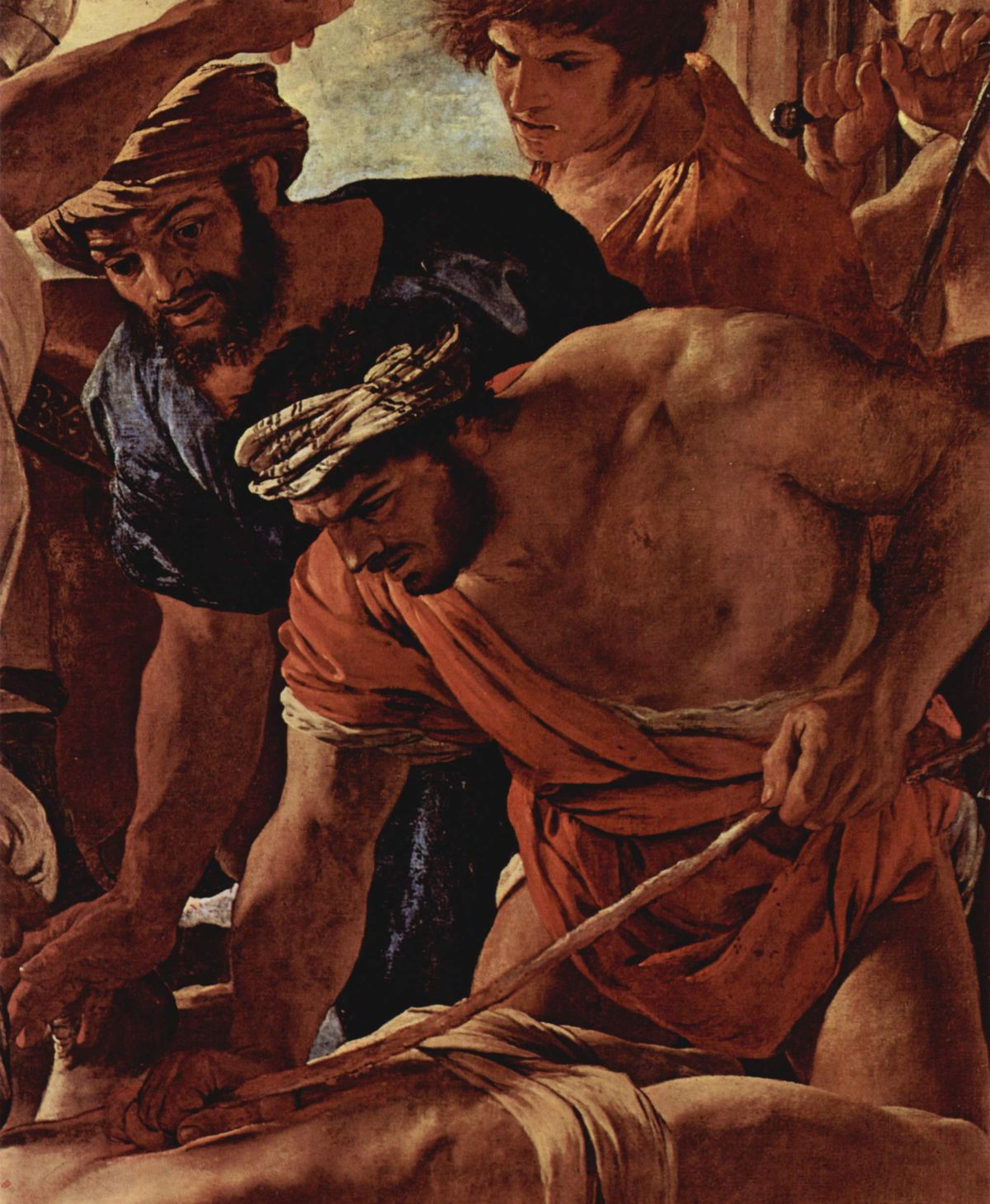
17세기 프랑스 고전주의 회화의 거장 니콜라 푸생(Nicolas Poussin, 1594–1665)이 1628년에서 1629년경 바티칸 성 베드로 대성당 제단화로 완성한 유화 성 에라스무스의 순교의 집행자 세부(Detail of the Executioners from The Martyrdom of Saint Erasmus, 프랑스어: Le Martyre de Saint Érasme détail)는 전체 원작 크기가 320.0 cm × 186.0 cm에 달하는 웅장한 기념비적 캔버스에 유채로 그린 대표적인 순교 제단화 최고 걸작의 핵심 부분입니다.
원작은 현재 바티칸 시국의 바티칸 미술관 회화관(Pinacoteca Vaticana, Vatican City)에 소장되어 있습니다.
바티칸 성 베드로 대성당 제단화 공모와 카라바조풍의 도전을 향한 화가의 고뇌
1620년대 후반 로마 화단에서 여전히 무명에 가까웠던 서른 중반의 푸생에게 인생 최대의 일생일대 기회가 찾아왔습니다. 당시 교황 우르바누스 8세의 조카이자 강력한 예술 후원자였던 프란체스코 바르베리니 추기경의 강력한 추천으로, 가톨릭 세계의 총본산인 바티칸 성 베드로 대성당의 제단화를 그리는 막중한 국가적 과업을 맡게 된 것입니다.
당시 로마는 피에트로 다 코르토나 같은 바로크 대가들의 현란한 장식과 카라바조를 따르는 화가들의 잔혹하고 자극적인 명암법이 관객들을 사로잡고 있었습니다. 푸생은 이 거대한 경쟁의 장에서 살아남아야 한다는 극심한 중압감과 정신적 고뇌에 시달리면서도, 잔인한 순교의 비극을 단순한 충격이 아닌 고대 그리스 조각의 엄격한 해부학적 질서와 장엄한 고전적 비장미로 승화시키고자 치열하게 번민했습니다.
화가는 4세기 디오클레티아누스 황제의 박해 당시 장을 윈치에 감겨 꺼내지는 참혹한 고문을 당했던 주교 성 에라스무스의 순교 장면 중, 고문을 집행하는 로마 군졸들과 사형집행인의 긴박한 순간을 화폭에 담았습니다.
화면 전면에는 머리에 수건을 질러 묶고 붉은 천을 두른 건장한 집행인이 온몸의 근육을 곤두세운 채 막대기를 쥐고 팽팽하게 힘을 주고 있습니다.
그 뒤에서는 터번을 쓴 사내와 젊은 병사가 집행인의 동작을 초조하게 주시하며 사형 집행을 재촉하고 있습니다.
인간의 잔혹한 폭력성과 뒤틀린 근육의 긴장감이 고스란히 드러나는 이 세부 화폭은, 성인의 거룩한 신앙과 세속적 폭력의 잔인한 대비를 통해 관람객의 영혼을 강렬하게 뒤흔드는 푸생 특유의 치밀한 고전주의 드라마를 숨 막힐 듯 생생하게 웅변합니다.
집행인의 팽팽한 등 근육에서 터번 쓴 사내의 서늘한 눈빛으로, 시선의 심리적 여정
그림을 마주하는 순간 관람객의 무의식적 시선은 화면 중앙 아래에서 강렬한 자연광을 받아 구릿빛으로 번뜩이는 사형집행인의 단단한 어깨와 팽팽하게 곤두선 등 근육으로 가장 먼저 빨려 들어갑니다.
머리에 흰 띠를 두르고 허리를 숙인 채 온 힘을 다해 막대기를 비틀어 쥐고 있는 집행인의 묵직한 힘과 무표정한 옆얼굴은 보는 이에게 깊은 시각적 전율과 함께 차가운 폭력의 서늘한 무게감을 선사합니다.
이어 시선은 집행인이 쥐고 있는 나무 막대의 대각선 각도를 따라 화면 왼쪽 위로 이동하여, 푸른 튜닉을 입고 머리에 갈색 터번을 두른 채 명령을 내리는 감독관의 거친 수염과 매서운 눈매로 옮겨갑니다.
굳은 얼굴로 집행인의 손끝을 확인하며 잔혹한 형벌을 지휘하는 남자의 냉혹한 시선을 확인하는 순간, 관람객은 일말의 자비도 찾아볼 수 없는 잔인한 고대 로마 박해 현장 한복판 속으로 온몸이 빨려 들어가게 됩니다.
마지막으로 시선은 화면 상단에서 고개를 숙인 채 형벌의 순간을 호기심 어린 표정으로 엿보고 있는 젊은 병사의 날카로운 이목구비를 지나, 사형집행인의 붉은 옷자락 아래로 비스듬히 누워 있는 성 에라스무스의 창백한 복부와 흰 천의 주름에 멈춥니다.
빛과 어둠이 충돌하며 빚어내는 조각 같은 인체 조형의 완벽한 조화를 마주하며, 관람객은 폭력을 압도하는 거룩한 순교의 숭고한 가치와 젊은 거장 푸생이 건네는 묵직한 지적 감동을 가슴 깊이 마주하게 됩니다.
17세기 프랑스 고전주의 순교화의 정점과 조형미, 미술계의 평가
미술계는 바티칸 성 베드로 대성당 제단화 성 에라스무스의 순교를 푸생이 로마 무대에 자신의 독보적인 조형 능력을 완벽하게 각인시킨 기념비적 출세작으로 평가합니다.
끔찍하고 잔혹한 주제임에도 불구하고 인물들의 해부학적 근육 구조를 고대 헬레니즘 조각처럼 완벽한 비례감으로 구축했을 뿐만 아니라, 붉은색과 푸른색 의복의 선명한 색채 대비, 땀방울이 맺힌 듯한 피부의 질감을 극도로 섬세한 명암법으로 완벽하게 구현했기 때문입니다.
광기와 폭력의 현장을 고결한 고전주의 조형 질서로 승화시켜 낸 푸생의 이 걸작 화폭은, 오늘날까지도 전 세계 수많은 감상자들에게 깊은 감탄과 잊을 수 없는 시각적 충격을 전해주는 불멸의 명작으로 손꼽히고 있습니다.
Detail of the Executioners from The Martyrdom of Saint Erasmus
Painted between 1628 and 1629 in Rome by the founder of French classicism and immortal master Nicolas Poussin (1594–1665), Detail of the Executioners from The Martyrdom of Saint Erasmus (French: Le Martyre de Saint Érasme détail) represents a crucial compositional register from the monumental altarpiece measuring 320.0 cm × 186.0 cm (126.0 in × 73.2 in).
The monumental original canvas is preserved in the distinguished permanent collection of the Pinacoteca Vaticana in Vatican City.
The St. Peter's Basilica Altarpiece Commission and the Challenge to Baroque Rivals
In the late 1620s, while still struggling for broad institutional recognition in Rome, the thirty-something Nicolas Poussin secured the most coveted commission of his career: an altarpiece for Saint Peter’s Basilica, secured through the influential patronage of Cardinal Francesco Barberini, nephew of Pope Urban VIII.
Surrounded by the triumphant theatrical illusions of Pietro da Cortona and the raw, violent realism of the Caravaggisti, Poussin confronted severe creative anxieties.
He strove to render the gruesome historical martyrdom not as sensationalized violence, but as a monument of classical balance, anatomical purity, and heroic Stoic fortitude.
The narrative depicts the horrific fourth-century execution of Saint Erasmus, Bishop of Formiae, during the persecutions of Emperor Diocletian, where the saint’s entrails were wound around a wooden capstan.
In this intimate detail of the executioners, a muscular henchman wearing a headband and a vibrant vermilion tunic bends forward, flexing his robust shoulder and back muscles as he operates the wooden mechanism.
Behind him, a bearded Roman soldier in a turban and a youthful warrior look on with cold concentration, orchestrating the torment.
The dramatic contrast between the executioners' physical strain and the spiritual endurance of the martyr underscores Poussin’s complete mastery of dramatic counterpoint.
Subconscious Trajectory of the Gaze: From Muscular Henchman to the Overseeing Guards
The observer's subconscious gaze is immediately magnetized by the central register, drawn to the sun-drenched, sculptural anatomy and muscular back of the crouching executioner.
His downward momentum, the sharp white headband securing his dark hair, and the dense sculptural modeling of his bare chest and shoulders establish an instant focal point of physical tension, brutal force, and classical draftsmanship.
The visual path then ascends along the diagonal line of his wooden lever toward the upper-left register, arriving at the weathered, bearded countenance of the supervisor clad in a blue tunic and turban.
Taking in his calculating, downturned gaze and the hand resting authoritatively near the victim, the viewer directly experiences the cold, systemic cruelty of imperial Roman persecution.
Finally, the visual trajectory sweeps past the curious, youthful warrior observing from above, before descending to the edge of the saint's pale torso and the white linen shroud resting upon the stone platform below.
Observing the harmonious equilibrium between dramatic Venetian lighting, rigorous antique anatomy, and ideological clarity, the spectator perceives the timeless nobility of sacred endurance and the profound aesthetic solace Poussin embedded within the monumental canvas.
The Monument of French Classical Martyrdom: Critical Legacy
Art historians revere the Vatican Martyrdom of Saint Erasmus as Poussin’s definitive public masterpiece in Rome, illustrating his successful synthesis of monumental physical energy and classical clarity.
By orchestrating delicate textural contrasts between sun-bronzed skin, heavy woolen draperies, polished metal, and rough timber within a unified geometric scheme, Poussin elevated a visceral scene of torment into an exquisite aesthetic treatise on spiritual victory over mortal violence.
This grand altarpiece endures as an inspiring testament to the master's creative fortitude, celebrating the triumph of Christian resilience and the transformative grace of living art.
본 컨텐트의 저작권은 팔렛트제주에 있습니다. 허가없는 무단전제를 금지합니다.
Copyright © Palette Jeju. All rights reserved. Unauthorized reproduction or redistribution is strictly prohibited.