성 엘리사벳과 세례 요한이 있는 성가족 The Holy Family with St. Elizabeth and John the Baptist
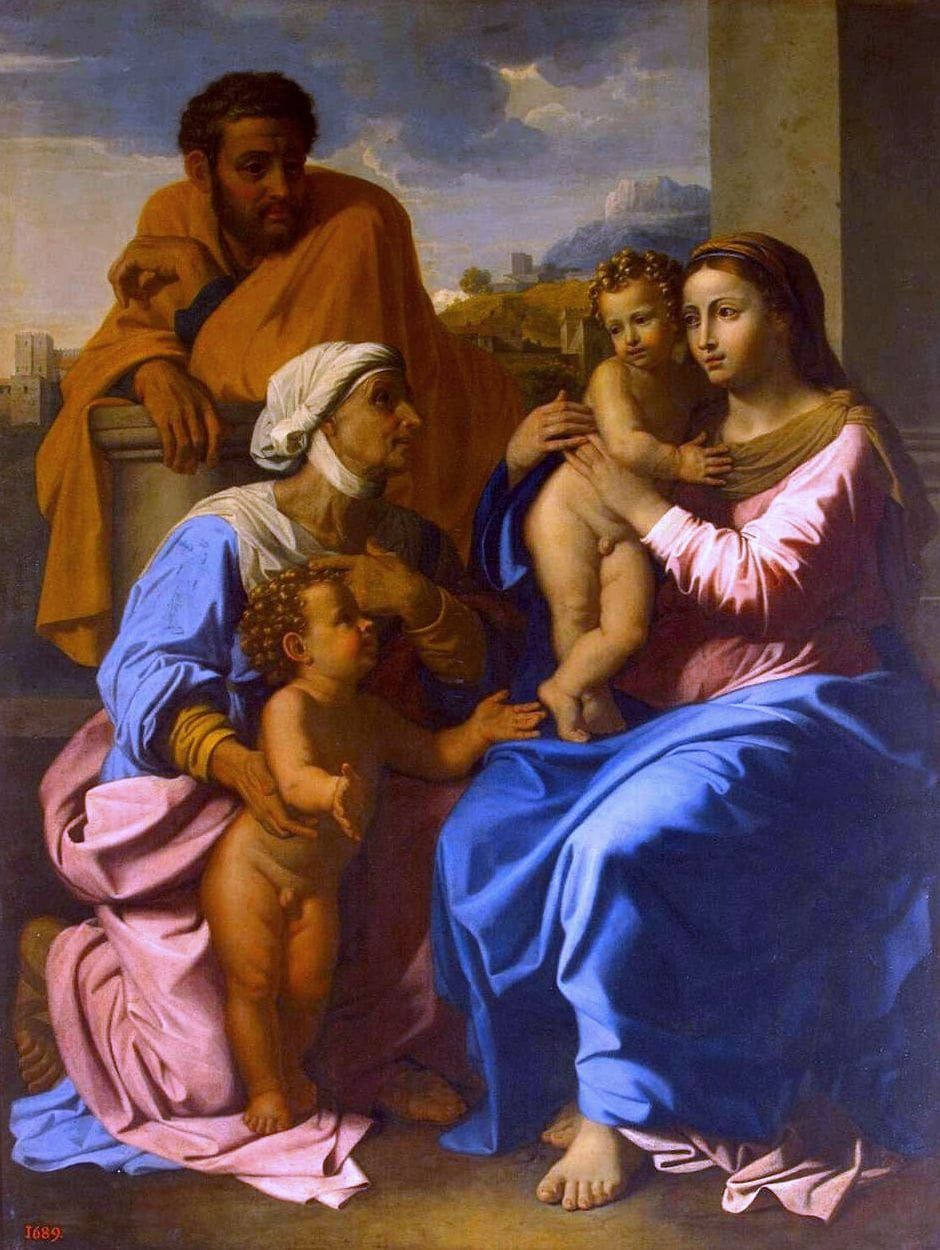
17세기 프랑스 고전주의 회화의 시조이자 서양 미술사 불멸의 거장 니콜라 푸생(Nicolas Poussin, 1594–1665)이 1655년경 로마에서 만년에 완성한 기념비적 성가족 유화 성 엘리사벳과 세례 요한이 있는 성가족(The Holy Family with Saint Elizabeth and John the Baptist, 프랑스어: La Sainte Famille avec sainte Élisabeth et saint Jean-Baptiste, 소장품 번호: ГЭ-1213)은 172.0 cm × 133.5 cm 크기의 웅장한 세로형 대형 캔버스에 유채로 그린 대표적인 신약성화 최고 걸작입니다.
현재 러시아 상트페테르부르크의 예르미타시 미술관(Hermitage Museum, Saint Petersburg)에 소장되어 있습니다.
만년의 깊은 육체적 고통과 거룩한 만남의 침묵을 향한 화가의 고뇌
1650년대 중반 예순을 넘긴 노년의 푸생은 손 떨림 증세와 오랜 지병으로 붓을 쥐기조차 힘든 극심한 육체적 시련을 겪고 있었습니다.
그러나 화가는 육신의 쇠약함 속에서도 라파엘로의 완벽한 기하학적 균형미와 고대 조각의 이상적인 형태미를 끝까지 탐구하며, 인간의 유한함을 뛰어넘는 거룩한 가족애의 평온을 화폭에 담고자 치열하게 번민했습니다.
성경 루카 복음서의 성스러운 계시를 바탕으로, 화가는 아기 예수와 그의 사촌이자 훗날 구원자의 길을 예비할 아기 세례 요한이 어머니들의 따스한 보살핌 속에서 운명적인 첫 만남을 갖는 순간을 포착했습니다.
화면 오른쪽에는 분홍빛 드레스와 짙푸른 망토를 우아하게 두른 성모 마리아가 두 손으로 어린 아기 예수를 감싸 안고 있고, 아기 예수는 당당하게 일어서서 사촌 요한을 그윽하게 내려다봅니다.
화면 왼쪽에서는 흰 수건을 머리에 쓴 늙은 성 엘리사벳이 아들 세례 요한의 어깨를 조심스럽게 받쳐 안고 있으며, 아기 요한은 양손을 공손히 벌려 구원자를 향해 경배를 올립니다.
화면 왼쪽 뒤편 발코니 너머에서는 황금빛 주황색 겉옷을 입은 성 요셉이 턱을 괴고 조용히 가족들을 지켜보고 있으며, 배경 뒤편의 푸른 하늘과 험준한 바위산은 훗날 두 아이가 감당해야 할 거룩한 십자가 수난의 운명을 장엄한 침묵으로 예고합니다.
일어선 아기 예수의 발끝에서 경배하는 아기 요한과 묵상하는 요셉으로, 시선의 심리적 여정
그림을 마주하는 순간 관람객의 무의식적 시선은 화면 오른쪽 위에서 따스한 자연광을 받아 대리석 조각처럼 뽀얗게 빛나는 아기 예수의 단단한 나체와 성모의 품에 안겨 서 있는 당당한 발끝으로 가장 먼저 빨려 들어갑니다.
어린 나이임에도 온화한 위엄을 드러내며 사촌을 내려다보는 아기 예수의 깊은 눈빛과 부드러운 곱슬머리는 보는 이에게 깊은 시각적 경건함과 함께 인류를 구원할 신의 아들의 거룩한 권위를 선사합니다.
이어 시선은 아기 예수를 받쳐 든 성모 마리아의 우아한 손길과 짙은 파란색 치마의 웅장한 주름을 지나, 화면 왼쪽 아래에서 두 손을 앞으로 내밀며 공손히 서 있는 아기 세례 요한의 천진난만한 옆모습으로 옮겨갑니다.
어머니 엘리사벳의 품에서 구원자를 알아보고 무릎을 굽히며 경배하는 어린 요한의 순결한 동작과 늙은 어머니의 주름진 자애로운 얼굴을 확인하는 순간, 관람객은 지상에서 가장 성스러운 두 가문의 따스한 사랑과 운명적 만남 한복판 속으로 온몸이 빨려 들어가게 됩니다.
마지막으로 시선은 화면 왼쪽 위 석조 기단에 팔을 얹고 이 거룩한 장면을 그윽한 눈빛으로 묵상하는 성 요셉의 묵직한 옆얼굴을 지나, 창밖으로 펼쳐진 고대 석조 도시와 저 멀리 푸른 산맥의 능선에 멈춥니다.
수직의 석조 기둥과 인물들의 유기적인 삼각형 배치가 빚어내는 완벽한 기하학적 균형을 마주하며, 관람객은 가족의 평온 속에 감춰진 숭고한 구원의 섭리와 노거장 푸생이 건네는 묵직한 지적 위로를 가슴 깊이 마주하게 됩니다.
17세기 프랑스 고전주의 종교 성화의 정점과 조형미, 미술계의 평가
미술계는 예르미타시 미술관의 성 엘리사벳과 세례 요한이 있는 성가족을 푸생이 만년에 도달한 완벽한 고전주의 조형 질서와 숭고한 신앙심이 집대성된 대표적인 대작 걸작으로 평가합니다.
단순한 모자 관계를 넘어 다섯 명의 인물이 뿜어내는 시선과 손짓을 완벽한 건축적 피라미드 구도 속에 단단하게 결합했을 뿐만 아니라, 성모의 푸른색과 분홍색, 엘리사벳의 자주색, 요셉의 황금빛 옷감이 이루는 완벽한 색채 하모니와 옷 주름의 조각적 입체감을 극도로 세련된 고전주의 명암법으로 완벽하게 구현했기 때문입니다.
인간적인 따뜻함과 신성한 구원 서사를 가장 격조 높은 시각 교향곡으로 승화시킨 푸생의 이 걸작 화폭은, 오늘날까지도 전 세계 수많은 감상자들에게 깊은 감탄과 잊을 수 없는 영혼의 안식을 전해주는 불멸의 명작으로 손꼽히고 있습니다.
The Holy Family with St. Elizabeth and John the Baptist
Painted around 1655 in Rome by the founder of French classicism and immortal master Nicolas Poussin (1594–1665), The Holy Family with Saint Elizabeth and John the Baptist (French: La Sainte Famille avec sainte Élisabeth et saint Jean-Baptiste, Inventory No. ГЭ-1213) is a monumental late devotional masterpiece in oil on canvas measuring 172.0 cm × 133.5 cm (67.7 in × 52.6 in).
It is preserved in the distinguished permanent collection of the Hermitage Museum in Saint Petersburg, Russia.
Late Physical Tribulations, Raphael's Architectural Purity, and the Solace of Sacred Kinship
During the mid-1650s in Rome, despite battling chronic illness, trembling hands, and the physical limitations of aging, Nicolas Poussin pursued his lifelong quest for philosophical balance and structural clarity.
Refusing to succumb to physical decline, the master engaged deeply with the monumental heritage of Raphael and the heroic calm of ancient Greco-Roman sculpture, seeking to capture the timeless dignity of sacred kinship within an ordered classical universe.
Inspired by sacred scriptural tradition, the narrative orchestrates the momentous encounter between the infant Christ and his cousin, the young Saint John the Baptist, guided by their devoted mothers.
On the right, the Virgin Mary, draped in luminous rose silk and a majestic mantle of ultramarine, cradles the standing Christ Child, who gazes downward with divine serenity.
On the left, the elderly Saint Elizabeth, crowned with a white linen headcloth, tenderly supports her infant son John, who extends his small hands in humble adoration toward his Lord.
Behind a stone balustrade in the upper left, Saint Joseph watches over the domestic gathering in contemplative silence, while the classical landscape and rugged mountains beyond frame the monumental scene in timeless solemnity.
Subconscious Trajectory of the Gaze: From Standing Christ to the Receptive Saint John
The observer's subconscious gaze is immediately magnetized by the central-right register, drawn to the luminous, sunlit flesh and upright classical contrapposto of the infant Christ.
His dignified posture, delicate facial modeling, and divine downward gaze establish an instant focal point of sovereign authority, sacred incarnation, and spiritual grace.
The visual path then follows Mary’s protective hands and the sweeping drapery of her blue mantle downward across the canvas to the figure of young John the Baptist.
Taking in John's open-handed gesture of reverence, his delicate curls, and the weathered, loving profile of Saint Elizabeth supporting him, the viewer directly experiences the profound emotional gravity and spiritual warmth uniting the two holy lineages.
Finally, the visual trajectory ascends past the massive balustrade to the pensive figure of Saint Joseph leaning against the stone sill, before sweeping toward the distant classical ramparts and blue mountain ridges beneath the clouds.
Observing the harmonious equilibrium between the pyramidal grouping, balanced primary colors, and antique relief staging, the spectator perceives the timeless nobility of sacred destiny and the profound aesthetic solace Poussin embedded within the canvas.
The Monument of Late French Classical Devotion: Critical Legacy
Art historians revere the Hermitage Holy Family with Saint Elizabeth and John the Baptist as a supreme pinnacle of Poussin’s late historical style, illustrating his complete mastery of psychological counterpoint and architectural composition.
By orchestrating delicate textural contrasts between sunlit marble flesh, heavy woolen draperies, cold stone parapets, and radiant atmospheric light within a unified geometric scheme, Poussin elevated a traditional devotional scene into an exquisite aesthetic treatise on cosmic grace and familial devotion.
This monumental historical canvas endures as an inspiring testament to the master's creative fortitude, celebrating the triumph of sacred faith and the transformative grace of living art.
본 컨텐트의 저작권은 팔렛트제주에 있습니다. 허가없는 무단전제를 금지합니다.
Copyright © Palette Jeju. All rights reserved. Unauthorized reproduction or redistribution is strictly prohibited.