성 안나와 성모자 (The Virgin and Child with Saint Anne)
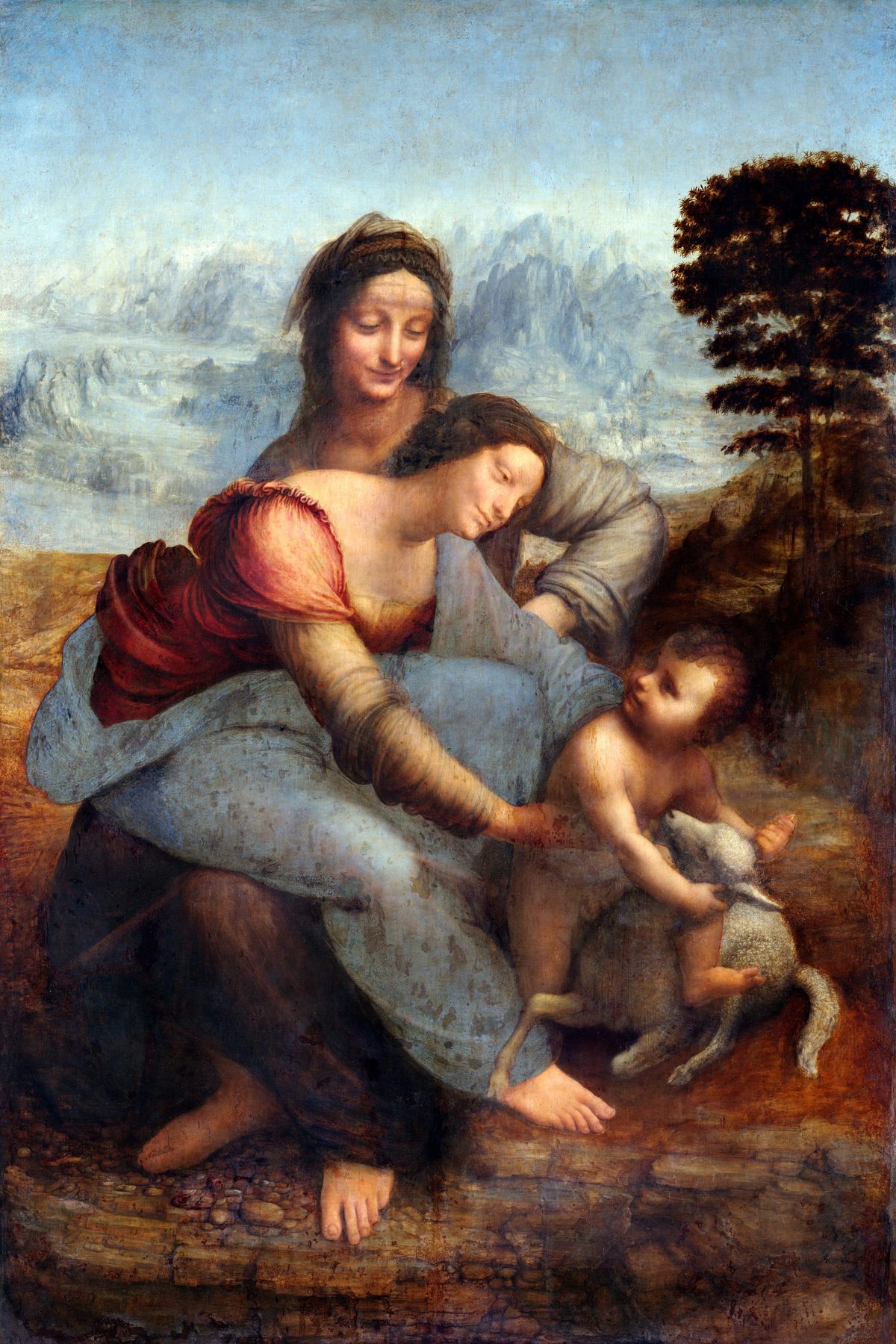
인류 미술사상 가장 완숙한 종교적 은유와 세대를 뛰어넘는 자애로움을 화폭에 담아낸 르네상스 회화의 정점, <성 안나와 성모자 (The Virgin and Child with Saint Anne)>입니다. 이 대작은 레오나르도 다 빈치(Leonardo da Vinci, 1452–1519)가 1501년경 시작하여 사망 직전인 1519년까지 오랜 세월에 걸쳐 수정을 거듭한 유화 유작으로, 실제 규격은 세로 168cm, 가로 130cm 크기이며 현재 프랑스 파리의 루브르 박물관(Musée du Louvre, Paris)에 소장되어 있습니다. 화면 상단에 자리한 성 안나와 그녀의 무릎 위에 앉은 성모 마리아, 그리고 어린 양을 끌어안으려는 아기 예수의 정교한 교감을 다빈치 특유의 대기원근법과 함께 정립해 낸 걸작입니다.
조형적 분석에 따르면, 작품 속 세 인물과 어린 양은 인체 구도의 정수를 보여주는 유기적 피라미드 구조를 형성합니다. 마리아가 자신의 무릎에서 앞으로 기울이며 아기 예수를 제지하려는 듯한 자세를 취하는 동안, 뒤편의 성 안나는 그 과정을 온화하고 신성한 미소로 내려다봅니다. 아기 예수가 움켜쥐고 있는 어린 양은 장차 인류의 죄를 대속할 십자가 수난과 '하나님의 어린양(Agnus Dei)'을 상징합니다. 아득한 배경에 펼쳐진 물빛 암봉들과 공기 스푸마토 명암법은 인물들의 붉고 푸른 의복 색채와 대조를 이루며 성스러운 서사의 깊이를 한층 높여줍니다.
이 걸작에 얽힌 역사적 배경 역시 대단히 신비롭고 다채롭습니다. 당초 피렌체 산티시마 안눈치아타 대성당의 제단화로 구상되었거나 프랑스 왕 루이 12세의 의뢰로 시작된 것으로 알려진 이 그림은, 레오나르도가 생의 마지막 순간까지 자신의 곁에 두고 계속 덧칠을 이어갔던 미완의 대작이기도 합니다. 후대의 지문 분석과 적외선 검사를 통해 그가 세밀한 붓질을 수십 겹 겹쳐 올린 흔적이 밝혀졌으며, 저명한 정신분석학자 지그문트 프로이트는 이 작품 속 성 안나와 마리아의 오묘한 연령차와 구도를 바탕으로 다빈치의 어린 시절 무의식과 두 어머니(친모 카테리나와 계모 도나 유지니아)에 대한 심리 수필을 써서 큰 화제를 모으기도 했습니다. 현대 미술사학자들은 이 작품을 레오나르도 조형 예술의 종합판이자 르네상스 인문주의적 모성애의 최상위 표현으로 높이 평가합니다.
이 화폭을 가만히 관찰하다 보면 인물들의 눈빛과 체온이 형성하는 무의식적 시선 동선이 대단히 매끄럽게 연결됩니다. 화면 가장 높은 곳에서 자애로운 미소를 짓고 있는 성 안나의 얼굴에서 출발한 시선은, 아래로 자식에게 몸을 뻗는 성모 마리아의 우아한 어깨선과 붉은 드레스의 주름을 타고 내리앉습니다. 이어 어린 양을 끌어안는 아기 예수의 천진난만한 손짓과 귀여운 발끝을 거쳐, 우측 상단의 커다란 나무 줄기와 배경의 푸른 바위산 맥을 타고 다시 성 안나의 온화한 눈빛으로 자연스럽게 순환합니다. 이러한 포근한 시각적 굴곡은 시각적 인지 긴장감을 완화해 주며 깊은 정서적 안식과 고요한 평온을 가져다줍니다.
This masterpiece, titled The Virgin and Child with Saint Anne, was created between 1501 and 1519 by the High Renaissance master Leonardo da Vinci (1452–1519). Measuring 168 cm in height by 130 cm in width, this oil on wood panel is permanently preserved in the Musée du Louvre in Paris, France. Depicting Saint Anne, her daughter the Virgin Mary, the Infant Jesus, and a sacrificial lamb against a jagged alpine landscape, the work stands as one of Leonardo's ultimate painterly achievements.
The formal structure arranges the figures into an interlocked, sculptural pyramid that demonstrates Leonardo's supreme mastery of organic geometry. As Mary leans forward from her mother's lap to gently restrain the Infant Jesus, Saint Anne gazes down with an ethereal, knowing smile. The lamb grasped playfully by the child directly symbolizes the Agnus Dei and Christ's destined Passion. Leonardo utilized subtle sfumato gradations and misty atmospheric perspective across the background peaks, creating an otherworldly contrast with the rich lapis lazuli and crimson drapery of the figures.
Rich historical legends and fascinating modern interpretations surround this iconic panel. Originally intended as an altarpiece for Florence or commissioned by King Louis XII of France, Leonardo kept the panel in his personal possession until his death, continuously refining its delicate layers over nearly two decades. In the 20th century, Sigmund Freud famously published a psychological analysis of the work, interpreting the harmonious presence of the two mothers as a reflection of Leonardo's childhood memories of both his biological mother and stepmother. Today, modern art historians revere the panel as the culmination of Leonardo's life's work, praising its profound emotional resonance and groundbreaking compositional elegance.
Gazing upon this magnificent painting leads the viewer through an exceptionally fluid and calming visual journey. The eye originates at the serene, smiling countenance of Saint Anne at the apex, glides gently down the diagonal curve of Mary's outstretched torso, and lingers upon the Infant Jesus embracing the lamb. Moving across the textured ground, the gaze sweeps upward along the silhouette of the dark tree and misty blue mountains back to Saint Anne's face, completing a harmonious visual circle that releases mental friction and induces a profound sense of inner peace.
본 리뷰에서 작품을 제외한 컨텐츠의 저작권은 팔렛트제주에 있습니다.
"퍼블릭도메인 고전명화"를 제외한 모든 창작 콘텐츠는 저작권법 제4조 및 제10조에 의거하여 보호됩니다. 무단 도용시 저작권법 제136조(벌칙)에 의거, 당사의 사전 서면 승인 없는 저작권 침해 행위를 금지합니다.