사모스의 무녀 The Samian Sibyl
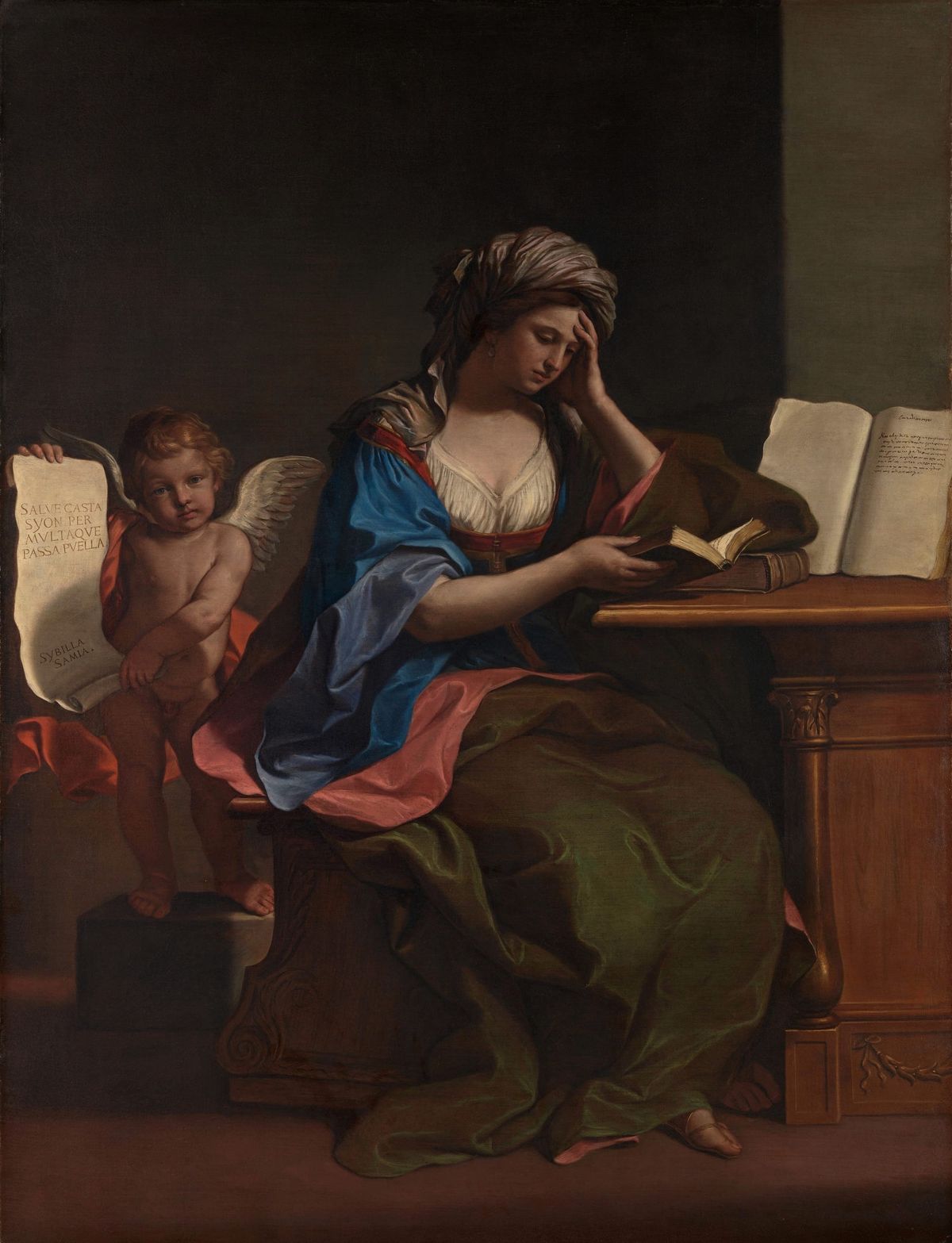
17세기 이탈리아 바로크 회화의 거장 조반니 프란체스코 바르비에리, 널리 귀에르치노(Guercino, 1591–1666)로 불리는 화가가 1651년에 완성한 유화 사모스의 무녀(The Samian Sibyl, 이탈리아어: La Sibilla Samia)는 120.0 cm × 98.0 cm 크기의 캔버스에 유채로 그린 대표적인 후기 고전주의 역사화 걸작입니다. 현재 영국 런던의 개인 소장 또는 유럽 주요 컬렉션에 소장되어 있습니다.
터번을 두른 여인의 깊은 사색과 두루마리를 떨어뜨린 아기 천사 소동
1650년대 초반 볼로냐에서 최고의 명성을 떨치던 귀에르치노는 고대 그리스와 로마 신화 속에서 미래를 내다보고 그리스도의 탄생을 예언했던 예언자 시빌라(무녀)들의 지혜와 신비로움을 화폭에 담아내고자 깊은 고뇌에 빠졌습니다. 화가는 단순히 예언의 글을 읽는 겉모습을 넘어, 인류의 운명과 신의 거룩한 뜻을 마주하며 깊은 사색에 잠긴 지적인 여성의 내밀한 고뇌를 우아한 고전주의 양식으로 구현하고자 했습니다. 화가는 화실에 원목 탁자와 두꺼운 양장본 책들을 펼쳐두고, 고급스러운 터번과 비단 드레스를 차려입은 여인과 아기 천사 모델을 세운 뒤 예언의 글귀가 적힌 두루마리를 쥐여주었습니다.
이 그림을 준비하던 날, 화실에서는 뭉클하면서도 웃음이 절로 나오는 소동이 벌어졌습니다. 무녀 역할을 맡은 여인이 한 손으로 이마를 짚고 작은 책에 시선을 고정한 채 깊은 생각에 잠겨 있는 동안, 뒤편에서 두루마리를 번쩍 들고 서 있던 어린 천사 모델이 몸을 비틀거리기 시작했습니다. 무거운 라틴어 양피지 두루마리를 양손으로 잡고 오래 서 있다가 팔에 힘이 빠져 그만 두루마리를 바닥으로 툭 떨어뜨리고 말았습니다.
바닥에 떨어진 두루마리가 도르르 굴러가자 아이가 깜짝 놀라 울먹였고, 그 소리에 이마를 짚고 있던 여인이 고개를 돌리며 다정하게 웃음을 터뜨렸습니다. 그 모습을 지켜보던 귀에르치노는 호탕하게 웃으며 얼른 아이에게 사탕을 쥐여주고 두루마리를 다시 들게 했습니다. 화가는 무녀의 이마에 드리운 깊은 지적 고뇌와 터번의 우아한 주름, 푸른색과 올리브 그린빛 비단 드레스의 부드러운 광택, 그리고 아기 천사의 날개와 두루마리에 적힌 선명한 예언 문구까지 놀라운 정밀함으로 화폭에 담아냈습니다. 사시라는 신체적 약점을 딛고 장엄한 고전주의 양식과 서정적인 우아함을 완성해 낸 거장의 원숙한 예술혼이 이 정적인 화폭 속에 영롱하게 빛나고 있습니다.
이마를 짚은 무녀의 사색에서 작은 책과 아기 천사의 두루마리로, 시선의 심리적 여정
그림을 마주하는 순간 관람객의 무의식적 시선은 화면 중앙 짙은 어둠 속에서 은은한 자연광을 받아 화사하게 빛나는 무녀의 우아한 이마와 머리를 감싼 커다란 터번으로 가장 먼저 빨려 들어갑니다. 왼손으로 이마를 가만히 괸 채 깊은 사색에 잠겨 책을 내려다보는 무녀의 차분하고 지적인 눈빛은 보는 이에게 깊은 시각적 매혹과 함께 조용한 지적 긴장감을 선사합니다.
이어 시선은 무녀가 오른손에 소중하게 들고 있는 작은 책의 펼쳐진 페이지와, 쇄골을 부드럽게 드러낸 순백의 린넨 속옷 및 화려한 푸른색 어깨 망토로 이동합니다. 손가락 끝으로 책장을 넘기며 신의 계시를 묵상하는 단아한 손놀림과 풍성한 분홍빛 숄의 부드러운 주름을 확인하는 순간, 관람객은 미래를 내다보는 예언자의 깊고 숭고한 침묵 속으로 서서히 빠져들게 됩니다.
마지막으로 시선은 무녀의 하체를 우아하게 덮고 있는 올리브 그린빛 롱드레스의 묵직한 주름을 지나, 화면 왼쪽 뒤편에서 커다란 라틴어 예언 두루마리를 든 채 관람객을 응시하는 귀여운 아기 천사의 깃털 날개와 오른쪽 탁자 위의 두꺼운 고문서 책에 멈춥니다. 고전적인 실내의 정적과 지혜로운 예언의 거룩한 무게를 마주하며, 관람객은 고대 신화와 기독교적 구원이 조화를 이루는 숭고한 가치와 귀에르치노가 건네는 묵직한 영혼의 위로를 가슴 깊이 마주하게 됩니다.
17세기 볼로냐 고전주의 무녀화의 정점과 조형적 완성도, 미술계의 평가
미술계는 사모스의 무녀를 귀에르치노가 도메니키노와 귀도 레니의 고전적 우아함을 계승하면서도 자신만의 독창적인 명암 대비와 감성적인 색채 조화를 완벽하게 구현해 낸 대표적인 후기 명작으로 평가합니다.
터번, 실크 드레스, 날개 깃털, 양피지 두루마리, 고서적의 종이 질감을 극도로 섬세한 명암법으로 완벽하게 분리하여 재현했을 뿐만 아니라, 인물의 내면적 지혜와 신비로운 사색의 순간을 품격 높은 시각적 언어로 승화시켰기 때문입니다. 고대 지혜의 아름다움과 영원한 구원의 메시지를 완벽한 균형미로 완성해 낸 귀에르치노의 이 기념비적인 화폭은, 오늘날까지도 수많은 감상자들에게 깊은 감탄과 잊을 수 없는 시각적 평온을 전해주는 불멸의 명작으로 손꼽히고 있습니다.
The Samian Sibyl
Painted in 1651 in Bologna by the preeminent Italian Baroque master Giovanni Francesco Barbieri, universally celebrated as Guercino (1591–1666), The Samian Sibyl (Italian: La Sibilla Samia) is an oil on canvas measuring 120.0 cm × 98.0 cm (47.2 in × 38.6 in), preserved in a distinguished European private collection.
The Turbaned Prophetess and the Dropped Scroll Commotion in the Studio
During the early 1650s in Bologna, Guercino dedicated his mature creative energies to an esteemed series of classical sibyls—the prophetic women of Greco-Roman antiquity celebrated for foretelling the incarnation of Christ. Guercino sought to transcend conventional static portraits, aiming instead to capture the profound psychological concentration of a prophetess wrestling with divine revelations. Arranging a wooden writing desk, classical architectural moldings, and heavy manuscript folios in his studio, the master draped his model in a plush turban and rich multicolored silks, while placing an inscribed Latin parchment scroll in the hands of a winged putto.
A delightfully humorous incident occurred while preparing the sitting for this canvas. As the model rested her forehead upon her left hand in deep contemplation while holding a small volume, the young boy posing as the attendant putto grew tired of supporting the heavy inscribed scroll. His grip loosened, and the parchment slipped from his hands, unrolling across the studio floorboards with a loud rustle.
The startled boy looked on the verge of tears, prompting the contemplative prophetess to turn her head and break into a warm, reassuring smile. Guercino laughed heartily, gave the child a sweet treat, and helped him lift the scroll once more. The master recognized that this brief moment of domestic tenderness brought a living grace to the classical theme. He meticulously recorded the sculptural folds of the turban, the luminous azure mantle draped over pink and olive-green silks, the downy feathers of the angel's wing, and the precise Latin lettering on the scroll. Channeling his mature mastery over balanced chiaroscuro, Guercino transformed this classical allegory into an enduring visual poem of intellectual nobility.
Subconscious Trajectory of the Gaze: From Pensive Forehead to the Inscribed Parchment
The observer's subconscious gaze is immediately magnetized by the upper-central register, drawn to the luminous, thoughtfully modeled countenance of the Sibyl framed by a voluminous cloth turban against the dark interior. Her downcast eyes, furrowed brow of concentration, and left hand supporting her head establish an instant focal point of intellectual depth and prophetic mystery.
The visual path then descends along her delicate white chemise to her right hand, which carefully holds the open pages of an octavo volume resting near the corner of the wooden table. Taking in the soft sheen of her azure sleeves and the rose drapery cascading over her lap, the viewer directly experiences the quiet intimacy of scholarly meditation and the solemnity of divine revelation.
Finally, the visual trajectory sweeps across the heavy olive-green skirt toward the left, resting upon the standing putto holding the inscribed Latin scroll reading of the Virgin birth, before moving across the open manuscript folios upon the carved wooden desk. Observing the harmonious equilibrium between classical monumentality, warm directional light, and psychological nuance, the spectator perceives the timeless nobility of sacred wisdom and the enduring aesthetic solace Guercino embedded within the canvas.
The Monument of Bolognese Classical Realism: Critical Legacy
Art historians revere The Samian Sibyl as a consummate masterpiece of Guercino’s late mature period, demonstrating his synthesis of the classical harmony of Guido Reni with his own signature atmospheric chiaroscuro.
By orchestrating delicate textural contrasts between woven turbans, shimmering silks, porous paper, soft feathers, and carved timber within a unified lighting scheme, Guercino elevated an ancient mythological figure into a profound meditation on wisdom and divine purpose. This magnificent historical canvas endures as an inspiring testament to the master's enduring creative genius, celebrating the poetic power of classical learning and the transformative grace of living art.
본 컨텐트의 저작권은 팔렛트제주에 있습니다. 허가없는 무단전제를 금지합니다.
Copyright © Palette Jeju. All rights reserved. Unauthorized reproduction or redistribution is strictly prohibited.