사이프러스와 별이 있는 길 - Road with Cypress and Star (Country Road in Provence by Night)
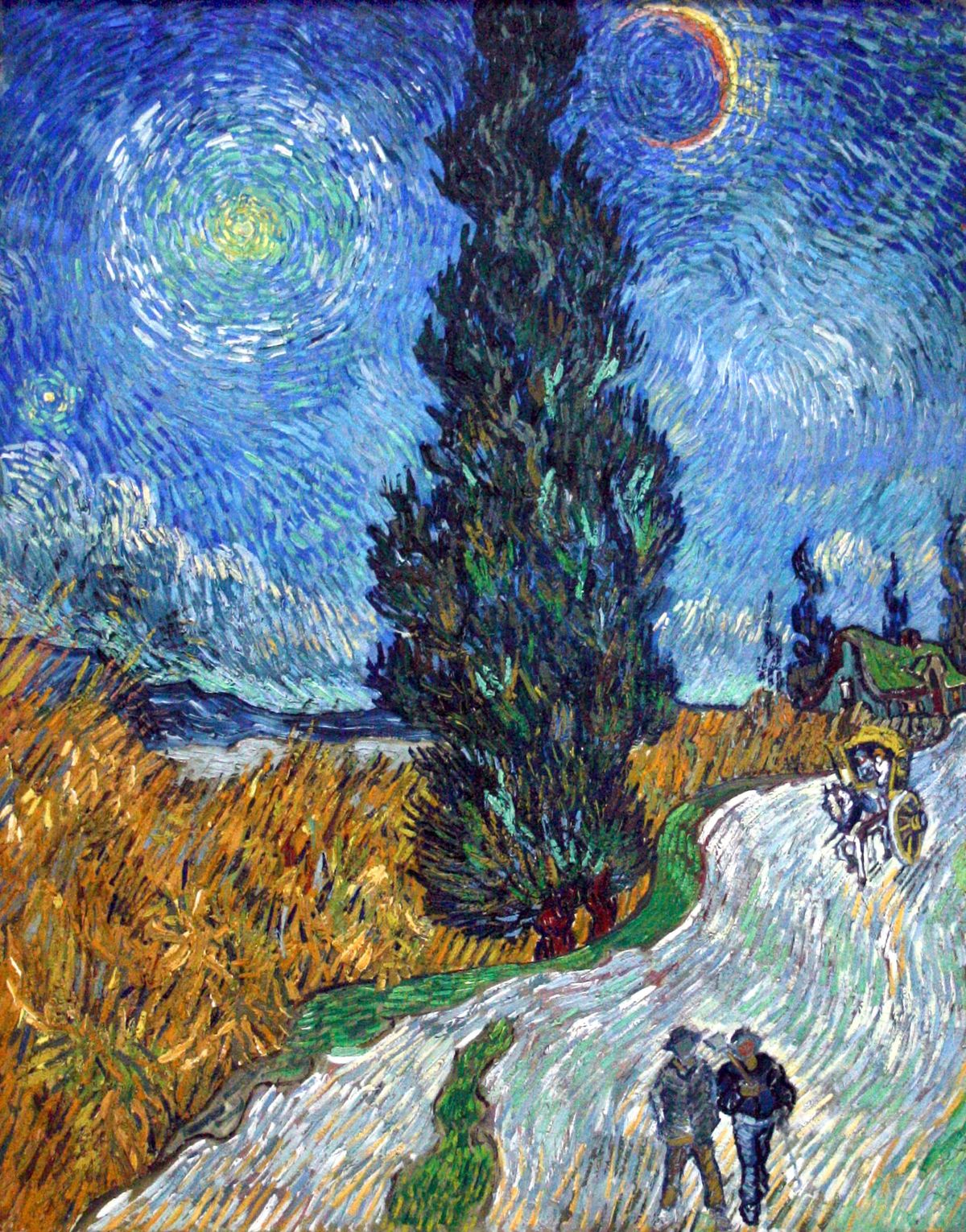
빈센트 반 고흐(Vincent van Gogh, 1853–1890)가 생애 마지막 해인 1890년 5월 프랑스 남부 생레미 드 프로방스(Saint-Rémy-de-Provence)의 생폴 드 모졸 수도원 정신병원을 떠나기 직전에 완성한 '사이프러스와 별이 있는 길(Road with Cypress and Star)'은 캔버스에 유채(Oil on canvas)로 제작된 풍경화입니다. 작품의 실제 규격은 세로 90.6cm, 가로 72.0cm이며, 현재 네덜란드 오테를로의 크뢸러 뮐러 미술관(Kröller-Müller Museum)에 영구 소장되어 있습니다.
고흐는 이 작품에서 화면 전체를 소용돌이치는 역동적인 곡선 리듬과 물감을 빚어 올리듯 두텁게 바르는 특유의 임파스토(Impasto) 기법으로 채웠습니다. 화면 중앙을 거대한 검은 불꽃처럼 가로지르는 짙푸른 사이프러스 나무는 지상과 천상을 잇는 거대한 기둥 역할을 하며, 좌측의 찬란하게 회전하는 샛별(금성)과 우측 상단의 붉은빛 초승달은 청록색과 군청색의 밤하늘을 황홀하게 밝힙니다. 황금빛 밀밭과 굽이치는 흙길, 그리고 마차와 두 보행자의 모습은 거친 사선과 곡선의 붓 터치로 직조되어 화면 전체가 살아 숨 쉬는 우주적 진동을 일으킵니다.
이 그림에는 고흐가 남프랑스 시절을 총결산하며 지독한 고독과 예술적 갈망 속에서 붓을 들었던 가슴 저린 인간적 에피소드가 담겨 있습니다. 1890년 5월, 고흐는 1년간의 고통스러운 정신병원 생활을 끝내고 북부 오베르 쉬르 우아즈로 떠날 준비를 하고 있었습니다. 짐을 싸던 고흐는 남프랑스를 떠나기 전, 자신이 그토록 사랑했던 '프로방스의 영혼'을 마지막으로 화폭에 온전히 봉인해 두고 싶다는 강박적인 열정에 사로잡혔습니다.
고흐는 해바라기가 아를의 상징이었듯, 사이프러스 나무야말로 남프랑스의 고결한 영혼이라고 믿었습니다. 그는 동생 테오에게 "이곳을 떠나기 전 마지막으로 사이프러스 나무를 그린 야경화를 하나 완성했다. 이집트의 오벨리스크처럼 완벽한 비례를 지닌 이 어두운 나무는 태양의 빛만큼이나 나를 사로잡는다"고 적었습니다. 당시 병원 정원사와 간호사들은 퇴원을 며칠 앞두고도 밤낮없이 캔버스 앞에 붙어 서서 땀을 비 오듯 흘리며 거칠게 붓을 휘두르는 고흐를 안타깝게 바라보았지만, 고흐에게 이 작업은 남부의 대자연에 바치는 가장 경건한 고별 의식이었습니다.
특히 길을 따라 묵묵히 걸어가는 지팡이를 짚은 두 남자의 실루엣은 고흐와 동생 테오, 혹은 고흐와 그가 그토록 그리워했던 동료 폴 고갱의 모습을 투영한 것으로 해석됩니다. 머나먼 밤길을 동행하는 두 나그네와 뒤따라오는 소박한 마차의 정경은, 평생 지독한 외로움 속에서도 누군가와 함께 삶의 길을 걷고 싶어 했던 고흐의 애틋한 인간적 갈망을 고스란히 드러냅니다. 또한 하늘에 나란히 뜬 눈부신 별과 신비로운 초승달은 1890년 4월 당시 실제로 남프랑스 밤하늘에서 관측되었던 금성과 수성의 근접 현상을 고흐가 직접 목격하고 캔버스에 영적인 시적 상상력으로 승화시킨 흔적입니다.
후대의 미술사학자들과 평단은 이 작품을 '별이 빛나는 밤'의 연장선상이자 반 고흐가 남프랑스 시기에 도달한 회화적 완성도의 최정점으로 평가합니다. 하늘과 대지, 식물과 인간이 하나의 거대한 생명의 리듬으로 합일되는 이 독창적인 공간 구성은 20세기 표현주의의 탄생을 알린 결정적 걸작이자, 화가의 실존적 고뇌와 영적 구원의 염원이 빚어낸 불멸의 명작으로 찬사를 받고 있습니다.
관람자의 시선은 가장 먼저 화면을 수직으로 양분하며 타오르는 검은 불꽃처럼 솟아오른 웅장한 사이프러스 나무의 짙푸른 양감에 압도됩니다. 이어 좌측 상단에서 눈부시게 소용돌이치는 황금빛 샛별과 우측의 초승달을 번갈아 훑은 뒤, 밤하늘의 푸른 물결을 타고 내려와 화면 하단에서 길을 걷는 두 나그네와 말 한 필이 끄는 마차의 따스한 실루엣에 머물게 됩니다. 이후 시선은 굽이치는 백색 흙길과 바람에 일렁이는 황금빛 밀밭의 리듬을 따라 화면 전체로 유려하게 순환합니다.
심리적으로 관람자는 대지를 뒤흔드는 우주적 소용돌이 속에서도 묵묵히 길을 걸어가는 사람들의 소박한 온기에서 깊은 정서적 안정감과 위안을 경험하게 됩니다. 짙푸른 밤하늘과 따스한 별빛이 자아내는 색채의 조화는 마음 깊은 곳에 억눌려 있던 외로움과 방황의 감정을 포근하게 감싸 안아주며, 어두운 인생의 밤길 속에서도 끝내 길을 밝혀주는 별빛과 같은 따뜻한 희망과 내면의 평온을 풍성하게 채워줍니다.
Road with Cypress and Star (Country Road in Provence by Night)
Painted by Vincent van Gogh (1853–1890) in Saint-Rémy-de-Provence in May 1890, Road with Cypress and Star is an iconic oil on canvas landscape measuring 90.6 cm in height and 72.0 cm in width. This legendary masterwork is permanently preserved in the prestigious collection of the Kröller-Müller Museum in Otterlo, Netherlands.
Van Gogh structured the entire composition around pulsating, undulating brushstrokes and thick, sculptural impasto. The towering, flame-like silhouette of the dark cypress rises like a colossal cosmic pillar dividing the terrestrial realm and the celestial dome. To the left, a brilliant morning star swirls within a vibrant halo, while an ethereal crescent moon glows on the right against a dynamic turbulence of cobalt, ultramarine, and turquoise, infusing the Provençal countryside with extraordinary living energy.
The painting holds an intimate and poignant history as Van Gogh's definitive farewell to the south of France. In May 1890, after enduring a year of agonizing isolation at the Saint-Paul asylum, the artist prepared to depart for Auvers-sur-Oise. Before leaving, he felt an overwhelming compulsion to create a final, definitive synthesis of the southern landscape that had profoundly redefined his artistic vision.
To Van Gogh, the cypress was the quintessential emblem of Provence, possessing the architectural grace of an Egyptian obelisk combined with an untamed spiritual vitality. Writing to his brother Theo, he remarked: "I have a last canvas of a cypress with a star to send... It is a cypress with a star, a last attempt." Asylum staff watched the frail painter work through the final days with breathless concentration, furiously layering pigments to capture the eternal spirit of the nocturnal landscape.
The two travelers walking with walking sticks along the curving road and the horse-drawn carriage behind them carry profound autobiographical resonance. Reflected within these humble figures is Van Gogh’s lifelong yearning for human brotherhood and enduring companionship—perhaps invoking the spiritual bond between himself and Theo, or his lost camaraderie with Gauguin. Furthermore, the rare astronomical conjunction of the glowing star and the crescent moon reflects real celestial events observed in the Provençal night sky in the spring of 1890, transformed by the artist into an enduring hymn to cosmic transcendence.
Modern art historians celebrate this painting as the thematic and stylistic culmination of Van Gogh’s southern period and a crowning jewel of Post-Impressionism. By dissolving rigid physical structures into fluid currents of pure emotional expression, Van Gogh elevated the genre of landscape into a sacred visual meditation on mortality, human pilgrimage, and celestial hope.
A viewer’s gaze is immediately seized by the monumental dark cypress soaring through the center of the canvas. The eyes then traverse the celestial expanse, moving between the radiant vortex of the golden star and the luminous crescent moon, before descending along the energetic blue sky currents to settle upon the modest figures and the carriage traveling along the winding road. Finally, the gaze sweeps across the rustling golden wheat fields, circulating effortlessly through the entire harmonious composition.
Psychologically, the juxtaposition of the infinite cosmic whirl with the quiet endurance of the travelers induces an immediate sense of grounded serenity and profound solace. The harmonious resonance between deep nocturnal blues and warm golden ambers dissolves subconscious fatigue and isolation, enveloping the observer in an enduring atmosphere of spiritual reassurance, peaceful fortitude, and restorative hope.
본 리뷰에서 작품을 제외한 컨텐츠의 저작권은 팔렛트제주에 있습니다.
"퍼블릭도메인 고전명화"를 제외한 모든 창작 콘텐츠는 저작권법 제4조 및 제10조에 의거하여 보호됩니다. 무단 도용시 저작권법 제136조(벌칙)에 의거, 당사의 사전 서면 승인 없는 저작권 침해 행위를 금지합니다.