생의 마지막 순간이 새겨진 대지의 맥박, 나무 뿌리 Tree Roots
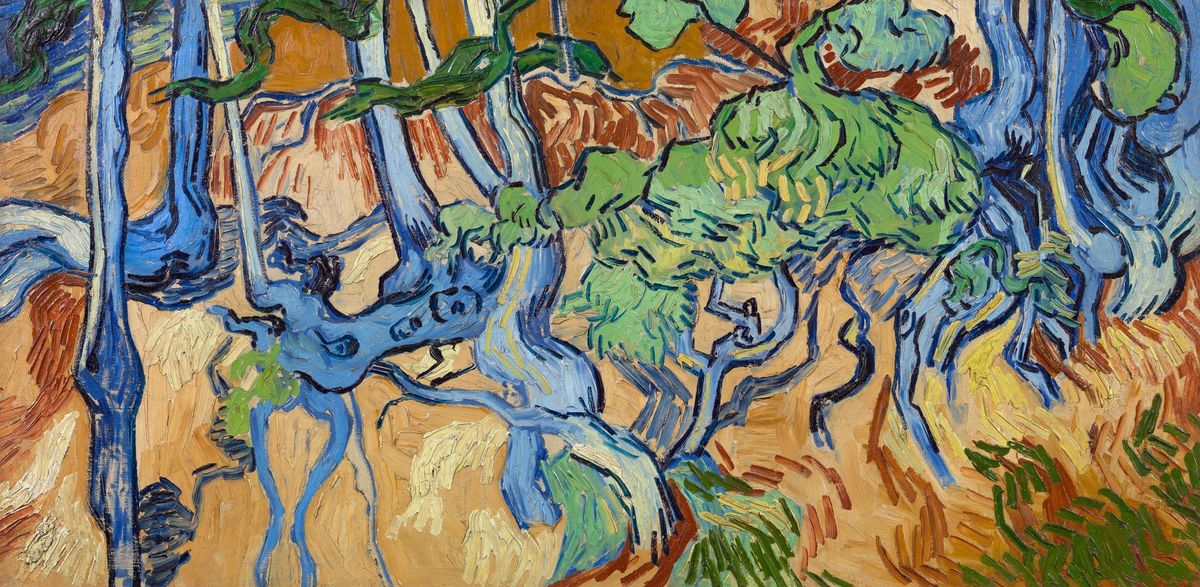
네덜란드의 후기 인상주의 거장 빈센트 반 고흐(Vincent van Gogh, 1853–1890)가 1890년 7월 프랑스 오베르 쉬르 우아즈(Auvers-sur-Oise)에서 그린 《나무 뿌리(Tree Roots)》는 가로 100.2 cm, 세로 50.3 cm 크기의 가로로 긴 캔버스에 유채로 완성한 작품으로, 현재 네덜란드 암스테르담의 반 고흐 미술관(Van Gogh Museum)에 영구 소장되어 있습니다.
오베르의 비탈길에서 마주한 생의 마지막 붓질과 발견의 드라마
이 그림은 반 고흐가 생을 마감하기 직전인 1890년 7월 27일, 치명적인 총상을 입기 몇 시간 전까지 매달렸던 사실상의 마지막 유작으로 미술사에 기록되어 있습니다. 오랜 세월 미완성 상태의 추상적 모티프로만 여겨졌던 이 작품은 2020년 미술사학자 바우터 반 데르 빈(Wouter van der Veen)이 1900년대 초반 오베르의 역사적인 엽서를 분석하던 중, 석회암 비탈길에 드러난 실제 나무 뿌리의 위치를 정확히 고증해내며 극적인 진실이 밝혀졌습니다.
화가가 묵고 있던 라부 여관(Auberge Ravoux)에서 불과 150m 떨어진 도비니 거리(Rue Daubigny)의 비탈에서 포착된 이 장면은, 삶의 가장 위태로운 벼랑 끝에서도 자연의 원초적인 생명력과 마지막 순간까지 치열하게 교감했음을 보여줍니다. 척박한 비탈의 흙을 움켜쥐고 뒤틀린 뿌리들은 생의 고통스러운 무게를 지탱하며 발버둥 치던 고흐 자신의 내면적 자화상이자 지상에 남긴 처절한 마지막 유언이었습니다.
무의식 속 시선이 유영하는 미로와 응축된 에너지
화폭을 마주하는 순간 감상자의 무의식은 원근법적 소실점과 지평선이 완전히 사라진 파격적인 구도 속에서 강렬한 시각적 충격을 경험합니다. 시선은 좌측 상단의 짙은 코발트 블루 줄기를 타고 미로처럼 얽힌 뿌리의 중심으로 빨려 들어가며, 밝은 황토색 모래흙과 흩뿌려진 연둣빛 잎사귀 사이를 쉼 없이 오가며 팽팽한 시각적 긴장감을 마주합니다.
이러한 시선 이동 속에서 관람자는 안정된 형태를 파악하려는 의식적 시도를 멈추고, 대지의 거친 마찰음과 꿈틀거리는 선들의 율동에 자연스럽게 동화됩니다. 이로 인해 감상자는 화가가 생의 마지막 순간까지 붙들고 있었던 극도의 정신적 고양감과 삶을 향한 처절한 집념을 내면 깊숙이 체감하게 됩니다.
20세기 추상 회화의 문을 연 혁신적 미술사적 평가
미술계는 《나무 뿌리》를 19세기 구상 회화의 전통을 해체하고 20세기 현대 추상 미술의 서막을 알린 선구적 걸작으로 평가합니다. 굵고 대담한 윤곽선, 대상을 순수한 색채와 면의 율동으로 분해한 화면 구성, 캔버스의 밑바탕이 그대로 드러난 거친 붓질은 훗날 야수파(Fauvism)와 추상표현주의(Abstract Expressionism)의 태동을 십수 년 앞서 예고했습니다. 대상을 사실적으로 재현하는 역할을 벗어던지고 내면의 격정을 순수한 조형 언어로 승화시킨 이 작품은, 반 고흐가 마지막 숨을 거두는 순간까지 예술적 진화를 멈추지 않았음을 증명하는 독보적인 유산입니다.
The Pulsing Rhythm of the Earth’s Final Breath, Tree Roots
Painted in July 1890 in Auvers-sur-Oise by Vincent van Gogh (1853–1890), Tree Roots is an oil on canvas measuring 50.3 cm × 100.2 cm (19.8 in × 39.4 in), preserved in the permanent collection of the Van Gogh Museum in Amsterdam, Netherlands.
The Final Brushstrokes on an Auvers Hillside and a Modern Revelation
Art historians widely recognize Tree Roots as Van Gogh’s poignant final canvas, worked on mere hours before he sustained his fatal gunshot wound on July 27, 1890. Long considered an enigmatic, semi-abstract composition, the exact historical context was dramatically illuminated in 2020 when researcher Wouter van der Veen identified the precise location from a vintage 1900s postcard, revealing the overgrown roots embedded along a limestone slope.
Situated on Rue Daubigny, merely 150 meters from the Auberge Ravoux where Vincent lodged, the scene reveals a tangled hillside clinging stubbornly to the earth. In these gnarled, exposed roots grappling with barren soil, Van Gogh captured not merely an arbitrary slice of nature, but a visceral metaphor for his own existential struggle—a sublime testament to resilient life enduring upon the precipice of oblivion.
Unconscious Visual Labyrinth and Concentrated Psychic Energy
Upon encountering the elongated canvas, the viewer’s subconscious is immediately captivated by the radical absence of traditional perspective and horizon lines. Visual perception plunges directly into the turbulent knots of cobalt blue trunks before weaving restlessly through the labyrinth of entangled roots, while the rhythmic counterpoint of vibrant ochre soil and dashes of lime-green foliage sustains an intense optical tension.
Navigating this dense thicket without conventional resting points, the observer instinctively ceases the search for stable forms and instead internalizes the raw kinetic energy of the vibrating contours. Through this perceptual immersion, the viewer directly absorbs the emotional urgency and fierce passion for existence embedded within each deliberate impasto stroke.
A Revolutionary Harbinger of 20th-Century Abstraction
Within modern art history, Tree Roots is revered as an extraordinary bridge between Post-Impressionism and modern Abstraction. The deliberate flattening of pictorial space, the rhythmic fragmentation of natural forms into autonomous chromatic marks, and the unprimed patches of raw canvas anticipate the breakthroughs of Fauvism and Abstract Expressionism by decades. By emancipating color and stroke from purely mimetic duties, Van Gogh transformed this vegetative struggle into an iconic monument of psychological truth, demonstrating an undiminished, fiercely innovative creative spirit until his very last breath.
본 컨텐트의 저작권은 팔렛트제주에 있습니다. 허가없는 무단전제를 금지합니다.
Copyright © Palette Jeju. All rights reserved. Unauthorized reproduction or redistribution is strictly prohibited.