생투앙로몬의 전경 (Vue de Saint-Ouen-l'Aumône, 1876)
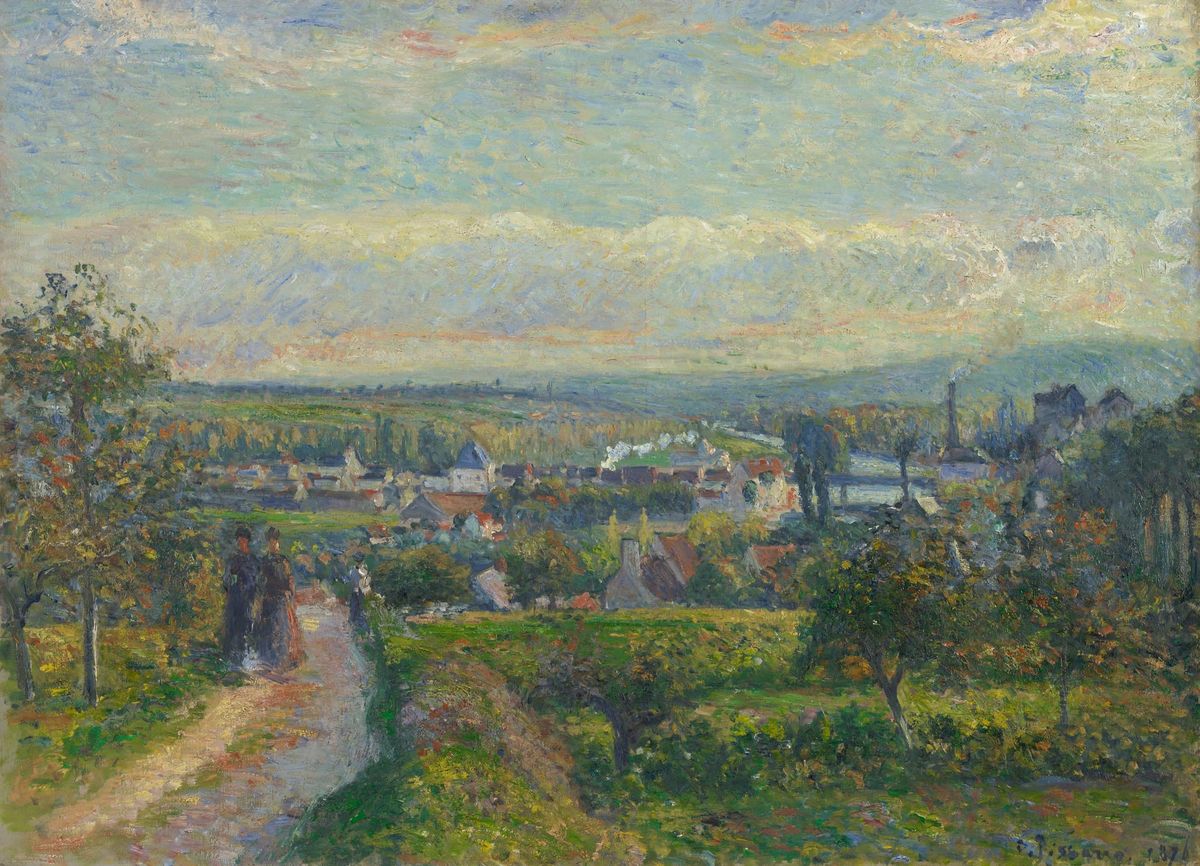
1876년 카미유 피사로는 퐁투아즈의 높은 언덕배기에서 우아즈강 건너편으로 넓게 펼쳐진 이웃 마을 생투앙로몬의 전경을 웅장한 파노라마 구도로 화폭에 담아냈습니다.
제2회 인상주의 전시회가 열리던 해에 완성된 이 작품은 가로 73.5cm, 세로 58.1cm 크기의 캔버스에 유채로 그려진 걸작으로, 현재 미국 뉴헤이븐의 예일 대학교 미술관에 소장되어 있습니다. 당시 피사로는 전형적인 이상화된 전원 풍경 대신, 유서 깊은 마을의 기와지붕들과 강변을 따라 들어선 공장 굴뚝, 그리고 대지 위를 달리는 증기기관차의 하얀 연기까지 가감 없이 포착하며 근대화의 숨결이 스며드는 당대 프랑스 풍경의 진실을 정직하게 기록했습니다.
관람자의 시각 인지 체계는 화면 좌측 하단의 양지바른 언덕길 위를 나란히 걸어가는 두 여인의 어두운 실루엣에 가장 먼저 닻을 내립니다. 밝은 햇살을 받아 빛나는 황토빛 흙길과 인물들이 자아내는 뚜렷한 명암 대비는 시각 피질의 중심와를 즉각 포획하며 풍경 탐색의 편안한 출발점을 확립합니다.
이어서 시선은 여인들의 발걸음이 향하는 완만한 내리막길의 대각선 축을 따라 하강하여, 중경에 오밀조밀 모여 있는 생투앙로몬 마을의 붉은 지붕들과 우아즈강의 맑은 물줄기, 그리고 강변을 가로지르는 철도 위로 피어오르는 하얀 증기 구름으로 자연스러운 도약 안구 운동을 진행합니다.
강 건너편의 평야와 우측 멀리 솟아오른 공장 굴뚝의 수직선을 훑은 눈길은, 화면 상단의 절반 가까이를 차지하는 웅장한 하늘로 상승하여 노란빛과 푸른빛이 교차하는 환상적인 뭉게구름의 대기감 속으로 시원하게 확장됩니다.
언덕 위 들판의 생생한 붓질과 햇살을 머금은 하늘의 온화한 광채가 망막 위에서 하나의 완성된 파노라마로 통합되는 순간, 관조자는 번잡한 일상의 긴장을 내려놓고 바람 부는 언덕 꼭대기에서 광활한 대지를 굽어보는 듯한 깊은 심리적 해방감과 내면의 평온을 체험하게 됩니다.
이 그림을 그릴 당시 피사로는 퐁투아즈를 거점으로 폴 세잔과 긴밀히 교류하며 대지의 물리적 구조감과 자연광의 유기적인 조화를 화폭에 구현하는 데 몰두하고 있었습니다.
그는 고전주의 풍경화처럼 공장의 굴뚝이나 철도를 인위적으로 감추지 않고, 자연의 순환과 인간의 새로운 생산 활동이 하나의 살아 숨 쉬는 풍경으로 융합되는 근대적 서사시를 완성했습니다.
동시대의 진보적 비평가들은 화려한 장식성을 배제하고 시대의 공기를 투명하게 담아낸 피사로의 캔버스를 두고 "새로운 시대를 맞이하는 대지의 호흡을 가장 정직하고 시적인 조형 질서로 엮어낸 거장의 눈"이라며 깊은 찬사를 보냈습니다.
광활한 대지의 호흡과 근대 산업의 활력을 눈부신 빛의 조화와 탄탄한 조형미로 승화시킨 피사로의 '생투앙로몬의 전경'은, 현대 미술사에서 인상주의 풍경화가 도달한 서정적 웅장함과 사회적 진실성을 완벽하게 증명하는 기념비적인 걸작으로 확고하게 평가받고 있습니다.
View of Saint-Ouen-l'Aumône (Vue de Saint-Ouen-l'Aumône, 1876)
In 1876, gazing across the Oise River from the elevated heights of Pontoise, Camille Pissarro captured an expansive, sun-drenched panorama of the neighboring settlement of Saint-Ouen-l'Aumône.
Executed during the watershed year of the Second Impressionist Exhibition, this horizontal oil on canvas, measuring 58.1 by 73.5 cm and preserved within the Yale University Art Gallery, stands as a defining monument of Pissarro's classical period. Bypassing archaic pastoral illusions, the master recorded the unvarnished reality of contemporary France, harmonizing rustic cottages and rolling orchards with riverside factories and the white plumes of a passing locomotive.
The observer’s perceptual framework instantly grounds itself upon the dark silhouettes of two women conversing along the sunlit pathway in the lower left. The sharp tonal contrast between their anchored figures and the luminous ochre road arrests the fovea, establishing an intuitive and emotionally reassuring structural threshold for spatial navigation.
From this domestic anchor, the ocular trajectory tracks the gentle descent of the earthen path toward the middle ground, sweeping across the red-tiled roofs of Saint-Ouen-l'Aumône, the shimmering bend of the Oise River, and the dynamic puffs of steam billowing along the rail line.
Traversing the distant plains and the slender verticality of factory chimneys rising on the far right, the gaze ascends into the vast, luminous expanse of the upper atmosphere, where radiant golden and azure clouds drift across the panoramic sky.
As the dense, vibrating brushstrokes of the foreground pasture and the serene atmospheric light coalesce into a unified sensory whole within the visual cortex, active visual scanning dissolves into profound contemplative stillness, attuned to the vast and tranquil expanse of the countryside.
While executing this canvas, Pissarro was working in close artistic camaraderie with Paul Cézanne in Pontoise, rigorously exploring how to fuse tectonic structural weight with the fleeting vibrations of open-air daylight.
Rather than viewing modern industrialization as an intrusion upon nature, Pissarro embraced railways, factories, and agrarian fields as interdependent elements of living reality, setting a monumental precedent for nineteenth-century landscape art.
Progressive critics universally lauded his unvarnished integrity, celebrating his extraordinary gift for uncovering moral gravity, historical truth, and delicate poetry within the changing topography of modern life.
Masterfully harmonizing structural weight with radiant atmospheric poetry, Pissarro's panoramic view of Saint-Ouen-l'Aumône remains celebrated across art history as an enduring pinnacle of mid-career Impressionist landscape painting.
본 콘텐츠의 저작권은 저작권자에게 있으며, 무단 전재 및 재배포를 금합니다.