생트마리의 바다 위 고깃배 - Fishing Boats on the Beach at Saintes-Maries-de-la-Mer
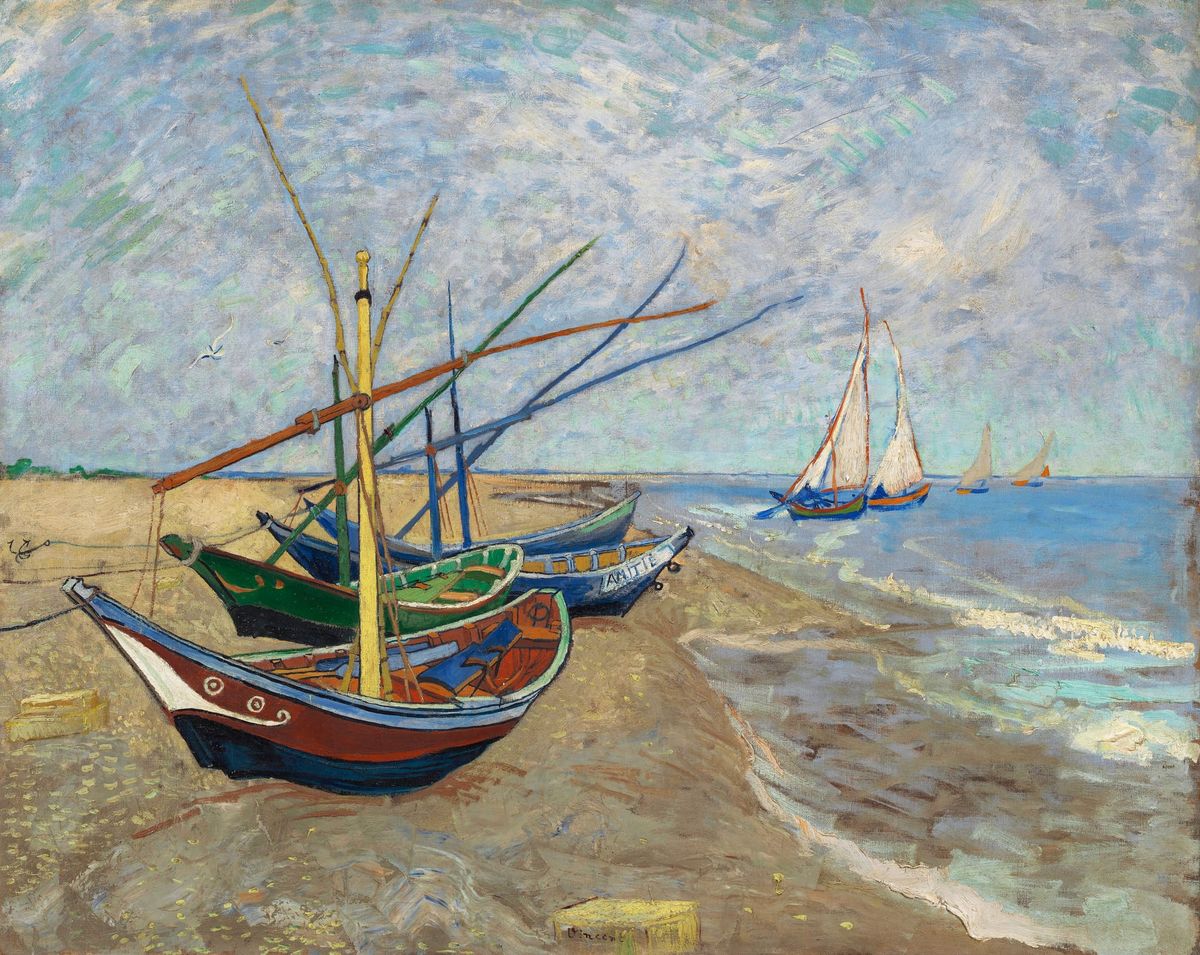
빈센트 반 고흐(Vincent van Gogh, 1853–1890)가 1888년 6월 프랑스 남부 지중해 연안 마을인 생트마리드라메르(Saintes-Maries-de-la-Mer)에서 구상하여 아를의 작업실에서 완성한 '생트마리의 바다 위 고깃배(Fishing Boats on the Beach at Saintes-Maries-de-la-Mer)'는 캔버스에 유채(Oil on canvas)로 제작된 풍경화입니다. 작품의 실제 규격은 세로 65.0cm, 가로 81.5cm이며, 현재 네덜란드 암스테르담의 반 고흐 미술관(Van Gogh Museum)에 영구 소장되어 있습니다.
고흐는 이 작품에서 모래사장에 정박한 어선들의 날렵한 곡선과 솟아오른 돛대를 대담하고 명확한 윤곽선으로 포착했습니다. 지중해 특유의 강렬한 태양빛 아래 반짝이는 바다와 하늘은 파란색, 흰색, 은회색의 짧고 경쾌한 붓질로 생동감 넘치게 분할되었으며, 고깃배의 몸체에는 붉은색, 녹색, 노란색, 군청색 등 순도 높은 원색을 두터운 임파스토(Impasto) 기법으로 얹어 마치 갓 칠해진 배의 실재감과 조형적 에너지를 극대화했습니다.
이 그림에는 반 고흐가 생애 처음으로 마주한 지중해의 압도적인 색채에 매료되었던 인간적인 에피소드가 깊이 배어 있습니다. 1888년 5월 말, 아를에 머물던 고흐는 지중해의 푸른 물결을 직접 눈에 담고 싶다는 열망 하나로 마차를 타고 남쪽으로 50킬로미터를 달려 작은 어촌 마을 생트마리드라메르로 향했습니다. 일주일 남짓한 짧은 체류 기간 동안 그는 바다의 변화무쌍한 색채에 완전히 압도당했습니다.
고흐는 매일 새벽 모래사장에 나가 어부들이 바다로 출항하기 전의 배들을 서둘러 스케치했습니다. 배들이 너무 일찍 바다로 나가는 바람에 현장에서 채색을 끝내지 못할까 봐 초조해하던 그는, 백사장에 주저앉아 잉크와 갈대펜으로 배의 구조와 돛대의 각도를 꼼꼼히 기록한 뒤 아를의 작업실로 돌아와 단숨에 이 유화 걸작을 완성했습니다.
당시 고흐는 동생 테오에게 보낸 편지에서 "지중해의 색깔은 고등어처럼 시시각각 변한다. 초록인지 보라인지, 혹은 파란색인지 분간할 수 없지만, 눈을 깜빡이는 순간 분홍빛이나 회색을 띤 빛이 스쳐 지나간다"며 평생 처음 맛본 남부 바다의 황홀경을 아이처럼 들뜬 목소리로 고백했습니다. 어촌 주민들은 모래바람을 맞으며 백사장에 웅크린 채 캔버스를 노려보던 붉은 수염의 화가를 신기하게 바라보았지만, 고흐는 그 며칠간의 여정에서 도시의 우울을 완벽히 털어내고 순수한 창작의 희열을 되찾았습니다.
후대의 미술사학자들과 평단은 이 작품을 반 고흐가 일본 우키요에 판화의 선묘적 구성과 남프랑스의 강렬한 원색을 결합하여 자신만의 독창적인 양식을 확립한 최고 정점의 마스터피스로 평가합니다. 모래사장에 비스듬히 놓인 배들의 구조적 리듬과 원경에서 부드럽게 항해하는 하얀 삼각 돛단배들의 배치는 평면성과 공간적 깊이를 완벽하게 조화시킨 후기 인상주의의 위대한 성취로 손꼽힙니다.
관람자의 시선은 가장 먼저 화면 좌측 하단에 정박한 채 선명한 붉은색과 청록색을 뽐내는 어선의 날렵한 뱃머리와 노란 돛대에 사로잡힙니다. 이어 허공을 가르며 시원하게 뻗은 긴 돛대들의 사선 리듬을 타고 뒤편에 나란히 놓인 배들을 훑은 뒤, 오른쪽 해안선을 따라 밀려오는 은백색 파도와 푸른 바다의 경계로 자연스럽게 이동합니다. 마지막으로 수평선 너머에서 춤추듯 떠 있는 하얀 돛단배들과 점묘처럼 흩뿌려진 찬란한 하늘의 붓 터치를 따라 화면 전체를 유려하게 순환하게 됩니다.
심리적으로 관람자는 백사장을 비추는 따스한 모래빛과 가슴을 뻥 뚫리게 만드는 지중해의 청량한 푸른빛이 자아내는 조화 속에서 즉각적인 정서적 개방감과 시각적 휴식을 경험하게 됩니다. 거친 파도를 헤치고 돌아와 안전하게 모래사장에 안착한 어선들의 단단한 형상은 무의식중에 내재된 삶의 방황과 피로를 어루만지며, 마음 깊은 곳에 든든한 평온함과 함께 새로운 여정을 시작할 수 있는 따뜻한 희망의 에너지를 풍성하게 채워줍니다.
Fishing Boats on the Beach at Saintes-Maries-de-la-Mer
Conceived in June 1888 during a journey to the Mediterranean fishing village of Saintes-Maries-de-la-Mer and completed in his studio in Arles, Fishing Boats on the Beach is an iconic oil on canvas landscape by Vincent van Gogh (1853–1890). Measuring 65.0 cm in height and 81.5 cm in width, this celebrated masterpiece is permanently housed in the collection of the Van Gogh Museum in Amsterdam, Netherlands.
Van Gogh delineated the sweeping curves and towering masts of the beached fishing vessels with bold, decisive contours inspired by Japanese woodblock prints. The shifting Mediterranean atmosphere is rendered with short, vibrant touches of turquoise, cobalt, and silvery white, while the boats themselves are sculpted with pure primary accents of vermilion, emerald, yellow, and ultramarine using thick, tactile impasto that imbues the wooden hulls with remarkable structural presence.
The canvas holds an intimate history of artistic wonder and personal rejuvenation. In late May 1888, yearning to witness the legendary colors of the open sea, Van Gogh took a carriage ride fifty kilometers south from Arles to the humble coastal village of Saintes-Maries. During this transformative one-week retreat, the infinite vitality of the Mediterranean completely revitalized his exhausted spirit.
Fearing that the local fishermen would launch their craft before he could capture their dynamic forms, Van Gogh rose at daybreak every morning, sitting directly on the sands to produce meticulous reed-pen drawings of the hulls and rigging. Returning to his Yellow House in Arles with these vibrant studies, he translated his immediate impressions onto canvas with explosive creative velocity.
In an ecstatic letter to his brother Theo, Van Gogh described the elusive Mediterranean waters as possessing the shifting hues of a mackerel: "You do not always know if it is green or violet, you do not always know if it is blue, because a second later the changing reflection has taken on a pink or gray tint." The local villagers observed the eccentric painter battling the sea breeze with quiet curiosity, unaware that this brief seaside pilgrimage would produce one of modern art's most radiant celebrations of maritime life.
Modern art historians celebrate this painting as a seminal breakthrough where Japanese compositional linearity and southern chromatic intensity fused seamlessly. The harmonious counterpoint between the grounded, rhythmic hulls in the foreground and the delicate triangular sails gliding along the horizon establishes an exquisite balance between terrestrial stability and poetic expanse.
A viewer’s gaze instinctively anchors upon the colorful, pointed bow and upright yellow mast of the primary vessel resting in the lower left foreground. From this tactile focal point, the eyes follow the energetic diagonal thrust of the wooden spars toward the adjacent craft, before drifting along the sweeping shoreline into the foaming azure tides. The gaze then ascends past the distant white sails, circulating effortlessly through the luminous, rhythmic brushstrokes of the sun-drenched sky.
Psychologically, the interplay between the warm golden shore and the boundless oceanic blue evokes an immediate sense of emotional release and mental clarity. The sight of robust vessels resting safely upon the sand gently dispels underlying stress and anxiety, instilling the observer with a grounded sense of security, enduring peace, and the inspiring promise of renewed beginnings.
본 리뷰에서 작품을 제외한 컨텐츠의 저작권은 팔렛트제주에 있습니다.
"퍼블릭도메인 고전명화"를 제외한 모든 창작 콘텐츠는 저작권법 제4조 및 제10조에 의거하여 보호됩니다. 무단 도용시 저작권법 제136조(벌칙)에 의거, 당사의 사전 서면 승인 없는 저작권 침해 행위를 금지합니다.