생 레미의 생 파울 병원 근처, 거대한 나무들이 있는 풍경 - The Large Plane Trees (Road Menders at Saint-Rémy)
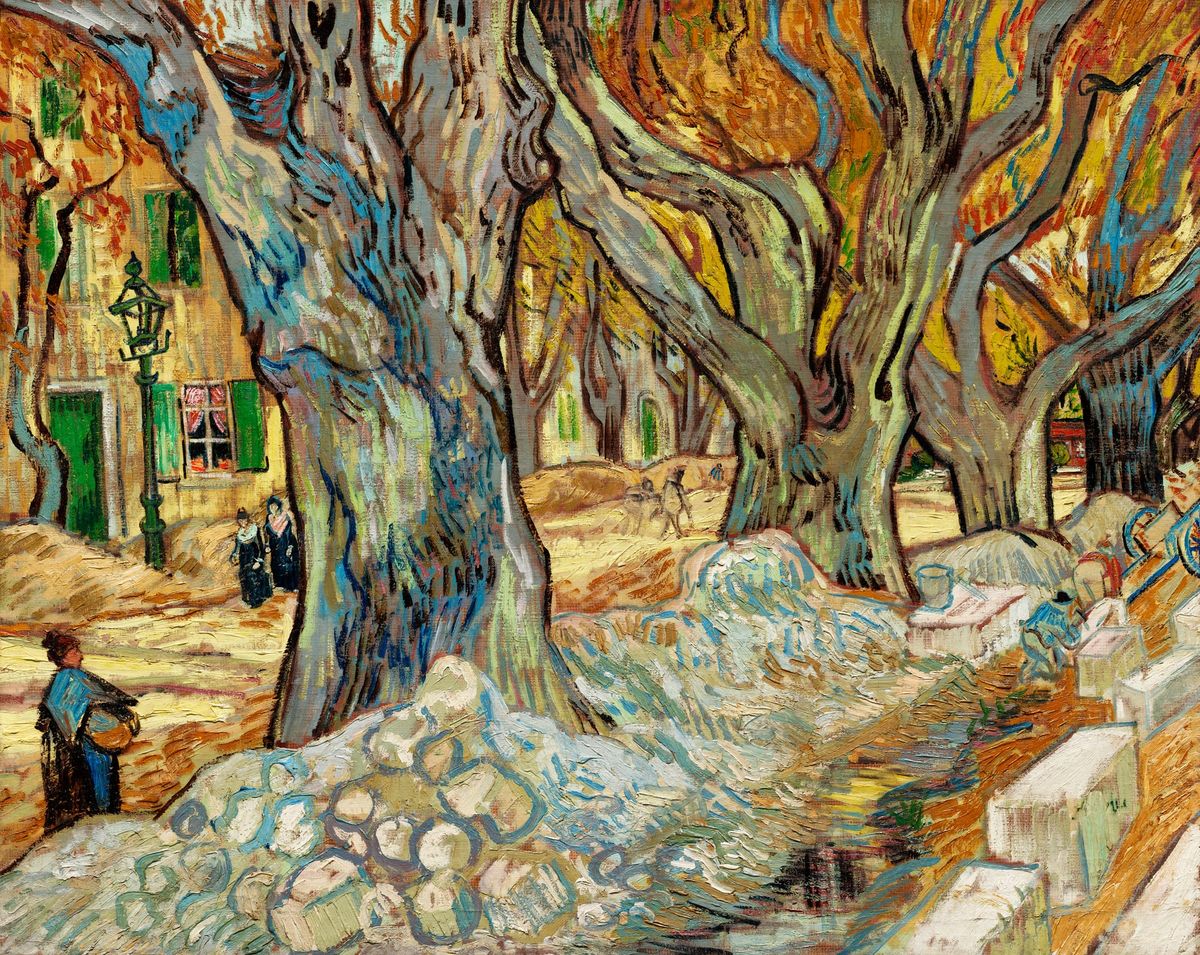
빈센트 반 고흐(Vincent van Gogh)가 1889년 11월 프랑스 생레미의 생폴 드 모졸 요양원에 머물던 시기에 완성한 대표적인 유화 풍경화입니다. 현재 미국 오하이오주 클리블랜드 미술관(The Cleveland Museum of Art) 등에 주요 버전으로 소장되어 있으며, 캔버스 위에 유채로 제작된 이 작품의 실제 사이즈는 약 73.4 × 91.8 cm입니다. 화면을 압도하는 거대한 플라타너스(버즘나무) 고목들의 뒤틀린 줄기와 노랗게 물든 가을 잎사귀, 그리고 도로를 보수하는 노동자들의 분주한 일상을 두텁고 역동적인 임파스토(Impasto) 기법으로 웅장하게 담아냈습니다.
고흐는 물감을 캔버스 위에 두껍게 얹어 플라타너스 나무껍질의 거칠고 울퉁불퉁한 결, 길가에 쌓인 돌무더기의 각진 양감, 그리고 휘몰아치는 가을 단풍의 물결을 촉각적으로 조각해냈습니다. 굵은 기둥을 타고 흐르는 짙은 청록색과 회갈색 선묘는 머리 위로 펼쳐진 눈부신 황금빛, 주황빛 나뭇잎들과 화려한 보색 대비를 이룹니다. 도로를 따라 율동감 있게 배치된 도로 보수 인부들과 지나가는 행인들의 실루엣은 장엄한 대자연의 스케일 속에서도 살아 숨 쉬는 인간적 온기를 불어넣습니다.
1889년 늦가을, 오랜 요양원 격리 생활 끝에 생레미 마을 안쪽으로 외출을 허가받은 고흐는 대로변에서 진행되던 도로 포장 공사와 거대한 플라타너스 가로수들의 위풍당당한 자태에 단숨에 매료되었습니다. 계절의 변화를 온몸으로 맞이하며 굳건히 서 있는 고목들은 고흐에게 시련을 버텨내는 거대한 생명력의 표상이었으며, 차가운 날씨 속에서도 묵묵히 길을 닦는 인부들의 모습은 정직한 노동의 숭고함을 상기시켰습니다. 그는 마을 대로변의 생생한 공기와 벅찬 활기를 동생 테오에게 편지로 전하며 창작에 대한 깊은 열정을 쏟아냈습니다.
하늘을 가릴 듯 뻗어나간 나뭇가지들의 유기적인 곡선과 길바닥의 촘촘한 붓자국은 화면 전체에 거대한 리듬감을 부여합니다. 미술사에서는 고흐가 자연의 형태를 자신의 실존적 감정 상태와 완벽하게 일치시킨 후기 인상주의의 절정기 걸작으로 평가하며, 기념비적인 공간 구성과 역동적인 필치를 통해 현대 표현주의 풍경화의 새 지평을 연 수작으로 꼽고 있습니다.
관람객의 무의식적인 시선은 화면 좌측 전면에 웅장하게 기둥을 내리고 하늘을 향해 힘차게 뻗어 올라간 거대한 플라타너스 나무의 뒤틀린 몸통과 짙푸른 나무껍질의 질감에서 자연스럽게 출발합니다. 수백 년의 세월을 묵묵히 견뎌낸 고목의 압도적인 조형미와 두터운 붓 터치에 시선이 머무는 순간, 보는 이는 찰나의 침묵과 함께 프로방스 가을날의 깊은 숨결 속으로 단숨에 몰입하게 됩니다.
이어 시선은 길을 따라 줄지어 서 있는 플라타너스 가로수들의 굵은 줄기를 타고 안쪽으로 이동하여, 우측 길가에서 무릎을 굽히고 돌을 깨며 도로를 정비하고 있는 보수공들의 다부진 실루엣과 푸른 작업복에 도달합니다. 흙먼지 속에서 묵묵히 삶의 터전을 일구는 정직한 노동의 온기와 마주하며, 대지와 호흡하는 인간의 끈질긴 생명력을 체감하게 됩니다.
이후 시선은 캔버스 상단을 황금빛으로 가득 채우며 타오르듯 굽이치는 노란 가을 단풍잎들의 웅장한 지붕을 훑은 뒤, 좌측의 초록색 창문이 달린 노란 가옥과 길가에 쌓인 회백색 돌무더기를 타고 다시금 전경의 흙길로 부드럽게 내려앉습니다.
장엄한 고목의 힘과 따스한 가을 햇살의 조화를 따라 순환한 시선이 편안히 안착할 때, 관람객의 내면에는 복잡한 일상의 번뇌와 피로가 정돈되고, 거친 풍파를 묵묵히 견뎌내는 자연과 삶이 건네는 깊은 위로와 함께 흔들리지 않는 심리적 안도감이 가득 차오르게 됩니다.
The Large Plane Trees (Road Menders at Saint-Rémy)
Painted by Vincent van Gogh in November 1889 during his residency at the Saint-Paul-de-Mausole asylum in Saint-Rémy-de-Provence, France, this magnificent landscape is preserved in the permanent collection of The Cleveland Museum of Art in Ohio, United States. Executed in oil on canvas, the actual size of the work is approximately 73.4 × 91.8 cm. Capturing the monumental trunks of ancient plane trees arching over a village boulevard alongside laborers paving the road, the painting orchestrates a powerful symphony of heavy impasto, dynamic contours, and glowing autumnal harmonies.
Van Gogh applied unmixed paint with dense, sculptural brushstrokes, carving out the sinuous, muscular bark of the giant trunks, the piles of pale paving stones in the foreground, and the blazing canopy of golden foliage above. The cool slate-blues and viridian greens defining the tree trunks create a striking complementary vibration against the fiery yellows and oranges of the autumn leaves. The small figures of the road menders and passing villagers integrated into the street scene infuse the vast organic framework with humble human warmth and rhythmic vitality.
During the late autumn of 1889, permitted to venture into the village of Saint-Rémy, Van Gogh was immediately struck by the street repairs taking place along the boulevard beneath the towering plane trees. To him, the massive trees, standing firm against the approaching winter, symbolized endurance and natural majesty, while the workers reshaping the ground embodied the noble simplicity of daily labor. In letters to his brother Theo, he described his fascination with the scene, capturing the crisp air and dynamic communal life of the Provençal town.
The sweeping, organic curves of the overarching branches and the rhythmic hatching across the ground give the entire composition a unified kinetic charge. Art historians celebrate this work as an extraordinary Post-Impressionist triumph, where topographical observation was transformed through intense subjective emotion, establishing a vital precursor to early 20th-century Expressionism.
A viewer's subconscious gaze is intuitively anchored first by the massive, twisting trunk of the foreground plane tree rising boldly on the left. Lingering upon the dense, corded ridges of grey-blue bark sculpted with thick pigment, the observer is drawn into an immediate atmosphere of ancient strength, shelter, and natural permanence.
The gaze then follows the receding line of tree trunks into the middle ground, arriving at the figures of the road menders working diligently alongside the curb. Absorbing the quiet focus of these laborers in their blue smocks surrounded by paving stones, the viewer experiences a reassuring connection to agrarian dignity and human resilience.
The eye ascends into the luminous, fiery canopy of golden leaves swirling across the upper canvas, taking in the warm autumnal radiance before drifting down past the green-shuttered building on the left and the pale gravel piles below.
Completing this visual and emotional circulation, the observer's gaze returns to the grounded stability of the great trees. The superficial anxieties of daily life recede, leaving the viewer restored with a lasting sense of grounding fortitude, warmth, and enduring psychological peace.
본 리뷰에서 작품을 제외한 컨텐츠의 저작권은 팔렛트제주에 있습니다.
"퍼블릭도메인 고전명화"를 제외한 모든 창작 콘텐츠는 저작권법 제4조 및 제10조에 의거하여 보호됩니다. 무단 도용시 저작권법 제136조(벌칙)에 의거, 당사의 사전 서면 승인 없는 저작권 침해 행위를 금지합니다.