류트 연주자와 술을 마시는 사내 The Lute Player and the Drinker
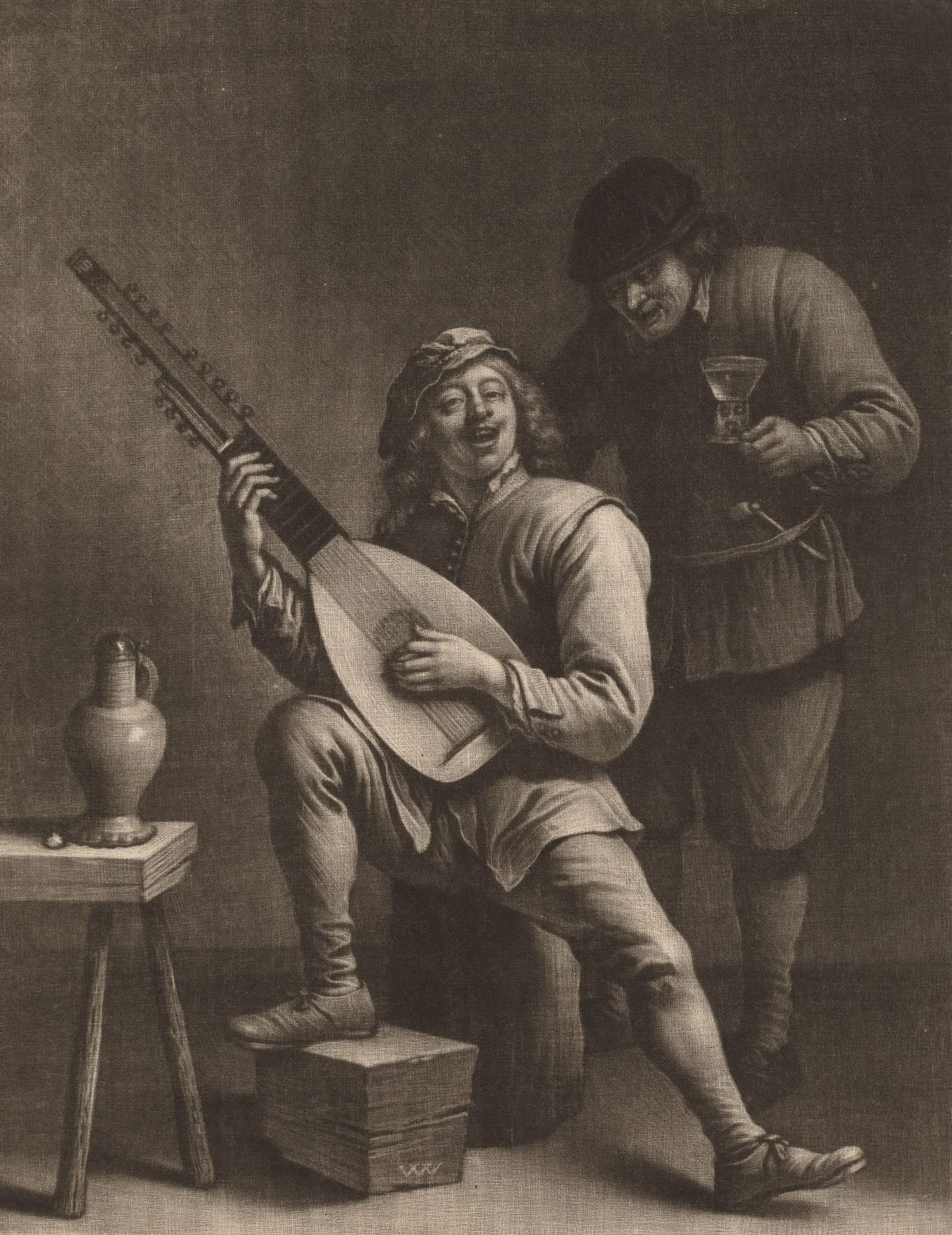
17세기 플랑드르 바로크 풍속화의 거장 소 다비드 테니어르스(David Teniers le Jeune, 1610–1690)의 원작 회화를 바탕으로, 플랑드르 출신의 판화가 발라랑 바이얀(Wallerant Vaillant, 1623–1677)이 17세기 중후반에 제작한 기념비적 메조틴트 판화 명작 류트 연주자와 술을 마시는 사내(The Lute Player and the Drinker, 또는 류트 연주자와 서 있는 사내, 공식 소장품 등록번호: 1946.21.175)는 27.5 cm × 31 cm 크기의 종이 위에 인쇄된 세밀한 흑백 톤의 판화 예술 최고 걸작입니다.
로젠월드 컬렉션(Rosenwald Collection)의 유서 깊은 기증을 통해 현재 미국 워싱턴 D.C.의 국립미술관(National Gallery of Art, Washington, D.C.)에 영구 소장되어 보존되어 오고 있습니다.
메조틴트 기법의 개척과 선술집 음악 문화를 향한 화가의 고뇌
17세기 중후반 판화가 발라랑 바이얀은 새로 개발된 흑백의 명암 표현 기법인 메조틴트(Mezzotint)를 활용하여 테니어르스의 생동감 넘치는 선술집 풍속화를 대중에게 널리 알리고자 깊이 몰두했습니다.
화가는 단순한 복제를 넘어, 류트를 품에 안고 환하게 노래를 부르는 연주자의 유쾌한 표정과 그 뒤에서 로머(Roemer) 유리잔을 들고 흥을 돋우는 애주가의 모습을 벨벳처럼 부드러운 흑백의 명암 대비 속에 어떻게 담아낼지 치열하게 번민했습니다.
국립미술관(National Gallery of Art)의 공식 소장 도록에 따르면, 이 판화 작품은 테니어르스가 포착한 17세기 플랑드르 선술집의 음악적 활기와 서민들의 해학적 일상을 바이얀의 독보적인 스크레이퍼 및 로커 기법으로 완벽하게 재해석한 대표적인 인물 풍속 판화로 분석됩니다.
화가는 어두운 실내 공간 속에서, 나무 의자에 걸터앉아 류트를 튕기는 사내와 그의 뒤편에서 술잔을 치켜든 동반자의 정겨운 순간을 화폭에 담았습니다.
화면 중앙에는 펠트 모자를 눌러쓰고 다리를 나란히 꼬은 채 긴 목의 류트를 품에 안고 노래하는 연주자가 자리하고 있으며, 그의 발아래에는 책무더기 위에 놓인 작은 항아리가 정교한 정물처럼 배치되어 있습니다.
연주자의 바로 뒤 어둠 속에서는 짙은 모직 옷을 입은 사내가 펠트 모자를 쓰고 키 높은 유리잔을 손에 든 채 미소 지으며 흥에 겨워하고 있습니다.
배경의 텅 빈 어둠과 빛을 받는 인물들의 입체적인 윤곽은, 고단한 일상 속에서 음악과 술을 통해 시름을 잊는 서민들의 소박한 유희와 따뜻한 유대를 손에 잡힐 듯 생생하게 웅변합니다.
노래하는 류트 연주자에서 술잔을 든 사내와 정교한 정물로, 시선의 심리적 여정
그림을 마주하는 순간 관람객의 무의식적 시선은 화면 중앙에서 부드러운 빛을 받아 환하게 드러나는 류트 연주자의 젖혀진 고개와 함박웃음을 짓는 입모양으로 가장 먼저 빨려 들어갑니다.
악기를 연주하며 노래에 깊이 취한 연주자의 유쾌한 표정은 보는 이에게 깊은 시각적 몰입감과 함께 선술집의 흥겨운 악대 소리를 전해줍니다.
이어 시선은 연주자의 손가락이 닿는 류트의 현과 교차하는 다리, 그리고 그의 발치 아래 책을 쌓아 올린 받침대 위에 놓인 둥근 항아리의 정교한 질감으로 이동합니다.
악기의 선율과 아늑한 실내 소품들의 세밀한 묘사를 확인하는 순간, 관람객은 쌉싸름한 맥주 향과 류트 현의 울림이 감도는 17세기 플랑드르 선술집 한구석 속으로 온몸이 빨려 들어가게 됩니다.
마지막으로 시선은 연주자의 어깨 뒤 어둠 속에서 술잔을 흔들며 미소 짓는 사내의 듬직한 실루엣을 거쳐, 화면 전체를 부드럽게 감싸 안는 메조틴트 특유의 벨벳 같은 흑백 톤과 은은한 대기감에 멈춥니다.
전면 인물들의 생생한 교감과 후면 짙은 어둠이 빚어내는 완벽한 명암의 조화를 마주하며, 관람객은 원작의 회화적 감동을 판화의 정교함으로 승화시킨 거장들의 예술적 깊이를 가슴 깊이 마주하게 됩니다.
17세기 북유럽 풍속 판화의 정점과 조형미, 미술계의 평가
미술계와 국립미술관 공식 도록은 류트 연주자와 술을 마시는 사내를 테니어르스의 해학적 인물 구성력과 바이얀의 혁신적인 메조틴트 기법이 가장 완벽한 조화로 결합된 대표적인 최고봉 판화 마스터피스로 평가합니다.
단순한 원작 복제를 넘어 흑과 백의 무수한 미색 조율을 통해 인물의 피부 질감, 의복의 주름, 유리잔의 투명한 반사광, 악기의 목재 결을 극도로 섬세한 판화 예술로 구현해 냈기 때문입니다.
음악과 술이 주는 삶의 위안을 가장 격조 높은 시각 예술로 승화시킨 이 걸작 판화는, 오늘날까지도 전 세계 수많은 감상자들에게 깊은 감탄과 잊을 수 없는 시각적 여운을 전해주는 불멸의 명작으로 손꼽히고 있습니다.
The Lute Player and the Drinker
Created in the latter half of the 17th century by the celebrated Flemish printmaker Wallerant Vaillant (1623–1677) after an original painting by the master of Flemish Baroque genre David Teniers the Younger (1610–1690), The Lute Player and the Drinker (also titled Lute-Player and a Standing Man, Accession No. 1946.21.175) is a magnificent mezzotint print on paper measuring 27.5 cm × 31 cm (10 13/16 in × 12 3/16 in).
Acquired through the esteemed Rosenwald Collection, it is preserved today in the distinguished permanent collection of the National Gallery of Art in Washington, D.C., United States.
The Innovation of Mezzotint and Tavern Music Culture
During the mid-to-late 17th century, printmaker Wallerant Vaillant advanced the newly developed tonal printmaking technique of mezzotint, seeking to translate the vibrant peasant genre scenes of David Teniers the Younger into rich, velvety monochromatic prints.
Moving beyond mere linear copying, the master printmaker meditated deeply on how to render the joyful expression of a lute player singing aloud alongside a companion holding a tall Roemer glass, achieving deep atmospheric gradients through controlled burr scraping.
According to curatorial records in the National Gallery of Art collection catalogue, this mezzotint masterpiece successfully captures the musical conviviality and rustic humor characteristic of Teniers's interior tavern subjects through Vaillant's exquisite mastery of shadow and light.
Vaillant staged the intimate scene within the dim interior of a Flemish alehouse.
In the center, a musician wearing a soft cap and a doublet sits upon a low stool, crossing his legs as he strums a long-necked lute and sings with an open mouth, positioned beside a simple wooden bench serving as an impromptu table.
Just behind him in the shadows, a standing companion wearing a dark cap holds a sparkling glass of wine, smiling warmly at the musical performance.
The deep, rich darks of the background and the luminous highlights upon the figures celebrate the simple comforts, camaraderie, and musical spirit of 17th-century rural life.
Subconscious Trajectory of the Gaze: From the Singing Lute Player to the Standing Drinker and Still-Life Elements
The observer's subconscious gaze is immediately magnetized by the central register, drawn to the luminous face of the lute player looking upward with an open, joyful expression as he strums his instrument.
His engaging posture, animated features, and the organic curves of the lute establish an instant focal point of auditory warmth, theatrical charm, and narrative focus.
The visual path then shifts downward toward his booted foot resting upon a stack of books and a small ceramic jug standing upon the rustic stool in the lower-left foreground.
Taking in the tactile qualities of the paper pages, wooden instrument, and earthen vessel, the viewer directly experiences the quiet, sensory atmosphere of a 17th-century tavern gathering.
Finally, the visual trajectory moves toward the standing companion holding the wine glass in the shadows, before sweeping across the velvety dark tones that unify the entire composition.
Observing the harmonious equilibrium between tonal richness, figural expression, and precise printmaking craftsmanship, the spectator perceives the timeless poetry of everyday leisure and the profound aesthetic brilliance embedded within the sheet.
The Monument of 17th-Century Printmaking: Critical Legacy
Art historians revere the National Gallery Lute Player and the Drinker as an exceptional achievement in seventeenth-century reproductive printmaking, illustrating the consummate ability of Wallerant Vaillant to translate Teniers's painted brushwork into rich mezzotint gradations.
By orchestrating delicate textural contrasts between soft felt fabric, gleaming glass highlights, wooden instrument bodies, and deep shadowy recesses within a unified tonal field, Vaillant transformed a rustic genre painting into an exquisite aesthetic treatise on light and human joy.
This precious historical print endures as an inspiring testament to the master printmaker's creative fortitude, celebrating the quiet poetry of everyday existence and the transformative grace of living art.
본 컨텐트의 저작권은 팔렛트제주에 있습니다. 허가없는 무단전제를 금지합니다.
Copyright © Palette Jeju. All rights reserved. Unauthorized reproduction or redistribution is strictly prohibited.