루브시엔의 겨울 밤나무 숲 - Chestnut Trees in Winter, Louveciennes
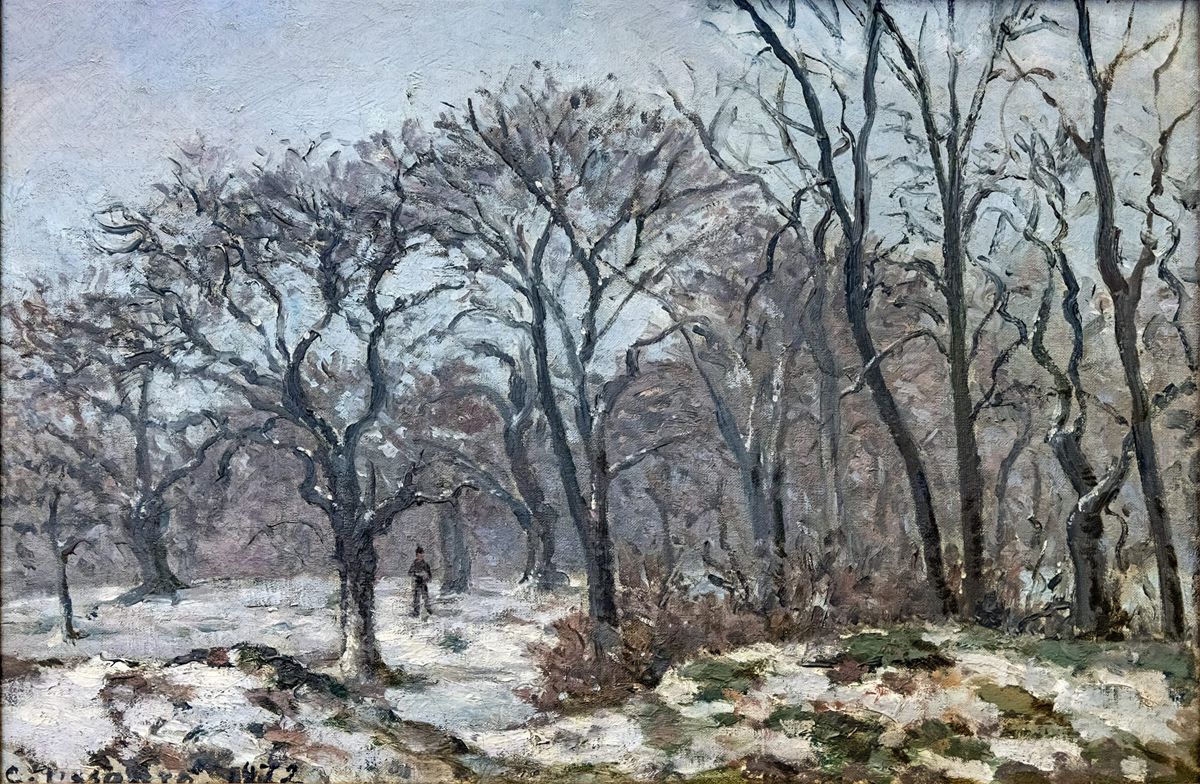
프랑스 인상주의의 위대한 스승이자 온화한 중심점이었던 카미유 피사로(Camille Pissarro)가 1872년에 완성한 '루브시엔의 겨울 밤나무 숲(Bois de châtaigniers en hiver, Louveciennes)'은 캔버스에 유채(Oil on canvas)로 제작된 수작입니다. 가로 40.4cm, 세로 27cm 크기의 아담한 캔버스에 담긴 이 작품은 현재 프랑스 툴루즈의 벰베르크 재단 미술관(Fondation Bemberg)에 소장되어 있습니다.
이 그림은 1870년 프로이센-프랑스 전쟁의 참화를 겪고 돌아온 직후 피사로의 붓끝에서 탄생한 특별한 사연을 품고 있습니다. 전쟁 발발 당시 피사로는 전란을 피해 루브시엔의 집을 버리고 런던으로 황급히 망명해야 했는데, 그가 자리를 비운 사이 주둔군 병사들이 그의 집과 아틀리에를 짓밟고 마당의 진흙탕에 수백 점의 캔버스를 깔아 훼손하는 비극을 겪었습니다. 젊은 시절 피땀 흘려 쌓아 올린 20여 년간의 초기 걸작 1,500여 점 중 무려 40여 점만을 제외한 대부분이 잿더미와 진흙 속으로 사라진 것입니다.
전쟁이 끝난 뒤 폐허가 된 집으로 돌아온 40대의 피사로는 절망에 주저앉는 대신, 묵묵히 이젤을 챙겨 들고 잎을 떨군 앙상한 겨울 숲으로 향했습니다. 그는 캔버스를 잃었을지언정 눈앞에 살아 숨 쉬는 빛과 대지의 영혼은 빼앗기지 않았음을 증명하듯, 나이프와 붓으로 물감을 두껍게 얹는 임파스토 기법을 구사하며 차가운 겨울 숲의 생명력을 생생하게 기록해 나갔습니다. 훗날 미술사학자들은 이 시기 피사로의 풍경화를 두고 크나큰 상실의 비극을 딛고 자연에 대한 깊은 경외와 예술적 부활을 선언한 가장 진솔하고 강인한 서정시로 평가하고 있습니다.
작품을 마주할 때 우리의 시선은 전면에 거칠고 두텁게 칠해진 눈과 흙이 뒤섞인 비탈길을 딛고, 화면 중앙에서 묵묵히 걸어오는 작은 인물에게 가장 먼저 가닿습니다. 인물의 존재를 확인한 시선은 이내 하늘을 향해 힘차게 뻗어나간 밤나무들의 굽이치는 나뭇가지 사이로 부드럽게 상승하며, 회청색의 겨울 하늘과 잎새 없는 가지들이 엮어내는 섬세한 선의 율동을 감상하게 됩니다.
이어 울창한 숲의 깊은 안쪽으로 시선이 이동하면서 차가운 눈밭과 마른 풀숲의 흙빛이 만들어내는 미묘한 음영의 층위를 차분히 탐색하게 됩니다. 이러한 시각적 여정은 관람자의 무의식 속에 고요한 침묵과 깊은 정서적 정화를 일으킵니다.
잎을 모두 비워낸 겨울나무들이 뿜어내는 묵직한 구조감과 대지의 질감은 복잡한 일상에 지친 뇌파를 차분하게 가라앉히고 내면의 불안을 흡수합니다. 눈 덮인 혹독한 계절 속에서도 묵묵히 자신의 자리를 지키며 다가올 봄을 품고 있는 대지의 호흡은, 바라보는 이의 무의식 속에 어떤 시련도 지나간다는 회복과 치유의 깊은 위로를 선사합니다.
Chestnut Trees in Winter, Louveciennes - Bois de châtaigniers en hiver, Louveciennes
Painted in 1872 by Camille Pissarro, the revered mentor and foundational anchor of French Impressionism, Chestnut Trees in Winter, Louveciennes (Bois de châtaigniers en hiver, Louveciennes) is an oil on canvas masterwork measuring 27 by 40.4 cm. This intimate yet powerful composition is permanently preserved in the prestigious Fondation Bemberg in Toulouse, France.
Behind this winter landscape lies a poignant story of profound artistic tragedy and unbreakable human resilience. During the outbreak of the Franco-Prussian War in 1870, Pissarro was forced to abandon his home in Louveciennes and flee into exile in London. Upon returning after the war, he was heartbroken to discover that occupying troops had ransacked his studio, using hundreds of his early canvases as doormats and mud covers in the yard. Out of nearly twenty years of dedicated labor and around 1,500 works, barely forty paintings survived the destruction.
Instead of yielding to despair, the forty-year-old master picked up his easel and walked directly into the barren winter woods. Determined to prove that no war could take away his vision and connection with nature, he applied thick, tactile strokes of oil with a palette knife and brush, capturing the honest chill and underlying warmth of the French soil. Modern art historians look back on these Post-War Louveciennes landscapes as an extraordinary testimony of rebirth, praising them as deeply moving odes to endurance, humility, and the quiet dignity of the earth.
Upon engaging with the canvas, the viewer's gaze instinctively lands on the solitary figure walking steadily through the path, anchored against the textured patches of melting snow and raw earth in the foreground. From this quiet human presence, our sight rises naturally along the twisted, muscular branches of the chestnut trees that weave an intricate silhouette against the pale, misty winter sky.
The eye then wanders smoothly into the quiet depths of the thicket, tracing the subtle harmony between cool slate blues, mossy greens, and rich woodland browns. This rhythmic visual path instills a profound sense of inner calm and emotional purification within the subconscious.
The uncluttered honesty of bare trees and grounded earth helps soothe mental noise, absorbing stress and inviting contemplative tranquility. Seeing nature stand resilient amid the winter cold subconsciously reassures the observer that all hardship is temporary, offering a grounded sense of patience, renewal, and quiet emotional comfort.
본 리뷰에서 작품을 제외한 컨텐츠의 저작권은 팔렛트제주에 있습니다.
"퍼블릭도메인 고전명화"를 제외한 모든 창작 콘텐츠는 저작권법 제4조 및 제10조에 의거하여 보호됩니다. 무단 도용시 저작권법 제136조(벌칙)에 의거, 당사의 사전 서면 승인 없는 저작권 침해 행위를 금지합니다.