루브시엔의 길 (La Route de Louveciennes, 1870)
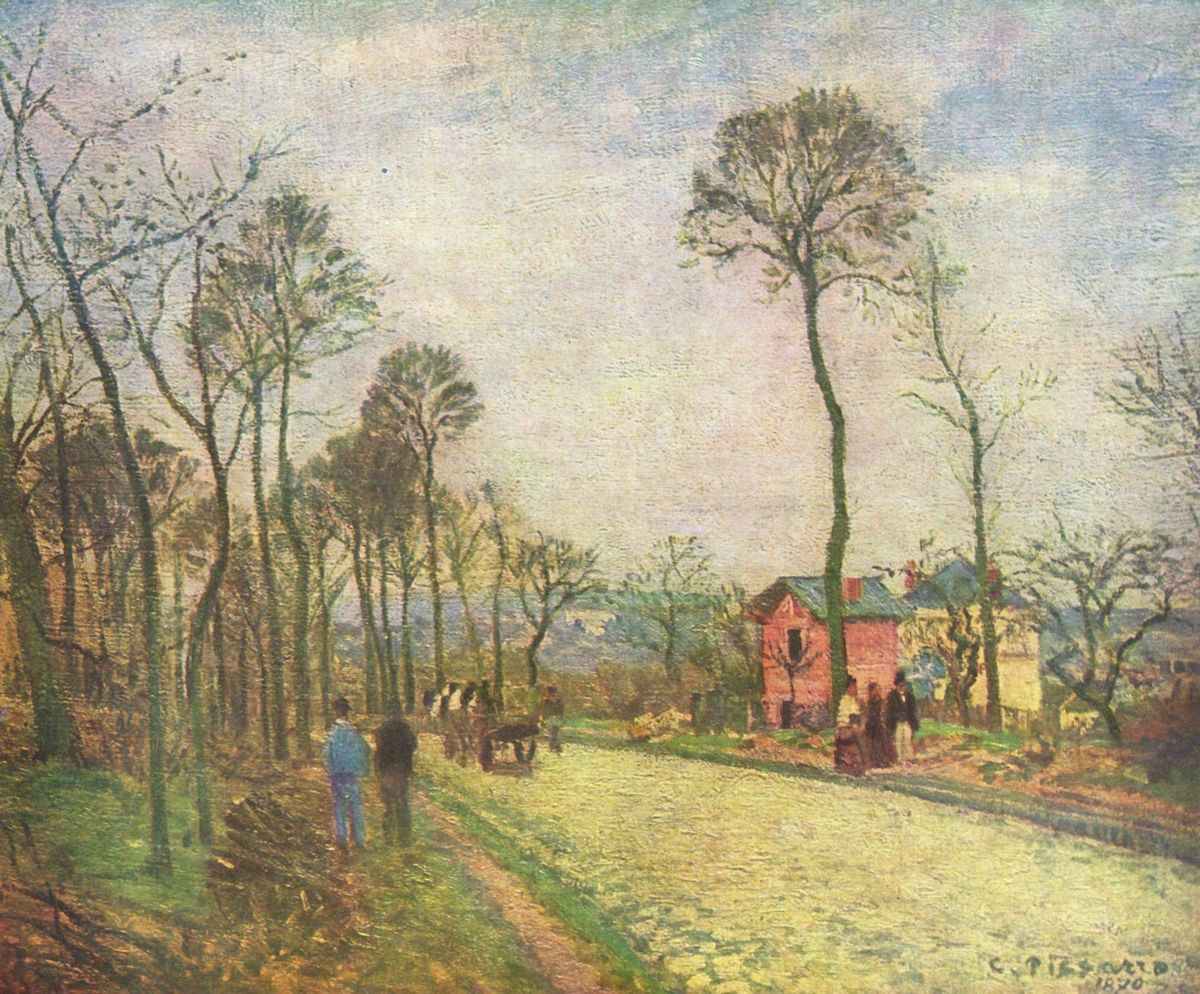
1870년 보불전쟁이 발발하기 직전, 파리 근교 루브시엔에 머물던 카미유 피사로는 햇살이 비추는 시골길과 가로수의 리듬 속에서 일상을 살아가는 평범한 사람들의 발걸음을 화폭에 담았습니다. 전쟁의 포화로 루브시엔 작업실에 남겨두었던 수많은 초기작들이 파괴되는 비극 속에서도 온전히 보존되어 현재 파리 오르세 미술관에 소장된 이 작품은, 가로 53.5cm, 세로 44cm 크기의 캔버스에 유채로 완성된 초기 인상주의의 대표적인 명작입니다. 피사로는 당대의 전형적인 풍경화 공식을 탈피하여, 자연스러운 원근감과 정직한 야외 광선으로 시골길의 고즈넉한 정취를 탁월하게 포착했습니다.
관람자의 시각 인지 체계는 화면 좌측 하단의 흙길 가장자리에서 푸른 옷을 입고 걸어가는 남성과 그 곁의 어두운 인물 실루엣에 가장 먼저 닻을 내립니다. 주변의 연둣빛 풀밭과 인물이 자아내는 명도 대비는 시각 피질의 중심와를 즉각 포획하며 시각적 탐색의 편안한 시작점을 형성합니다.
이어서 시선은 밝은 햇살을 받아 환하게 빛나는 자갈길의 완만한 대각선 축을 따라 화면 우측 중경의 분홍빛과 노란빛 시골 가옥들, 그리고 그 곁에 서서 대화를 나누는 마을 사람들의 점경으로 자연스러운 도약 안구 운동을 진행합니다.
가옥 뒤로 우뚝 솟아오른 키 큰 포플러 나무의 우아한 수직선을 타고 올라가 좌측 가로수들의 섬세한 나뭇가지 리듬과 은은한 은백색 하늘을 훑은 뒤, 길 저 멀리 아스라하게 사라지는 마차의 소실점으로 이어지는 시선의 흐름은 2차원 평면을 호흡하는 3차원 공간으로 시원하게 확장합니다.
화면 전체에 부드럽게 흩뿌려진 햇살의 온기와 나무들의 맑은 그림자가 망막 위에서 하나의 평화로운 광경으로 통합되는 순간, 관조자는 번잡한 일상의 긴장을 내려놓고 따스한 봄날의 시골길을 느긋하게 산책하는 듯한 깊은 심리적 안도감과 내면의 평온을 체험하게 됩니다.
이 그림을 그릴 당시 피사로는 클로드 모네와 함께 야외 현장에서 빛과 그림자의 상호작용을 연구하며 화폭 위에 색채의 순도를 높이는 새로운 기법을 끊임없이 실험하고 있었습니다. 그는 길가에 드리운 그림자를 검은색으로 칠하는 고전적인 방식을 과감히 버리고, 주변 풀밭과 하늘의 푸른빛을 머금은 다채로운 색조로 표현하여 햇살의 생생한 반사광을 구현했습니다.
동시대의 동료 예술가들과 진보적 비평가들은 인위적인 극적 연출 없이 평범한 길목에서 대지의 진솔한 아름다움을 길어 올린 피사로의 작업 태도를 두고 "자연과 인간의 호흡을 가장 정직하고 따뜻하게 기록한 붓"이라며 높은 평가를 보냈습니다.
평범한 시골 마을의 길목에 깃든 빛의 미세한 떨림과 인간 삶의 온기를 균형 잡힌 조형미로 완성해 낸 피사로의 루브시엔 풍경화는, 현대 미술사에서 인상주의가 감각적 빛의 탐구를 넘어 대지에 대한 깊은 애정으로 완성된 역사적 수작으로 확고하게 자리매김하고 있습니다.
The Road to Louveciennes (La Route de Louveciennes, 1870)
Just before the upheaval of the Franco-Prussian War in 1870, Camille Pissarro documented the serene atmosphere of Louveciennes, capturing the quiet cadence of villagers traveling along a sunlit country road. Miraculously preserved while nearly fifteen hundred of his early canvases were destroyed during the wartime occupation, this masterpiece, measuring 44 by 53.5 cm and preserved in the Musée d'Orsay, stands as a quintessential monument of early Impressionism, blending rigorous geometric balance with the fresh truth of direct natural light.
The observer’s perceptual framework instantly anchors upon the gentle figure in blue walking along the lower-left verge accompanied by his companion. This subtle human focal point stimulates the fovea against the fresh green grass, establishing an intuitive foundation for spatial navigation.
From this leftward anchor, the ocular trajectory tracks the luminous diagonal expanse of the cobblestone road, sweeping toward the warm rose and ochre facades of the village cottages and the conversational clusters of townspeople in the right midground.
Ascending along the slender, elegant silhouette of the solitary roadside tree, the gaze moves across the delicate branches of the left-hand grove before tracing the vast, pearlescent sky down toward the horse-drawn cart receding into the distant vanishing point, synthesizing these layered planes into an expansive three-dimensional sanctuary.
As the ambient warmth of the sun and the rhythmic dappled shadows integrate into a cohesive visual harmony within the visual cortex, active visual scanning dissolves into profound contemplative stillness, attuned to the timeless peace of the rural landscape.
During this fertile period, Pissarro worked in close artistic camaraderie with Claude Monet, pioneering the method of rendering cast shadows through luminous, chromatic tones rather than dead academic blacks.
By capturing the living vibrations of light upon damp earth and stone without artificial melodrama, the master established a standard of atmospheric realism that deeply impressed peers like Paul Cézanne and Édouard Manet.
Progressive critics universally lauded Pissarro’s unpretentious vision, celebrating his exceptional gift for discovering monumental poetry and quiet nobility within the unadorned corridors of everyday life.
Masterfully harmonizing linear clarity with delicate atmospheric warmth, Pissarro's view of the road to Louveciennes remains celebrated across art history as an enduring foundation of modern landscape art.
본 콘텐츠의 저작권은 저작권자에게 있으며, 무단 전재 및 재배포를 금합니다.