루브시엔의 대화 - The Conversation, Louveciennes
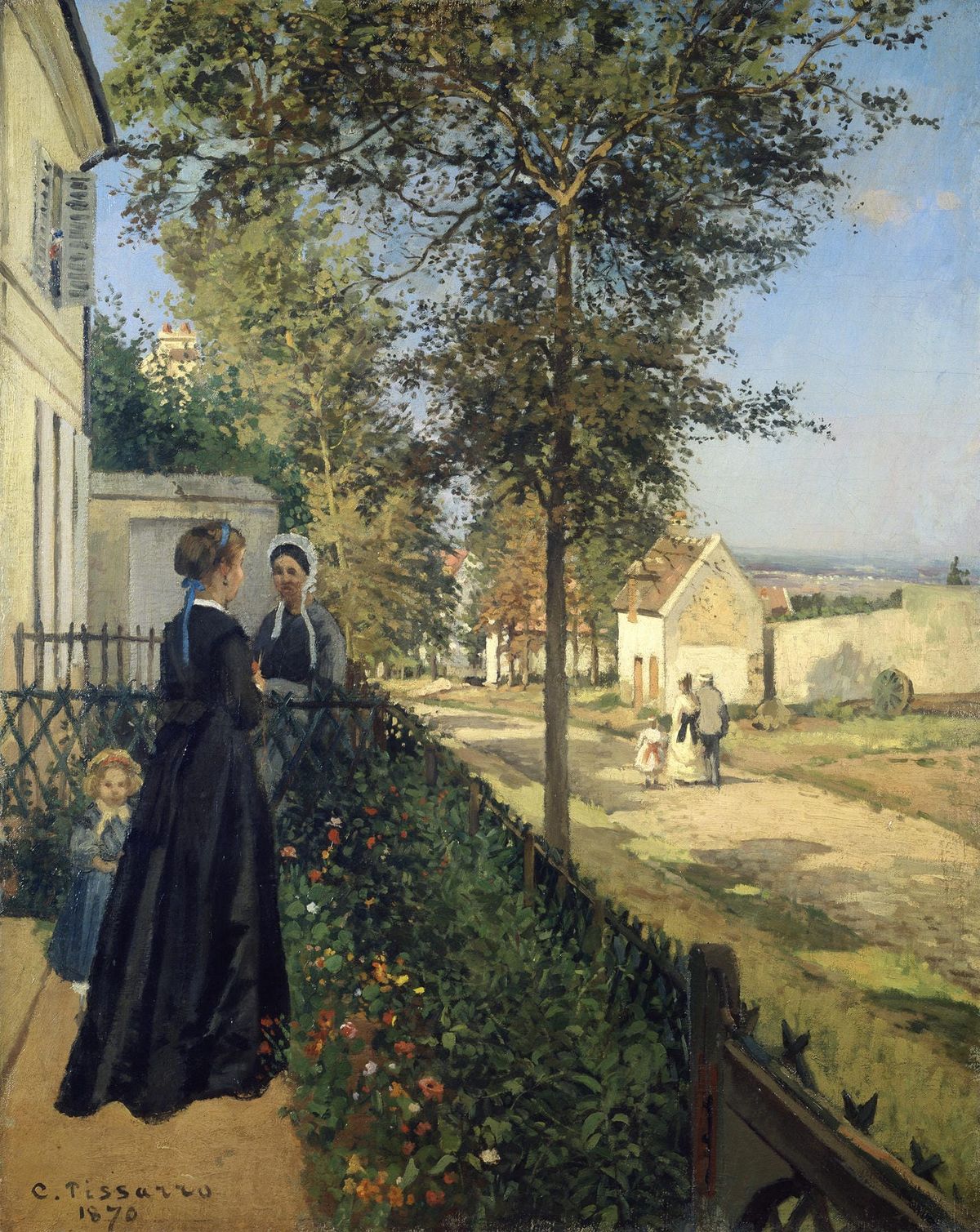
프랑스 인상주의의 든든한 스승이자 다정한 관찰자였던 카미유 피사로(Camille Pissarro)가 1870년에 완성한 '루브시엔의 대화(La Conversation, Louveciennes)'는 캔버스에 유채(Oil on canvas)로 제작된 초기 인상주의의 귀중한 걸작입니다. 가로 74cm, 세로 100.5cm 크기의 이 작품은 현재 스위스 취리히 미술관(Kunsthaus Zürich)의 에밀 뷔를레 컬렉션(Emil Bührle Collection)에 소장되어 있습니다.
이 그림에는 프로이센-프랑스 전쟁의 전화가 닥치기 직전, 피사로 가족이 누렸던 평화롭고 찬란했던 마지막 여름날의 감동적인 비하인드 스토리가 담겨 있습니다. 작품 전면에서 푸른 리본을 매고 검은 드레스를 입은 여인은 피사로의 헌신적인 아내 줄리 벨레(Julie Vellay)이며, 그 곁에서 수줍게 관람자를 바라보는 금발의 어린아이는 훗날 화가가 되는 장남 뤼시앵 피사로(Lucien Pissarro)입니다. 피사로는 자신이 사랑하는 가족과 이웃이 울타리 너머로 정답게 이야기를 나누는 소박한 일상의 순간을 눈부신 프랑스 근교의 햇살 속에 영원히 포착했습니다.
그러나 이 평화는 오래가지 못했습니다. 그림이 완성된 1870년 여름 전쟁이 터지자 피사로 일가는 모든 살림과 그림들을 남겨둔 채 런던으로 급히 피난을 떠나야 했습니다. 그가 자리를 비운 사이 주둔군 병사들이 루브시엔의 집을 점령해 그의 초기 캔버스 수백 점을 정원의 진흙 발판이나 땔감으로 써버리는 참극이 벌어졌습니다. 이로 인해 피사로의 초기작 대부분이 영원히 소실되었으나, 기적적으로 살아남은 몇 안 되는 이 작품은 피사로의 초기 예술혼과 가족애를 온전히 증명하는 대체 불가능한 보물이 되었습니다. 훗날 미술사학자들은 이 작품을 두고 엄격한 원근법 구도 위에 인상주의 특유의 생생한 빛과 대기의 호흡을 완벽하게 녹여낸 걸작이자, 다가올 비극 직전의 순수한 일상을 담아낸 가장 애틋한 서정시로 평가합니다.
작품을 마주할 때 우리의 시선은 좌측 전면에 단정하고 우아하게 서 있는 푸른 리본의 여인과 꽃밭 뒤에서 빼꼼히 얼굴을 내민 어린아이의 순진한 눈망울에 먼저 머뭅니다. 정겨운 모자의 모습과 울타리 너머 이웃 여인의 온화한 표정을 확인한 시선은, 집 앞 화단에 알록달록 피어난 꽃들의 화사한 색채를 따라 기분 좋게 미끄러집니다.
이어 화면 중앙을 시원하게 가로지르는 흙길의 원근감을 타고 시선이 깊숙이 들어가며, 따사로운 햇살을 받으며 다정하게 걸어가는 가족의 뒷모습과 저 멀리 아스라이 펼쳐진 푸른 계곡의 수평선으로 확장됩니다. 마지막으로 하늘 높이 솟아올라 푸른 창공을 수놓는 나무 잎사귀들의 산들거리는 붓 터치를 올려다보며 화면 전체의 맑고 쾌적한 공기를 만끽하게 됩니다.
이러한 시각적 흐름은 관람자의 무의식 속에 깊은 정서적 안정과 평온한 안도감을 채워줍니다. 정갈한 울타리가 주는 심리적 보호감과 탁 트인 시골길의 개방감이 완벽한 균형을 이루며 일상의 불안과 피로를 부드럽게 씻어내 줍니다. 따뜻한 햇살 아래 이웃과 나누는 소박한 대화, 가족의 따스한 체온이 깃든 풍경은 바라보는 이의 무의식 깊은 곳에 잃어버린 평화에 대한 그리움과 함께 살아갈 용기를 북돋워 주는 정서적 위로를 선물합니다.
The Conversation, Louveciennes - La Conversation, Louveciennes
Painted in 1870 by Camille Pissarro, the revered mentor and compassionate soul of French Impressionism, The Conversation, Louveciennes (La Conversation, Louveciennes) is an early oil on canvas masterpiece measuring 100.5 by 74 cm. This radiant and historical composition is permanently preserved in the Emil Bührle Collection at the Kunsthaus Zürich in Switzerland.
Beneath the idyllic surface lies a poignant domestic narrative set against the brink of historical tragedy. The elegant figure standing in the left foreground with a bright blue hair ribbon is Pissarro's devoted wife, Julie Vellay, while the charming blonde child peering from behind the blossoming fence is their eldest son, Lucien Pissarro, who would later become a celebrated artist himself. Pissarro captured this fleeting, intimate scene of his wife casually chatting with a neighbor over the garden fence during the luminous summer days in Louveciennes.
Tragically, this pastoral bliss was abruptly shattered when the Franco-Prussian War erupted later that year. The family fled in haste to London, forced to abandon their home and studio. Occupying troops ransacked the property, brutally using hundreds of Pissarro's precious early canvases as mud covers in the garden and firewood. While most of his formative life's work was reduced to ashes, this rare surviving masterpiece miraculously escaped destruction. Today, art historians revere it as a priceless milestone where classic spatial perspective seamlessly harmonizes with the vibrant, atmospheric light of burgeoning Impressionism.
Upon viewing the canvas, the spectator's gaze instinctively alights on the dark, stately profile of the woman with the blue ribbon and the shy, luminous face of the child nestled among the foliage. After absorbing this tender familial presence, the eye glides softly across the colorful dabs of flowers blooming along the garden border.
The gaze then travels effortlessly down the sunlit rural road, receding toward the strolling couple in the middle ground and expanding outward into the vast, hazy expanse of the distant river valley. Finally, our attention rises into the delicate, airy canopy of the tall central tree dancing against the pale blue sky, embracing the refreshing clarity of the open air.
This visual journey evokes a profound sense of psychological security and serene reassurance within the subconscious. The comforting structure of the garden fence combined with the expansive horizon gently alleviates mental fatigue, creating a harmonious sanctuary in the mind. Observing this peaceful communion of neighborly warmth and radiant summer sunshine nurtures the soul with timeless comfort, familial love, and enduring pastoral peace.
본 리뷰에서 작품을 제외한 컨텐츠의 저작권은 팔렛트제주에 있습니다.
"퍼블릭도메인 고전명화"를 제외한 모든 창작 콘텐츠는 저작권법 제4조 및 제10조에 의거하여 보호됩니다. 무단 도용시 저작권법 제136조(벌칙)에 의거, 당사의 사전 서면 승인 없는 저작권 침해 행위를 금지합니다.