루브시엔 풍경 (View from Louveciennes, 1869–1870)
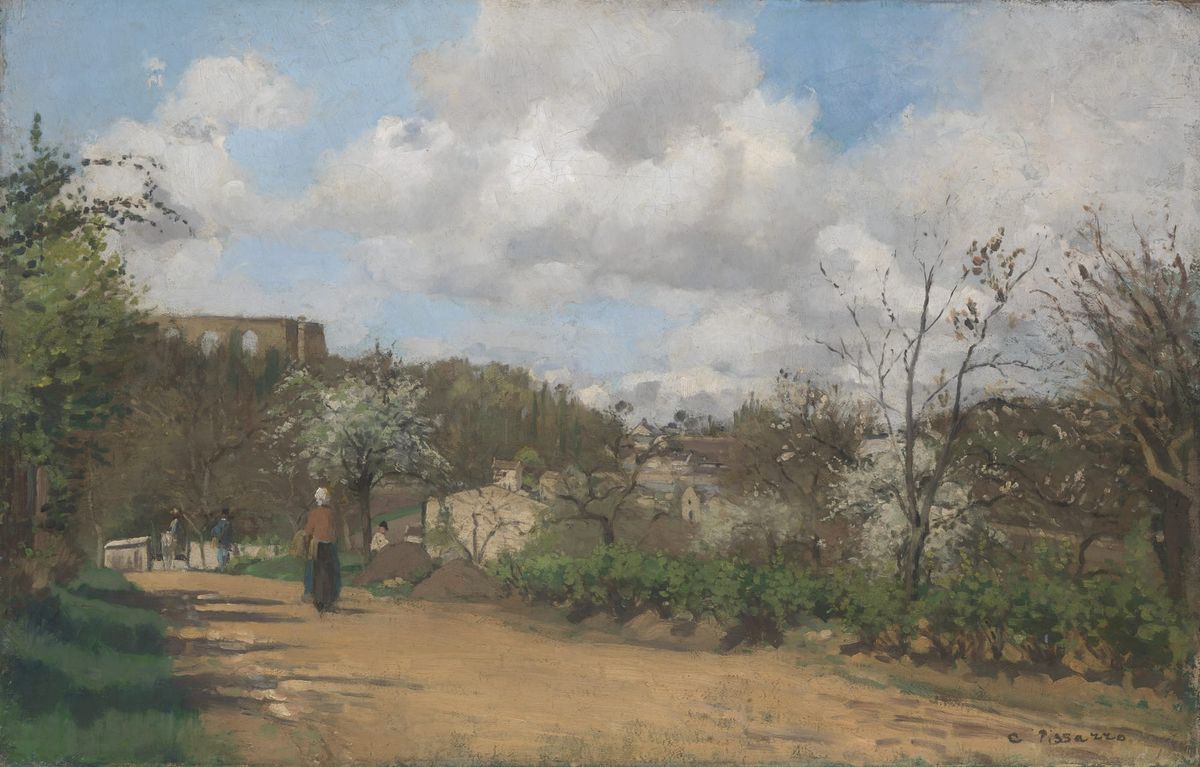
1869년 봄 파리 근교 루브시엔으로 거처를 옮긴 카미유 피사로는 클로드 모네, 오귀스트 르누아르와 긴밀하게 교류하며 찰나의 자연광을 야외에서 포착하는 회화적 실험에 몰두했습니다. 화면 좌측 원경에는 루이 14세 시절 베르사유 궁전에 물을 공급하기 위해 세워진 웅장한 마를리 수도교가 아스라이 자리 잡고 있지만, 피사로는 거대한 역사적 기념비보다 흙길을 오가는 평범한 마을 사람들과 봄을 맞아 하얗게 피어난 과수원 꽃나무의 생명력에 시선을 두었습니다. 가로 82cm, 세로 52.7cm 크기의 캔버스에 유채로 완성된 이 작품은 훗날 보불전쟁의 포화로 수많은 초기작이 소실되기 직전, 인상주의 여명기의 맑고 신선한 감각이 온전히 보존된 귀중한 걸작입니다.
관람자의 시지각 체계는 캔버스의 절반을 시원하게 채운 웅대한 뭉게구름과 푸른 하늘의 개방감에서 출발하여, 화면 좌측 흙길을 걸어가는 여인의 실루엣에 자연스럽게 닻을 내립니다. 여인의 붉은 상의와 짙은 치마가 이루는 색채 대비는 시각 피질의 중심와를 자극하며 명확한 조형적 구심점을 확립하고, 시선은 그녀의 완만한 발걸음을 따라 길 안쪽으로 부드럽게 미끄러집니다.
이어서 시선은 길가에 늘어선 녹색 덤불과 화사하게 흩뿌려진 흰 꽃나무의 섬세한 필치를 스치며, 나뭇가지 사이로 내려다보이는 마을 지붕들과 저 멀리 수도교로 이어지는 공간적 원근을 훑어 내려갑니다. 파편화된 색채의 점들이 대기 원근법을 통해 3차원의 실재감으로 통합되는 순간, 관람자는 번잡한 일상의 시각적 피로에서 벗어나 맑은 봄바람이 스치는 전원의 온화한 시공간으로 깊이 빠져드는 심리적 이완을 경험하게 됩니다.
루브시엔 시절 피사로는 인근 부지발에 살던 모네와 이젤을 나란히 펼쳐 두고 빛의 반사와 공기의 떨림을 탐구하며 초기 인상주의의 조형적 기틀을 함께 다졌습니다. 전통 아카데미의 인위적인 구도를 과감히 벗어나 자연의 솔직한 결을 있는 그대로 담아내고자 했던 그의 끈기 있는 탐구는 훗날 인상주의가 독자적인 예술 운동으로 확고히 자리 잡는 든든한 밑거름이 되었습니다.
거대한 역사적 유물마저 소박한 시골 풍경의 자연스러운 일부로 녹여낸 피사로의 균형 잡힌 조형 언어와 따스한 인간미는, 오늘날 현대 미술사에서 자연과 인간의 진솔한 교감을 보여준 가장 서정적이고 완성도 높은 초기 인상주의의 이정표로 확고한 평가를 받고 있습니다.
View from Louveciennes (View from Louveciennes, 1869–1870)
In the spring of 1869, Camille Pissarro moved to the serene village of Louveciennes, where he worked in close companionship with Claude Monet and Pierre-Auguste Renoir to pioneer plein air painting. While the massive 17th-century Aqueduct of Marly—built under Louis XIV to channel water to Versailles—looms quietly along the distant horizon on the left, Pissarro intentionally favored the humble pulse of rural life, celebrating walking villagers and blossoming fruit trees over monumental historical architecture. Measuring 52.7 by 82 cm, this exquisite oil on canvas stands as a rare surviving jewel from the dawn of Impressionism, painted just prior to the devastating Franco-Prussian War that destroyed much of his early oeuvre.
The observer’s perceptual framework is initially captured by the sweeping volume of sun-drenched cumulus clouds expanding across the upper atmosphere, before grounding itself upon the lone peasant woman traversing the rustic pathway on the lower left. The warm contrast of her earthy red bodice and deep blue skirt provides an intuitive ocular anchor, directing visual scanning smoothly along the gentle recession of the unpaved road.
From this focal juncture, the gaze traverses the textured impasto of roadside foliage and white spring blossoms, drifting toward the nestled village rooftops in the valley and the classical arches of the aqueduct beyond. As the visual cortex synthesizes these loose, energetic brushstrokes into a unified spatial reality, the viewer transitions from conscious observation into deep psychological repose, gently immersed in the crisp, sunlit tranquility of the French countryside.
During this fertile period in Louveciennes, Pissarro and Monet frequently painted identical vantage points in the surrounding landscape, mutually deciphering how sunlight dissolves contour into vibrating color. By discarding rigid academic formulas in pursuit of nature's authentic harmony, Pissarro laid the foundational aesthetic upon which the Impressionist revolution would triumphantly emerge.
Revered for integrating historic grandeur with the understated elegance of rural existence, Pissarro's masterwork remains celebrated across art history as a timeless testament to human scale, natural light, and the dawn of modern landscape painting.
본 콘텐츠의 저작권은 저작권자에게 있으며, 무단 전재 및 재배포를 금합니다.