폐쇄된 굴레 속에서 갈망한 자유의 출구, 교도소 안뜰 The Prison Courtyard
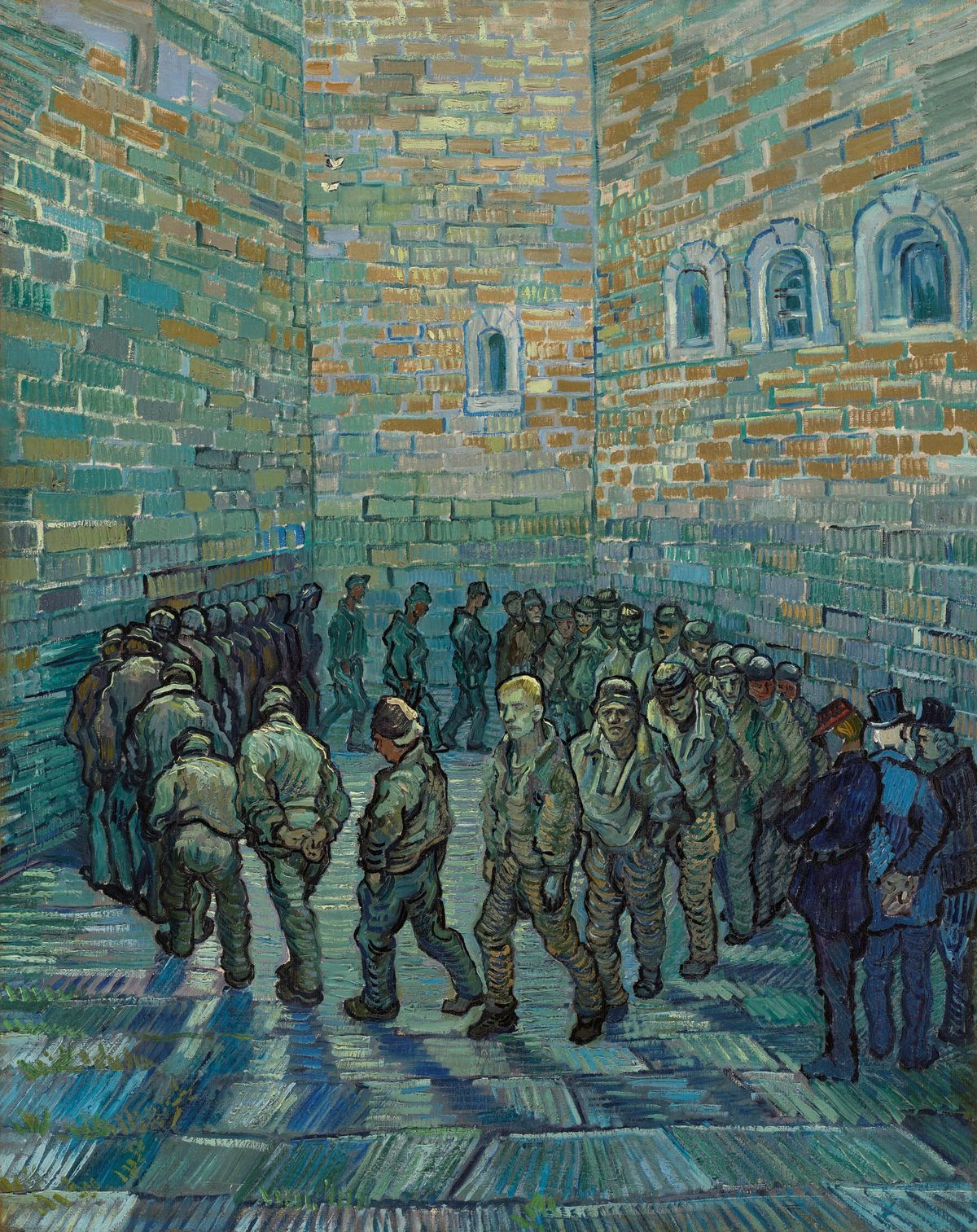
후기 인상주의의 거장 빈센트 반 고흐(Vincent van Gogh, 1853–1890)가 1890년 2월 프랑스 생레미의 생폴 드 모졸 정신병원에 머물 당시 완성한 유화 《교도소 안뜰(The Prison Courtyard, 또는 원형 보행)》은 80.0 cm × 64.0 cm 크기의 캔버스에 담긴 작품으로, 현재 러시아 모스크바의 푸시킨 미술관(Pushkin State Museum of Fine Arts)에 영구 소장되어 있습니다.
단절과 억압의 공간에서 승화된 도레의 판화와 고흐의 자화상
1890년 초, 극심한 정신적 고통 속에서 생레미 요양원에 자진 입원 중이던 고흐는 야외 사생을 나갈 수 없는 답답한 현실 속에서 흑백 판화 복제본들을 유화로 재해석하는 작업에 몰두했습니다. 이 작품은 프랑스의 유명 삽화가 귀스타브 도레(Gustave Doré)의 목판화 《런던: 순례여행(London: A Pilgrimage)》에 수록된 영국 뉴게이트 교도소의 원형 운동 장면을 모티브로 삼아 탄생했습니다.
고흐는 차갑고 건조한 흑백 삽화에 특유의 청록색과 차가운 황토색을 덧입혀 생동감 넘치면서도 숨 막히는 고립의 분위기로 탈바꿈시켰습니다. 특히 끝없는 원을 그리며 무기력하게 걷고 있는 수감자들 가운데, 캔버스 정면을 향해 모자를 벗은 채 유일하게 얼굴을 드러낸 금발의 남성은 화가 자신의 모습을 은유적으로 투영한 것으로 널리 알려져 있습니다. 벽돌담 높은 곳에 그려진 두 마리의 나비는 닿을 수 없는 바깥세상과 영혼의 자유를 향한 고흐의 애절한 갈망을 상징하며, 폐쇄된 요양원 생활에 짓눌려 있던 그의 비극적 내면을 선명하게 웅변합니다.
무의식 속 시선이 갇히는 폐쇄 회로와 심리적 중압감
감상자의 무의식적인 시선은 캔버스 하단에서 원형을 그리며 행진하는 죄수들의 발걸음을 따라 시계 방향으로 회전하며 그림 속으로 진입합니다. 수감자들의 굽은 등과 무거운 발걸음이 만들어내는 반복적인 리듬은 보는 이로 하여금 빠져나갈 수 없는 궤도에 갇힌 듯한 시각적 답답함을 안겨줍니다. 그러다 정면을 응시하는 금발의 수감자와 마주하는 순간, 맴돌던 시선은 멈칫하며 깊은 내적 충격을 받게 됩니다.
이어 시선은 죄수들을 에워싸고 있는 거대한 육각형 벽돌 벽을 따라 화면 상단으로 수직 상승하지만, 높은 벽에 뚫린 좁은 아치형 창문들 역시 외부로의 탈출을 철저히 차단합니다. 결국 벽면에 작게 흩날리는 두 마리의 흰 나비에 시선이 닿으면서, 관람자는 의식하지 못하는 사이 폐쇄된 공간이 주는 극심한 억압감과 그 속에서 가냘프게 피어오르는 탈출에 대한 열망 사이의 심리적 긴장감을 고스란히 체감하게 됩니다.
번안을 넘어선 내면적 상징주의, 미술사적 성취
미술계는 이 작품을 단순한 원작 판화의 모사를 넘어, 대상의 도상을 빌려 화가 자신의 실존적 고뇌와 정신적 유폐 상태를 완벽하게 고백한 독창적인 상징주의 회화로 높이 평가합니다. 차가운 청록빛과 메마른 흙빛의 대비, 붓 터치 하나하나에 응축된 묵직한 마티에르는 인간의 근원적인 고독과 구속이라는 보편적 주제를 탁월하게 시각화했습니다. 도레의 사회 비판적 묘사를 한 인간의 절박한 영혼의 드라마로 변용해 낸 이 걸작은, 생레미 시기 반 고흐가 이룩한 심리적 표현주의의 정점으로 미술사에 확고히 자리 잡고 있습니다.
Yearning for Freedom Within an Endless Loop, The Prison Courtyard
Painted in February 1890 during his stay at the Saint-Paul de Mausole asylum in Saint-Rémy-de-Provence by Vincent van Gogh (1853–1890), The Prison Courtyard (also known as The Round of the Prisoners) is an oil on canvas measuring 80.0 cm × 64.0 cm (31.5 in × 25.2 in), preserved in the permanent collection of the Pushkin State Museum of Fine Arts in Moscow, Russia.
Beyond Gustave Doré’s Print: Confinement, Longing, and a Hidden Self-Portrait
In early 1890, while enduring voluntary confinement at the Saint-Rémy asylum and frequently barred from painting outdoors due to recurring mental crises, Van Gogh turned to translating black-and-white prints into rich chromatic compositions. This canvas draws directly from a wood engraving by the French illustrator Gustave Doré, originally executed for London: A Pilgrimage to depict the exercise yard at Newgate Prison.
Van Gogh transformed Doré's documentary image into an existential allegory by suffusing the monochromatic scene with luminous turquoise, slate blues, and muted ochres. Among the subdued prisoners trudging in a monotonous circle, the central bareheaded figure with blond hair is widely interpreted by art scholars as an emotional self-portrait. High above the crushing masonry walls, two delicate white butterflies flutter toward the light—a tender yet heartbreaking emblem of the elusive liberty and spiritual release for which the painter desperately yearned.
Psychological Trajectory of the Gaze and the Architecture of Confinement
The observer’s gaze is instinctively drawn into the lower foreground, pulled along the repetitive circular trajectory of the trudging convicts. The rhythmic cadence of hunched shoulders and heavy strides creates an inescapable vortex, instilling a profound subconscious sensation of entrapment. This visual loop is suddenly arrested when the gaze encounters the frontal face of the central prisoner, whose vulnerable expression establishes an intimate and melancholic dialogue with the viewer.
From this focal encounter, visual perception ascends along the dizzying vertical planes of the hexagonal brick enclosure, seeking an exit, only to find the narrow arched windows barred and impassive. When the eye finally registers the faint pair of white butterflies hovering near the top, the viewer subconsciously internalizes the stark emotional polarity between crushing terrestrial confinement and the fragile pursuit of transcendence.
Transforming Illustration into Existential Symbolism: Critical Significance
Modern art historians celebrate The Prison Courtyard not as a derivative copy, but as a monumental triumph of psychological Symbolism and Post-Impressionist emotional expression. By restructuring Doré's social commentary through a highly subjective palette and rhythmic impasto, Van Gogh universalized his personal crisis into an enduring meditation on human isolation and endurance. The painting stands as a pivotal testament to Van Gogh’s extraordinary ability to transmute personal agony into transcendent artistic resonance during the twilight of his life.
Copyright © Palette Jeju. All rights reserved. Unauthorized reproduction or redistribution is strictly prohibited.
본 컨텐트의 저작권은 팔렛트제주에 있습니다. 허가없는 무단전제를 금지합니다.