푸른 파동 속에 각인된 고독한 결의, 자화상 Self-Portrait
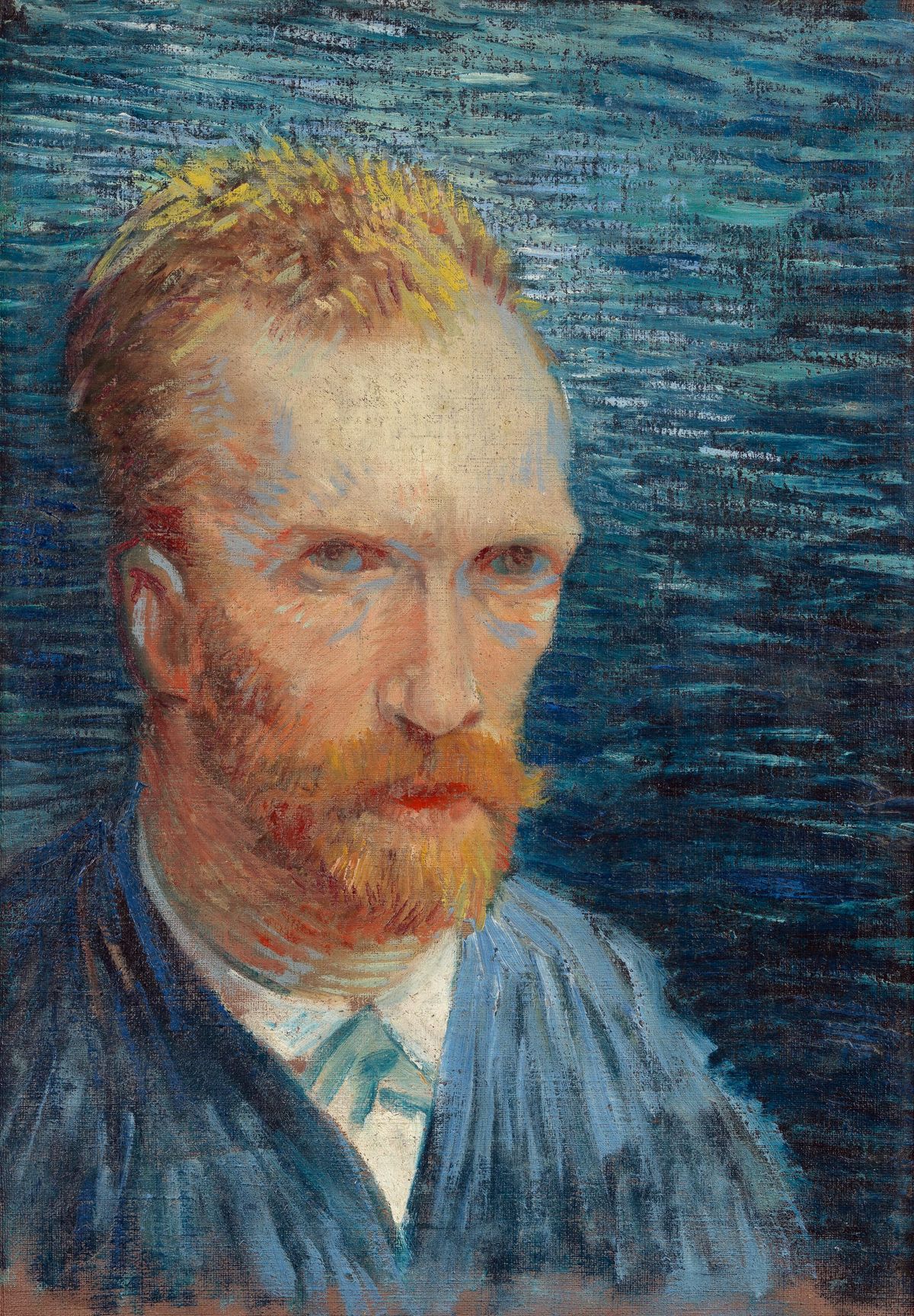
네덜란드의 후기 인상주의 거장 빈센트 반 고흐(Vincent van Gogh, 1853–1890)가 1887년 여름 프랑스 파리에서 완성한 유화 《자화상(Self-Portrait)》은 44.1 cm × 31.8 cm 크기의 판지에 유채로 그린 작품으로, 현재 네덜란드 암스테르담의 반 고흐 미술관(Van Gogh Museum)에 영구 소장되어 있습니다.
파리의 용광로 속에서 완성된 붓질의 율동과 재료의 비밀
1887년 여름, 파리의 첨단 미술 조류에 온몸으로 부딪히며 작업에 몰두하던 고흐는 신인상주의의 점묘주의와 분할 필치를 자신만의 독창적인 조형 언어로 재구성하는 실험을 감행했습니다. 유화 물감을 살 돈조차 아껴야 했던 가난한 시절, 그는 비싼 캔버스 대신 두꺼운 마분지(Cardboard) 위에 과감하게 유화 붓질을 올리며 수많은 자화상을 남겼습니다.
이 작품의 흥미로운 비하인드 중 하나는 그가 값싼 종이 판지를 활용하면서도 유화 특유의 무겁고 기름진 질감을 덜어내기 위해 파스텔처럼 건조하고 날렵한 터치를 구사했다는 점입니다. 짙푸른 바다처럼 일렁이는 청색 배경 속에 자신을 홀로 세운 고흐는, 동생 테오에게 보낸 편지에서 "나 자신의 초상을 그리는 일은 단순히 외모를 닮게 그리는 것이 아니라 내 안의 영혼과 투쟁하는 일"이라고 고백했습니다. 대도시 파리의 소음 속에서도 화가는 거울을 마주 보며 예술을 향한 자신의 순수한 집념과 꺾이지 않는 내적 결의를 붓끝으로 증명해 보였습니다.
무의식 속 시선의 몰입과 심리적 긴장감
감상자의 시선은 화폭의 정중앙에서 번뜩이는 화가의 날카롭고 깊은 눈빛으로 가장 먼저 빨려 들어갑니다. 화면 너머를 꿰뚫어 볼 듯 응시하는 양 눈의 강렬한 집중력은 보는 이의 무의식 속에 즉각적인 긴장감을 유발하며 시선을 단숨에 결박합니다.
이어 시선은 이마와 미간에 촘촘하게 새겨진 붉고 노란 붓 터치들을 타고 흘러내려, 불꽃처럼 타오르는 붉은 오렌지빛 수염과 굳게 다문 입술로 이동합니다. 그 후 시선은 인물의 주위를 감싸며 수평으로 격렬하게 파도치는 청록색과 감청색 배경의 리드미컬한 터치들로 확장됩니다. 붉은 수염의 따스한 온기와 배경의 서늘한 푸른색이 자아내는 극명한 보색 충돌 속에서, 관람자는 의식하지 못하는 사이에 화가가 겪었던 내면의 고독과 그 고독을 삼켜버릴 듯한 예술적 열정의 파동을 고스란히 체감하게 됩니다.
표현주의의 길을 연 필치의 독창성과 미술사적 평가
미술계는 이 자화상을 반 고흐가 파리 체류 기간 동안 이룩한 '필치와 색채의 자율성'을 가장 집약적으로 보여주는 걸작으로 평가합니다. 빛을 과학적으로 분할하던 쇠라의 점묘법을 기계적으로 답습하지 않고, 붓 터치 자체에 생명력과 감정의 호흡을 불어넣은 그의 방식은 훗날 20세기 표현주의(Expressionism)의 문을 연 결정적 계기가 되었습니다.
배경의 푸른 선들이 만들어내는 역동적인 진동과 인물의 굳건한 표정이 완벽한 조화를 이루는 이 작품은, 예술적 방황의 시기를 지나 독자적인 거장으로 우뚝 서게 된 반 고흐의 찬란한 도약을 상징하는 불멸의 유산입니다.
Resolute Spirit Amidst an Azure Rhythm, Self-Portrait
Painted in the summer of 1887 during his pivotal Paris period by Vincent van Gogh (1853–1890), Self-Portrait is an oil on cardboard measuring 44.1 cm × 31.8 cm (17.4 in × 12.5 in), preserved in the permanent collection of the Van Gogh Museum in Amsterdam, Netherlands.
Parisian Experimentation: Rhythmic Brushwork and Humble Materials
In the summer of 1887, amidst the intellectual ferment of avant-garde Paris, Van Gogh immersed himself in transforming Neo-Impressionist divisionism into an intensely personal visual rhythm. Struggling with persistent poverty, Vincent frequently substituted expensive linen canvases with modest cardboard supports, executing a series of probing self-portraits to master color harmonies and gestural dynamism.
A compelling aspect of this period lies in his tactile handling: by painting directly onto unprimed cardboard, the porous surface absorbed the excess oil, yielding a matte, fresco-like texture akin to drawing in pure pigment. Encapsulated against a surging field of rhythmic blue dashes, Vincent conveyed his introspective struggle. As he noted to his brother Theo, studying his own reflection was never a vain exercise in external likeness, but a demanding spiritual inquiry—an artistic declaration of unflinching resolve forged in the vibrant yet challenging crucible of the French capital.
Psychological Trajectory of the Gaze and the Dynamic Resonance of Complementary Tones
The observer’s gaze is immediately seized by the penetrating, steel-blue eyes that anchor the upper register of the face. Piercing through the pictorial plane, this unrelenting gaze establishes an instantaneous psychological tension, locking the subconscious in a direct and intimate dialogue.
From the arresting gaze, visual perception cascades down the directional facets of the brow and nose, guided by fine striations of vermilion and ochre, before encountering the bristling, fiery textures of the orange beard and the tightly drawn lips. The eye then disperses into the background, carried along the horizontal waves of dense Prussian blue and turquoise strokes that surround the bust like a magnetic field. Trapped within this vibrant chromatic friction between fiery warmth and oceanic coolness, the viewer subconsciously internalizes the profound equilibrium between the artist's existential solitude and his boundless creative vitality.
Emancipated Brushwork and the Foundations of Expressionism: Critical Legacy
Art historians celebrate this 1887 Self-Portrait as an exceptional testament to Van Gogh’s breakthrough into absolute stylistic autonomy.
Rather than adopting the rigid, impersonal dots of pointillism, Vincent transformed every mark into an expressive vector of energy, laying the foundational framework for 20th-century Expressionism. By synthesizing linear harmony with intense psychological presence, this portrait stands as an enduring monument to Van Gogh's emerging mastery, immortalizing the moment he transcended conventional technique to speak directly to the human soul.
Copyright © Palette Jeju. All rights reserved. Unauthorized reproduction or redistribution is strictly prohibited.
본 컨텐트의 저작권은 팔렛트제주에 있습니다. 허가없는 무단전제를 금지합니다.