푸른 창공을 향해 뻗은 아기의 작은 두 손과 황금빛 날갯짓, 아기 천사와 나비 Putto und Schmetterling
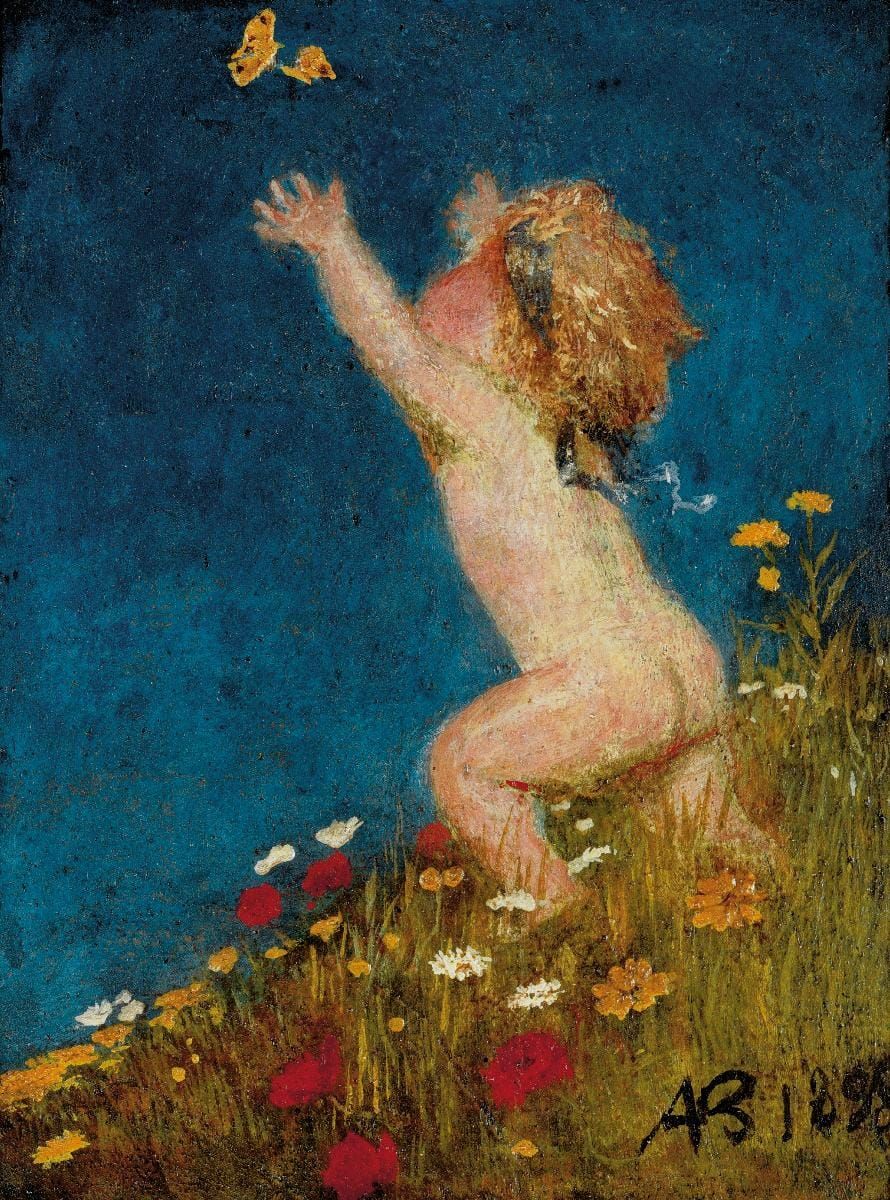
스위스 출신의 상징주의 거장 아놀드 뵈클린(Arnold Böcklin, 1827–1901)이 1898년에 피렌체 인근 산 도메니코에서 완성한 유화 아기 천사와 나비(Putto and Butterfly, 독일어: Putto und Schmetterling)는 46.0 cm × 34.5 cm 크기의 나무 패널에 유채로 그린 대표적인 후기 소품 명작입니다. 현재 스위스 취리히의 쿤스트하우스 취리히(Kunsthaus Zürich)에 소장되어 있습니다.
노화가의 황혼기에 찾아온 소박한 동심과 르네상스 장식미의 부활
1890년대 후반 칠순을 넘긴 노년의 뵈클린은 뇌졸중 후유증으로 인한 신체적 한계 속에서도 이탈리아 토스카나의 화실에서 붓을 놓지 않았습니다. 당시 유럽 미술계는 장엄한 대작만을 예술가의 위대함으로 평가하는 경향이 강했지만, 화가는 인생의 황혼기에 이르러 오히려 자연이 품은 가장 작고 순수한 생명체들의 움직임에 깊은 애정을 쏟았습니다. 거창한 신화의 영웅 서사나 어두운 죽음의 알레고리에서 잠시 벗어나, 화가는 이탈리아 르네상스 프레스코화에 자주 등장하던 사랑스러운 아기 천사(푸토)의 모티브를 맑고 경쾌한 붓 터치로 재해석했습니다.
화면 속 짙푸른 하늘을 배경으로 들꽃이 만발한 언덕 위에서, 통통한 나체의 아기 천사가 허공을 향해 뒤꿈치를 들고 까치발을 딛고 서 있습니다. 아기는 잡힐 듯 날아오르는 노란 나비를 쫓아 고사리 같은 두 손을 힘껏 뻗고 있습니다. 뵈클린은 르네상스 고전 예술의 장식적인 아름다움에 어린아이의 순진무구한 생명력을 덧입혀, 삶의 찰나적인 아름다움과 잡히지 않는 꿈을 쫓는 인간의 순수한 갈망을 시각화했습니다. 육체의 쇠약과 죽음의 문턱 앞에서도 끝내 잃지 않았던 노거장의 맑고 따뜻한 동심이 이 아담한 화폭 속에 보석처럼 빛납니다.
높이 뻗은 아기의 손끝에서 날아오르는 나비로, 시선의 심리적 여정
그림을 마주하는 순간 관람객의 무의식적 시선은 화면 중앙에서 짙푸른 밤하늘 같은 푸른 배경을 향해 까치발을 딛고 서 있는 아기 천사의 발그레한 뺨과 통통한 분홍빛 살결로 가장 먼저 이끌립니다. 뒤꿈치를 바짝 들고 엉덩이를 뒤로 뺀 채 온몸을 위로 뻗은 아기의 생동감 넘치는 자세는 보는 이에게 티 없는 순수함과 사랑스러운 미소를 선사합니다.
이어 시선은 아기가 하늘 높이 간절하게 뻗어 올린 작은 두 손과, 그 손끝 바로 위에서 가볍게 팔랑거리는 두 마리의 노란 나비로 이동합니다. 손을 뻗으면 닿을 듯하지만 결코 쉽게 잡히지 않고 하늘로 날아오르는 나비의 황금빛 날갯짓을 확인하는 순간, 관람객은 어린 시절 누구나 한 번쯤 경험했던 설레는 순간의 감각을 떠올리게 됩니다.
마지막으로 시선은 아기의 흩날리는 금발 머리와 머리에 묶인 푸른 리본을 지나, 화면 아래쪽 비탈길을 따라 화사하게 피어난 붉은 양귀비꽃과 노란 야생화들에 멈춥니다. 깊고 푸른 대기의 신비로운 색채와 대지를 수놓은 들꽃의 화사함이 빚어내는 완벽한 조화를 마주하며, 관람객은 복잡한 세상의 무게를 잊게 해주는 순수한 생명의 기쁨과 자연의 따스한 온기를 가슴 깊이 체감하게 됩니다.
말년 소품 회화의 서정성과 상징주의의 온기, 미술계의 평가
미술계는 아기 천사와 나비를 거대한 대작들을 쏟아내던 뵈클린이 말년에 완성한 가장 사랑스럽고 시적인 상징주의 소품 걸작으로 평가합니다.
단순한 전원 풍경의 한 장면을 넘어서, 짙은 코발트블루와 선명한 원색 꽃들의 보색 대비, 그리고 어린아이의 원초적인 활력을 통해 잡히지 않는 이상의 세계를 향해 손을 뻗는 인간의 영혼을 완벽하게 은유했기 때문입니다. 노년의 고통과 피로를 잊고 순수한 생명의 아름다움을 다정하게 포착해 낸 뵈클린의 이 눈부신 캔버스는 오늘날까지도 수많은 감상자들에게 맑은 동심과 따스한 위로를 전해주는 소중한 유산으로 손꼽힙니다.
The Luminous Leap toward the Fleeting Gold, Putto and Butterfly
Painted in 1898 in San Domenico near Florence by the preeminent Swiss Symbolist master Arnold Böcklin (1827–1901), Putto and Butterfly (German: Putto und Schmetterling) is a late oil on wood panel measuring 46.0 cm × 34.5 cm (18.1 in × 13.6 in), preserved in the permanent collection of the Kunsthaus Zürich in Zurich, Switzerland.
Late Intimacy, Tuscan Repose, and the Revival of the Renaissance Putto
In the late 1890s, the septuagenarian Arnold Böcklin persevered in his Tuscan studio despite the lingering physical limitations of a stroke. While European critics often measured an artist's stature solely by colossal programmatic canvases, the master in his twilight years found profound delight in the smallest, most innocent phenomena of nature. Departing momentarily from ominous mythological epics and somber allegories, Böcklin revived the beloved motif of the Renaissance putto, reinterpreting the classical cherub through a fresh, vibrant Symbolist palette.
Against a saturated expanse of deep cobalt blue, a plump, naked putto stretches upward on tiptoe upon a flower-strewn hillside. With wide eyes and rosy cheeks, the child strains both hands toward a pair of golden butterflies fluttering just beyond reach. Böcklin synthesized the decorative grace of Italian Renaissance frescoes with the spontaneous vitality of childhood, transforming a simple pastoral vignette into a poetic allegory of humanity reaching toward fleeting beauty and unattainable ideals. This intimate panel stands as a radiant testament to the master's enduring innocence and warmth of spirit amidst physical decline.
Subconscious Trajectory of the Gaze: From Reaching Hands to the Gilded Wings
The observer's subconscious gaze is immediately captivated by the buoyant silhouette of the putto poised at the center, drawn to the luminous, rosy contours of the child’s flesh standing out against the deep azure background. The energetic tension of the child arching backward on tiptoe establishes an immediate atmosphere of playful innocence and kinetic charm.
The visual path then ascends along the child's outstretched arms, coming to rest upon the delicate yellow butterflies hovering near the top left edge. Observing the near-tactile proximity between the reaching fingers and the fluttering insects, the viewer experiences a delightful moment of suspense, evoking universal memories of childhood wonder.
Finally, the trajectory descends past the wind-tousled curls and delicate blue headband, resting upon the vibrant slope dotted with crimson poppies and golden wildflowers in the lower foreground. Taking in the striking chromatic harmony between the intense blue sky and the terrestrial flora, the spectator perceives the timeless simplicity of natural joy and the restorative peace of an unburdened spirit.
The Poetic Warmth of Late Masterworks: Critical Legacy
Art historians celebrate Putto and Butterfly as one of Böcklin’s most exquisite late cabinet pictures, demonstrating his versatility beyond monumental drama.
By contrasting a bold, monochromatic blue void with the vivid warmth of wildflowers and human flesh, Böcklin elevated a lighthearted motif into a profound visual emblem of the human soul seeking transcendent light. This tender masterwork endures as a vital gem within the artist's legacy, celebrating the pure vitality of youth and the eternal poetry of the living world.
본 컨텐트의 저작권은 팔렛트제주에 있습니다. 허가없는 무단전제를 금지합니다.
Copyright © Palette Jeju. All rights reserved. Unauthorized reproduction or redistribution is strictly prohibited.