풀을 뜯는 시골 여인 (Paysanne cueillant de l'herbe, 1881)
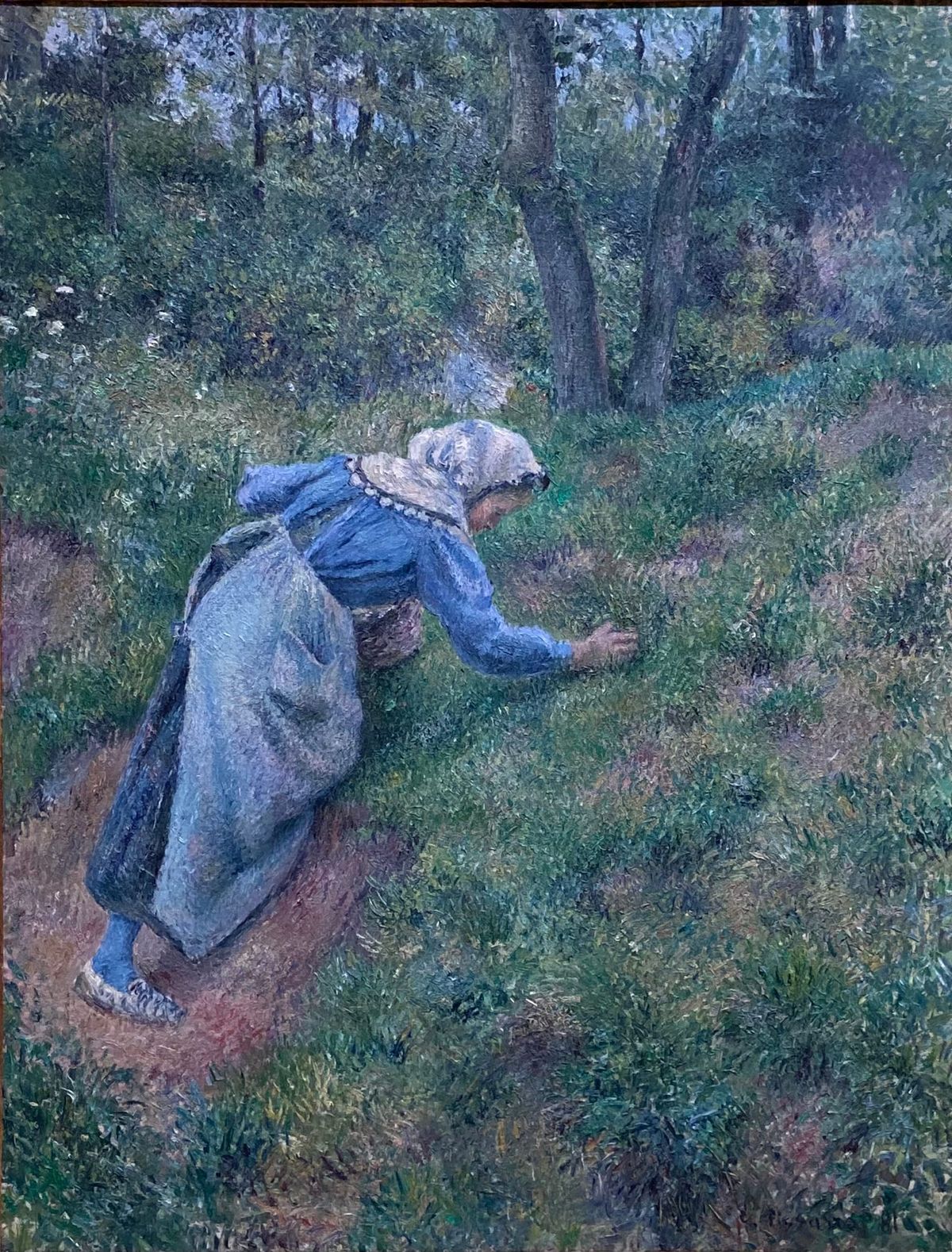
1880년대 초반 퐁투아즈 언덕에서 농촌 인물과 자연의 유기적인 결합을 탐구하던 카미유 피사로는 경사진 비탈길에서 몸을 깊이 숙인 채 풀을 뜯는 여인의 역동적인 노동의 순간을 화폭에 포착했습니다.
그는 인물을 단순히 풍경의 장식적 요소로 축소하지 않고, 대지의 질감과 완벽하게 맞물리는 주체로 다룸으로써 흙과 인간이 나누는 가장 진솔한 교감을 화면에 구축했습니다. 가로 50cm, 세로 65cm 크기의 세로형 캔버스에 유채로 완성된 이 작품은 촘촘하게 엮어낸 직조형 붓터치와 과감한 사선 구도를 바탕으로, 대지에 뿌리내린 농촌 민중의 건강한 생명력을 탁월한 조형적 응집력으로 증언하는 수작입니다.
관람자의 시각 인지 체계는 화면 좌측 중앙에서 짙푸른 작업복과 푸른 앞치마를 두른 채 비탈을 따라 몸을 기울인 여인의 묵직한 볼륨감에 가장 먼저 도달합니다. 풀밭의 연둣빛과 푸른 의복이 빚어내는 청량한 채도 대비는 시각 피질의 중심와를 즉각 포획하며 화면의 조형적 구심점을 확립합니다.
이어서 시선은 둥근 머리수건의 곡선을 타고 내려와 풀을 향해 길게 뻗어나간 여인의 오른손과 그 손끝이 닿아 있는 촉각적인 풀숲의 질감으로 자연스러운 도약 안구 운동을 진행합니다.
풀잎을 훑은 시선은 여인의 발치 아래로 드러난 붉은 황토색 흙길의 사선 축을 따라 하강한 뒤, 다시 화면 상단의 울창한 숲과 두 그루의 굵은 나무 기둥 사이로 스며드는 은은한 푸른 대기광으로 부드럽게 확장됩니다.
캔버스 전체를 빽빽하게 채운 수만 개의 작은 붓질들이 망막 위에서 하나의 싱그러운 대지의 호흡으로 통합되는 순간, 관조자는 번잡한 일상의 긴장을 내려놓고 고요한 숲속 비탈길에 오롯이 서 있는 듯한 깊은 심리적 안도감과 내면의 평온을 체험하게 됩니다.
이 그림을 그릴 당시 피사로는 제6회 인상주의 전시회 출품을 준비하며 에드가 드가와의 교류를 통해 인물의 순간적인 동세를 견고한 조형 질서 속에 안착시키는 실험에 몰두하고 있었습니다.
그는 고전 회화의 정형화된 자세를 과감히 거부하고, 비탈길에 위태롭게 버티어 선 다리와 땅을 향해 굽힌 허리의 유기적인 긴장감을 사실적으로 기록하여 일상적인 노동에 깃든 성스러운 존엄성을 부여했습니다.
동시대 미술계와 진보적 평론가들은 대지의 거친 피부와 인물의 호흡을 분리하지 않고 하나의 유기체처럼 엮어낸 피사로의 독창적인 기법을 두고 "농촌의 영혼과 흙냄새를 가장 숭고하게 빚어낸 진정한 회화적 승리"라며 높은 찬사를 보냈습니다.
대지의 결을 닮은 농촌 여인의 묵묵한 발걸음과 푸른 식생의 생명력을 눈부신 색채의 조화로 완성해 낸 피사로의 이 인물 풍경화는, 현대 미술사에서 인상주의가 감각적 빛의 유희를 넘어 인간 실존에 대한 가장 정직하고 따뜻한 찬가로 승화된 역사적 걸작으로 확고하게 평가받고 있습니다.
Peasant Woman Gathering Grass (Paysanne cueillant de l'herbe, 1881)
During the early 1880s in Pontoise, Camille Pissarro dedicated himself to exploring the profound symbiosis between rural laborers and the living earth, capturing a peasant woman leaning deeply into a grassy slope to gather fodder.
Rejecting the conventional tendency to reduce agrarian figures to incidental landscape ornaments, the master anchored the laborer into the very physical fabric of the terrain, transforming an everyday chore into a powerful testament to rural endurance. Measuring 65 by 50 cm, this vertical oil on canvas employs a dynamic diagonal composition and densely cross-hatched brushstrokes, celebrating the vital dignity of field labor through tightly unified textural architecture.
The observer’s perceptual framework instantly anchors upon the solid mass of the woman in the left-center, clad in rich cerulean and cobalt work garments as she braces against the hillside. The vibrant chromatic resonance between her blue dress and the verdant chartreuse pasture arrests the fovea, establishing an intuitive foundation of spatial and visual equilibrium.
From this robust human center, the ocular trajectory tracks downward along the gentle arc of her shoulder toward her outstretched right arm, lingering upon the delicate touch of her fingers brushing against the textured grass.
Sweeping down to the exposed reddish-brown soil of the pathway supporting her clogs, the gaze ascends along the rhythmic diagonal of the incline toward the dense background thicket, where the trunks of two slender trees dissolve into the cool, dappled forest light above.
As the thousands of vibrating, interwoven pigment touches coalesce into a unified sensory whole within the visual cortex, active visual scanning transitions into profound contemplative stillness, attuned to the restorative quietude and unadorned truth of nature.
While executing this canvas, Pissarro was preparing for the Sixth Impressionist Exhibition, actively exchanging ideas with Edgar Degas on how to capture unstudied physical postures within rigorous structural compositions.
Rather than adopting idealized studio poses, Pissarro rendered the authentic muscular tension of physical toil, celebrating the quiet resilience of working people without condescending parlor sentimentality.
Contemporary critics ardently championed this unvarnished realism, admiring Pissarro's singular ability to fuse the raw vitality of the soil with the enduring moral dignity of the peasant soul.
Masterfully harmonizing structural weight with vibrant atmospheric poetry, Pissarro's depiction of the peasant woman gathering grass remains celebrated across art history as an enduring pinnacle of nineteenth-century humanist Impressionism.
본 콘텐츠의 저작권은 저작권자에게 있으며, 무단 전재 및 재배포를 금합니다.