퐁투아즈 인근의 작은 마을 - Hamlet in the Environs of Pontoise
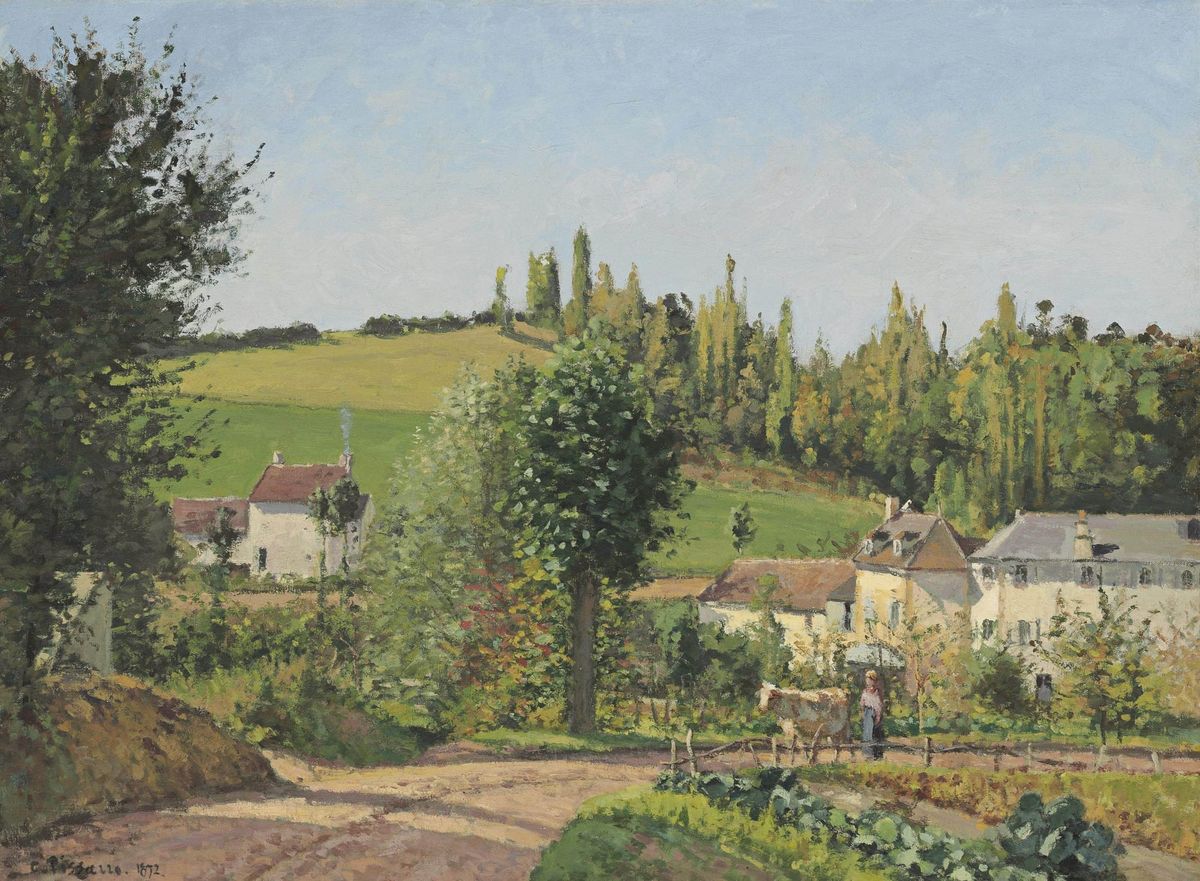
프랑스 인상주의 화파의 인자한 아버지이자 빛의 조형미를 집요하게 탐구했던 카미유 피사로(Camille Pissarro)가 1872년에 완성한 '퐁투아즈 인근의 작은 마을(Hameau aux environs de Pontoise / Hamlet in the Environs of Pontoise)'은 캔버스에 유채(Oil on canvas)로 제작된 귀중한 전원 풍경화 명작입니다. 가로 74cm, 세로 54cm 크기의 이 작품은 퐁투아즈 언덕 아래 자리한 소박한 촌락의 정경을 담아냈으며, 현재 개인 소장처(Private Collection)에 소중히 보관되어 있습니다.
이 그림에는 프로이센-프랑스 전쟁의 상흔을 딛고 새로운 예술적 도약을 이루어내던 피사로의 치열한 창작열과 동료들과의 깊은 유대가 깃들어 있습니다. 1871년 런던 피난 생활을 마치고 프랑스로 돌아온 피사로는 1872년 평화로운 시골 마을 퐁투아즈에 새로이 보금자리를 마련했습니다. 이 시기 젊은 폴 세잔과 아르망 기요맹이 피사로의 가르침을 얻고자 퐁투아즈로 찾아왔고, 피사로는 거장이자 멘토로서 이들과 함께 매일같이 이젤을 메고 들판을 누비며 야외 사생에 몰두했습니다.
당시 파리의 화상들은 부르주아적 별장이나 화려한 유흥지를 선호했지만, 피사로는 텃밭을 일구고 소를 돌보는 농부들의 소박한 일상과 흙냄새 나는 시골집들을 진솔하게 화폭에 담았습니다. 그는 스승 카미유 코로의 조화로운 고전적 구도 감각 위에 빛의 떨림을 포착하는 밝고 경쾌한 인상주의적 색채를 덧입혔습니다. 훗날 미술사학자들과 평단은 이 1872년 퐁투아즈 시기의 작업을 두고, 훗날 제1회 인상주의 전시회로 만개하게 될 인상주의 화풍의 조형적 균형과 자연주의적 진정성이 가장 완벽하게 성숙한 불후의 전환점으로 높이 평가하고 있습니다.
작품을 마주할 때 우리의 시선은 햇살을 받아 완만하게 굽어지는 전면의 따스한 흙길과 싱그럽게 자라난 배추 텃밭의 질감에 가장 먼저 가닿습니다. 텃밭 너머로 울타리 곁에서 젖소를 돌보고 있는 시골 여인의 소박하고 정겨운 실루엣을 확인한 시선은, 그녀의 뒤편에 옹기종기 자리 잡은 흰 석회벽 가옥들과 붉은 기와지붕의 단단한 구조감을 타고 자연스럽게 중앙으로 이동합니다.
이어 맑은 굴뚝 연기가 피어오르는 왼쪽 언덕 너머의 외딴집을 거쳐, 화면 상단을 웅장하게 가로지르는 푸른 언덕과 하늘을 향해 곧게 뻗은 미루나무들의 리드미컬한 수직선으로 시선이 상승합니다. 마지막으로 나뭇가지 너머로 부드럽게 펼쳐진 연한 하늘빛과 뭉게구름의 투명한 대기 속으로 시선이 시원하게 확장되며, 퐁투아즈 전원에 감도는 맑고 온화한 공기를 만끽하게 됩니다.
이러한 시각적 흐름은 관람자의 무의식 속에 깊은 정서적 안정과 평온한 안도감을 불러일으킵니다. 대지를 든든하게 받치는 흙빛과 눈부신 햇살을 머금은 싱그러운 초록빛의 조화는 일상의 번잡한 스트레스와 시각적 긴장을 차분하게 가라앉혀 줍니다. 변함없이 대지를 일구며 살아가는 인간의 삶과 자연이 빚어내는 고요한 조화는, 바라보는 이의 무의식 깊은 곳에 있는 불안을 어루만져 주며 지친 마음에 깊은 쉼과 따스한 위로를 선물합니다.
Hamlet in the Environs of Pontoise - Hameau aux environs de Pontoise
Painted in 1872 by Camille Pissarro, the revered patriarch and foundational pillar of French Impressionism, Hamlet in the Environs of Pontoise (Hameau aux environs de Pontoise) is an oil on canvas masterwork measuring 54 by 74 cm. This luminous rustic landscape capturing the quiet dignity of country life is preserved in a prestigious private collection.
Behind this captivating canvas lies an inspiring narrative of post-war rebirth, artistic solidarity, and deep mentorship. Returning to France following his exile in London during the Franco-Prussian War, Pissarro established his family in the tranquil town of Pontoise in 1872. That same year, young painters including Paul Cézanne and Armand Guillaumin traveled to Pontoise to study alongside him. Embracing his role as a generous mentor, Pissarro led his companions into the surrounding countryside daily to capture the fleeting subtleties of natural daylight en plein air.
While the Parisian art market favored glamorous riverside resorts, Pissarro remained steadfast in celebrating the unadorned authenticity of working villages, cabbage patches, and sunlit cottages. Drawing upon the tonal harmony of Camille Corot, he infused the composition with the radiant, fragmented palette of early Impressionism. Today, art historians revere Pissarro's 1872 Pontoise period as a quintessential turning point where classical landscape structure seamlessly merged with spontaneous atmospheric luminosity, directly paving the way for the historic First Impressionist Exhibition.
Upon viewing the canvas, the spectator's gaze instinctively alights on the warm, sunlit dirt road winding through the foreground and the textured leaves of the thriving vegetable patch. Moving toward the rustic fence, our attention gently settles upon the peasant woman tending her cow, a tender embodiment of agrarian domesticity.
The gaze then travels along the whitewashed stone facades and terracotta roofs of the village hamlet, before drifting toward the solitary house on the left where a faint wisp of chimney smoke rises quietly. Finally, our attention climbs the rhythmic vertical lines of poplar trees crowning the gentle green hill, expanding into the vast, luminous expanse of the pale blue sky.
This visual journey awakens a profound sense of grounded security and peaceful reassurance within the subconscious. The comforting harmony between warm earth tones and refreshing, sun-kissed foliage gently dissolves mental fatigue, inviting the mind into a tranquil sanctuary of quiet contemplation. Observing the peaceful coexistence between humble human labor and the enduring rhythms of nature restores the spirit with timeless serenity, simplicity, and pastoral peace.
본 리뷰에서 작품을 제외한 컨텐츠의 저작권은 팔렛트제주에 있습니다.
"퍼블릭도메인 고전명화"를 제외한 모든 창작 콘텐츠는 저작권법 제4조 및 제10조에 의거하여 보호됩니다. 무단 도용시 저작권법 제136조(벌칙)에 의거, 당사의 사전 서면 승인 없는 저작권 침해 행위를 금지합니다.