폭풍전야의 대지에 울려 퍼진 영혼의 절규, 까마귀가 나는 밀밭 Wheatfield with Crows
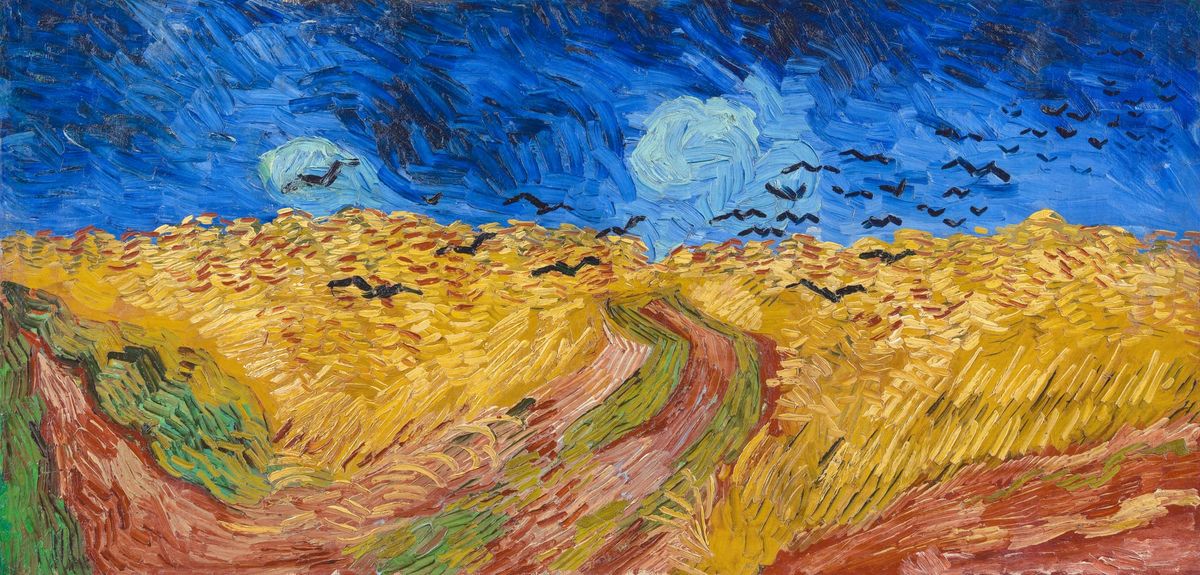
후기 인상주의의 위대한 거장 빈센트 반 고흐(Vincent van Gogh, 1853–1890)가 생애 마지막 달인 1890년 7월 프랑스 오베르 쉬르 우아즈(Auvers-sur-Oise)에서 완성한 유화 《까마귀가 나는 밀밭(Wheatfield with Crows)》은 가로 103.0 cm, 세로 50.5 cm 크기의 더블 스퀘어(Double-square) 캔버스에 담긴 작품으로, 현재 네덜란드 암스테르담의 반 고흐 미술관(Van Gogh Museum)에 영구 소장되어 있습니다.
오베르의 거친 하늘 아래 쏟아낸 슬픔과 극도의 고독
1890년 7월 초, 반 고흐는 파리에 사는 동생 테오를 방문한 뒤 테오 가족의 재정적 어려움과 어린 조카의 건강 문제로 극심한 심리적 압박감을 느끼며 오베르로 돌아왔습니다. 마음의 짐을 짊어진 채 들판으로 나간 그는 거친 붓질로 사나운 먹구름이 뒤덮인 광활한 밀밭을 화폭에 담아내기 시작했습니다.
그는 생전 테오에게 보낸 마지막 편지 중 하나(Letter 898)에서 "불안한 하늘 아래 펼쳐진 끝없는 밀밭을 그리는 데 오랜 시간이 걸리지 않았다. 그 안에서 내가 느끼는 슬픔과 극도의 외로움을 표현하는 것은 어렵지 않았다"고 고백했습니다. 오랜 세월 대중 사이에서 이 작품이 고흐의 자살 직전 마지막 유작으로 널리 알려졌을 만큼, 어둡게 일렁이는 하늘과 갈 곳을 잃은 채 흩어지는 까마귀 떼는 화가의 비극적인 삶의 종막을 둘러싼 가장 강렬하고 상징적인 일화로 남아 있습니다.
무의식 속 시선의 방황과 팽팽한 심리적 긴장감
감상자의 시선은 화폭 전면에 세 갈래로 거칠게 갈라진 붉은 흙길을 마주하며 깊은 무의식적 혼란에 빠져듭니다. 중심 길은 화면 너머로 이어지지 못한 채 밀밭 한가운데서 홀연히 끊어지고, 좌우의 길 역시 캔버스 밖으로 급격히 꺾여 나가며 보는 이의 뇌리에 '어디로도 향할 수 없다'는 강렬한 막다른 골목의 심리적 폐색감을 일으킵니다.
이어 시선은 황금빛으로 일렁이는 밀 이삭들의 격렬한 파도를 타고, 화면 상단을 짓누르는 짙은 남벽색과 검푸른 먹구름의 경계선으로 수직 상승합니다. 그 어두운 창공 속에서 불규칙하게 흩날리며 관람객 쪽으로 다가오는 듯한 검은 까마귀 떼는 시각적 긴장감을 최고조로 끌어올립니다. 황금빛 노랑과 칠흑 같은 암청색의 격렬한 보색 충돌 속에서, 감상자는 화가가 마주했던 실존적 불안과 거대한 자연의 압도적인 생명력을 무의식 깊은 곳에서 동시에 경험하게 됩니다.
20세기 표현주의의 탄생을 알린 불멸의 기념비, 미술사적 평가
미술계는 《까마귀가 나는 밀밭》을 단순한 풍경 묘사를 완전히 초월하여 인간 내면의 원초적인 비극성을 자연의 형상에 완벽히 투사한 후기 인상주의 최고의 걸작으로 평가합니다.
이 작품에서 드러난 과감하고 두터운 임파스토 기법, 형태의 대담한 왜곡, 그리고 색채를 감정의 직접적인 전달 도구로 해방시킨 조형적 실험은 훗날 20세기 초 유럽을 뒤흔든 표현주의(Expressionism)와 추상화의 모태가 되었습니다. 화가의 격정적인 붓끝에서 터져 나온 색채의 울부짖음은 한 세기가 지난 오늘날에도 미술사에서 가장 숭고하고도 비장한 예술적 고백으로 영원히 기억되고 있습니다.
A Soul’s Cry Echoing Across the Tempestuous Earth, Wheatfield with Crows
Painted in July 1890 in Auvers-sur-Oise by Vincent van Gogh (1853–1890), Wheatfield with Crows is an oil on canvas measuring 50.5 cm × 103.0 cm (19.9 in × 40.6 in), preserved in the permanent collection of the Van Gogh Museum in Amsterdam, Netherlands.
Gathering Storms over Auvers: Filial Sorrow and Infinite Solitude
In early July 1890, burdened by news of his brother Theo’s financial distress and his infant nephew’s frail health, Van Gogh returned to Auvers in a state of profound emotional agitation. Seeking solace in the vast rural plains surrounding the village, he threw himself into painting the wide expanses of undulating wheat under turbulent, bruised skies.
Writing to Theo in Letter 898, Vincent poignantly confessed that he had painted vast fields of wheat under troubled skies to express his immense sadness and extreme loneliness. Long romanticized in popular culture as his final suicide canvas, this monumental painting remains the defining historical emblem of Van Gogh’s emotional tempest, where the chaotic dispersion of black crows and the foreboding twilight immortalized the tragic crescendo of his mortal journey.
Psychological Trajectory of the Gaze and Unconscious Turmoil
The observer’s subconscious is immediately destabilized by the jarring trio of reddish-ochre pathways cleaving the foreground. The central path terminates abruptly within the dense wheat, leading nowhere, while the flanking trails veer abruptly out of frame, imparting an immediate, instinctive sensation of disorientation and existential entrapment.
From this ruptured earth, the gaze is swept upward through the kinetic golden waves of the wheat stalks toward the oppressive indigo and pitch-black clouds suffocating the horizon. Hovering in the stormy upper register, the jagged flock of black crows advances toward the viewer, escalating the optical tension. Caught between the electrifying clash of chrome yellow and deep Prussian blue, the viewer subconsciously internalizes both the raw ferocity of untamed nature and the painter's overwhelming inner crisis.
The Dawn of Modern Expressionism: Critical Reception and Legacy
Art historians revere Wheatfield with Crows as a crowning pinnacle of Post-Impressionism, representing the complete emancipation of landscape painting from external observation into psychological truth.
The feverish, rhythmic impasto, the radical spatial tension of the double-square format, and the aggressive dissonance of complementary hues laid the foundational bedrock for 20th-century Expressionism. By transmuting his agonizing despair into a breathtaking chromatic symphony, Van Gogh created an eternal monument to the human spirit that continues to resonate as one of the most sublime achievements in Western art.
Copyright © Palette Jeju. All rights reserved. Unauthorized reproduction or redistribution is strictly prohibited.
본 컨텐트의 저작권은 팔렛트제주에 있습니다. 허가없는 무단전제를 금지합니다.