폭풍 전야의 먹구름 아래 끝없이 펼쳐진 초록의 위안, 비구름 아래 오베르의 들판 Wheat Fields under Clouded Sky / Plain near Auvers
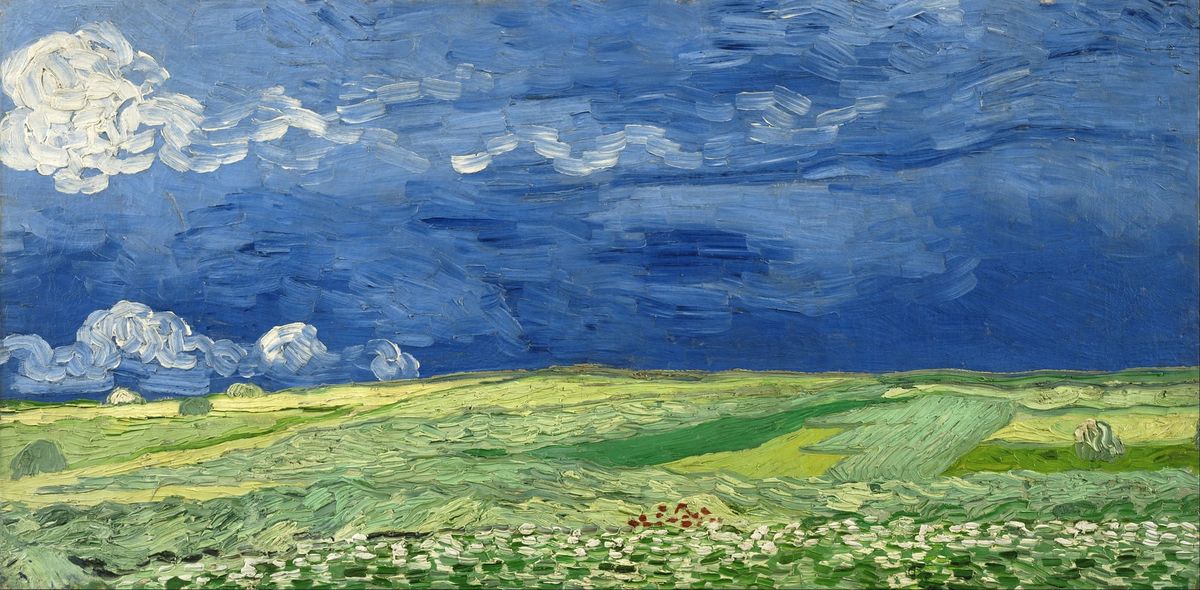
후기 인상주의의 거장 빈센트 반 고흐(Vincent van Gogh, 1853–1890)가 생애 마지막 달인 1890년 7월 프랑스 파리 근교 오베르 쉬르 우아즈(Auvers-sur-Oise)에서 완성한 유화 비구름 아래 오베르의 들판(Wheat Fields under Clouded Sky, 또는 비구름 아래의 들판)은 50.0 cm × 100.5 cm 크기의 파노라마 캔버스에 유채로 그린 대표작입니다. 현재 네덜란드 암스테르담의 반 고흐 미술관(Van Gogh Museum)에 영구 소장되어 있습니다.
마지막 날들의 안식과 가로로 긴 더블 스퀘어 화폭의 탄생
1890년 7월, 생의 마지막 갈림길에 서 있던 고흐는 파리 근교 오베르의 고원 지대로 올라가 지평선 끝까지 아스라이 펼쳐진 광활한 밀밭과 마주했습니다. 그는 가로와 세로 비율이 1대 2에 달하는 독특한 '더블 스퀘어(Double-Square)' 규격의 캔버스를 주문하여, 눈앞에 펼쳐진 거대한 대지와 하늘의 파노라마를 시원하게 담아내기 시작했습니다.
이 무렵 고흐는 동생 테오의 재정적 어려움과 어린 조카의 건강 문제, 그리고 자신의 만성적인 정신적 고통이 겹치며 극심한 불안에 시달리고 있었습니다. 하지만 역설적이게도 폭풍이 몰려오는 하늘 아래 끝없이 펼쳐진 초록빛 들판을 바라볼 때, 그는 세상의 번잡함을 잊고 순수한 자연의 품 안에서 깊은 치유를 경험했습니다. 동생 테오와 제수 요한나에게 보낸 마지막 편지 중 하나에서 그는 "불온한 하늘 아래 끝없이 펼쳐진 들판을 그렸다. 굳이 말로 표현하지 않아도 이 캔버스가 내가 말로 다하지 못한 건강함과 위로의 힘을 당신들에게 전해줄 것이라 믿는다"고 적었습니다. 대지의 싱그러운 풀빛 속에 자신의 모든 고뇌를 쏟아붓고 영혼의 평온을 되찾고자 했던 화가의 숭고한 염원이 붓끝마다 담백하게 서려 있습니다.
무의식 속 시선의 공간 횡단과 정서적 카타르시스
작품을 마주하는 순간 감상자의 무의식적 시선은 캔버스 하단에 하얀 들꽃들이 별처럼 점점이 박혀 있는 짙은 에메랄드빛 풀밭의 싱그러운 질감으로 가장 먼저 이끌립니다. 바닥에 가로로 리드미컬하게 깔린 붓 터치와 그 사이로 수줍게 얼굴을 내민 붉은 양귀비꽃의 미세한 점들은 보는 이의 마음에 생생한 촉각적 생동감과 시각적 흥미를 촉발합니다.
이어 시선은 완만한 구릉을 따라 파도처럼 물결치는 연두색, 올리브 그린, 황록색의 다양한 밭이랑들을 스쳐 지나며, 가로로 길게 뻗은 지평선을 향해 시원하게 미끄러져 들어갑니다. 화면을 가로지르는 광활한 대지의 흐름은 보는 이의 시야를 좌우로 활짝 열어젖히며 깊은 심리적 해방감을 선사합니다.
그 후 시선은 지평선 위로 무겁게 내려앉은 짙은 코발트 블루와 남빛의 거대한 비구름으로 급격히 상승합니다. 하늘 좌측과 하단에 솜사탕처럼 피어오른 하얀 구름 덩어리들의 역동적인 질감을 마주할 때, 감상자의 내면은 폭풍 전야의 서늘한 바람과 맑은 대기의 숨결을 동시에 체감하게 됩니다. 무거운 비구름의 짙푸른 어둠과 대지의 눈부신 연둣빛이 이루는 웅장한 색채의 조화 속에서, 관람자는 의식하지 못하는 사이 일상의 피로와 불안을 씻어내고 대자연이 품어주는 거대한 침묵과 숭고한 평온에 깊이 젖어들게 됩니다.
파노라마 공간 혁신과 감정의 추상화, 미술사적 평가
미술계는 비구름 아래 오베르의 들판을 반 고흐가 만년에 도달한 조형적 대담함과 감정의 정제미가 가장 순수하게 응축된 최고의 걸작으로 평가합니다.
전통적인 풍경화의 원근법적 소실점과 세부 묘사를 과감히 배제하고, 순수한 색면의 대비와 굵은 붓질의 방향성만으로 공간의 무한성과 내면의 심리 상태를 완벽하게 시각화했습니다. 인상주의의 순간적 빛 포착을 뛰어넘어 색채 자체를 영혼의 울림을 전달하는 독립적인 매개체로 해방시킨 이 작품은, 훗날 20세기 색면 추상화와 현대 표현주의 풍경화의 태동에 결정적인 길잡이가 된 불멸의 조형적 기념비로 빛나고 있습니다.
Boundless Solace Beneath the Gathering Storm, Wheat Fields under Clouded Sky
Painted in July 1890 during his profound final weeks in Auvers-sur-Oise by Vincent van Gogh (1853–1890), Wheat Fields under Clouded Sky (also known as Plain near Auvers) is an oil on canvas measuring 50.0 cm × 100.5 cm (19.7 in × 39.6 in), preserved in the permanent collection of the Van Gogh Museum in Amsterdam, Netherlands.
The Panoramic Horizons of Auvers: A Sanctuary of Infinite Green
During the fateful summer of 1890, Van Gogh frequently climbed to the expansive plateau overlooking the village of Auvers-sur-Oise, where the vast ocean of undulating wheat fields stretched toward the horizon. Embracing an elongated panoramic double-square canvas format, he sought to capture the monumental breadth of the northern landscape in all its atmospheric grandeur.
At this juncture, Vincent was weighed down by emotional vulnerability, anxieties regarding his family's financial stability, and recurring psychological distress. Yet, when confronting the boundless green plains beneath turbulent summer skies, he discovered an extraordinary sense of spiritual restoration. In one of his poignant final letters to his brother Theo and sister-in-law Jo, Vincent affirmed that he had painted vast fields under turbulent skies to express health and restorative forces that he could not put into words. The canvas stands as a magnificent testament to nature as the ultimate spiritual refuge.
Psychological Trajectory of the Gaze and Subconscious Expansion
The observer’s subconscious gaze is immediately welcomed by the foreground meadow, carpeted with staccato dashes of pure white wildflowers and subtle crimson poppy accents. Rendered in rhythmic, horizontal strokes of jade and vibrant emerald, this luminous base provides an immediate tactile connection to the living soil.
From this grounded expanse, visual perception glides across the undulating quilt of lime green, chartreuse, and olive furrows, sweeping effortlessly toward the distant, low-lying horizon. The horizontal momentum of the double-square canvas expands the field of view, creating an immediate sensation of psychological liberation and unconfined space.
Visual attention then surges into the atmospheric tempest above, where deep cobalt and indigo storm clouds gather with majestic gravity against buoyant plumes of white cumulus. Navigating the dramatic chromatic dialogue between the brooding nocturnal heavens and the incandescent vitality of the green fields, the viewer subconsciously internalizes the cleansing stillness that precedes the storm, absorbing a profound aura of peace and quiet fortitude.
Panoramic Modernism and Chromatic Purity: Critical Legacy
Art historians revere Wheat Fields under Clouded Sky as an absolute pinnacle of Van Gogh’s spatial and expressive mastery, capturing his late style at its most poetic and refined.
By abandoning conventional vanishing points in favor of sweeping, horizontal color planes and expressive paint textures, Van Gogh elevated landscape painting into a vessel of pure psychic resonance. Foreshadowing the spatial dynamics of 20th-century Color Field painting and Abstract Expressionism, this masterwork endures as a transcendent monument to the healing power of the natural world and the immortal resilience of the human soul.
본 컨텐트의 저작권은 팔렛트제주에 있습니다. 허가없는 무단전제를 금지합니다.
Copyright © Palette Jeju. All rights reserved. Unauthorized reproduction or redistribution is strictly prohibited.