피리를 손에 든 목동 Shepherd
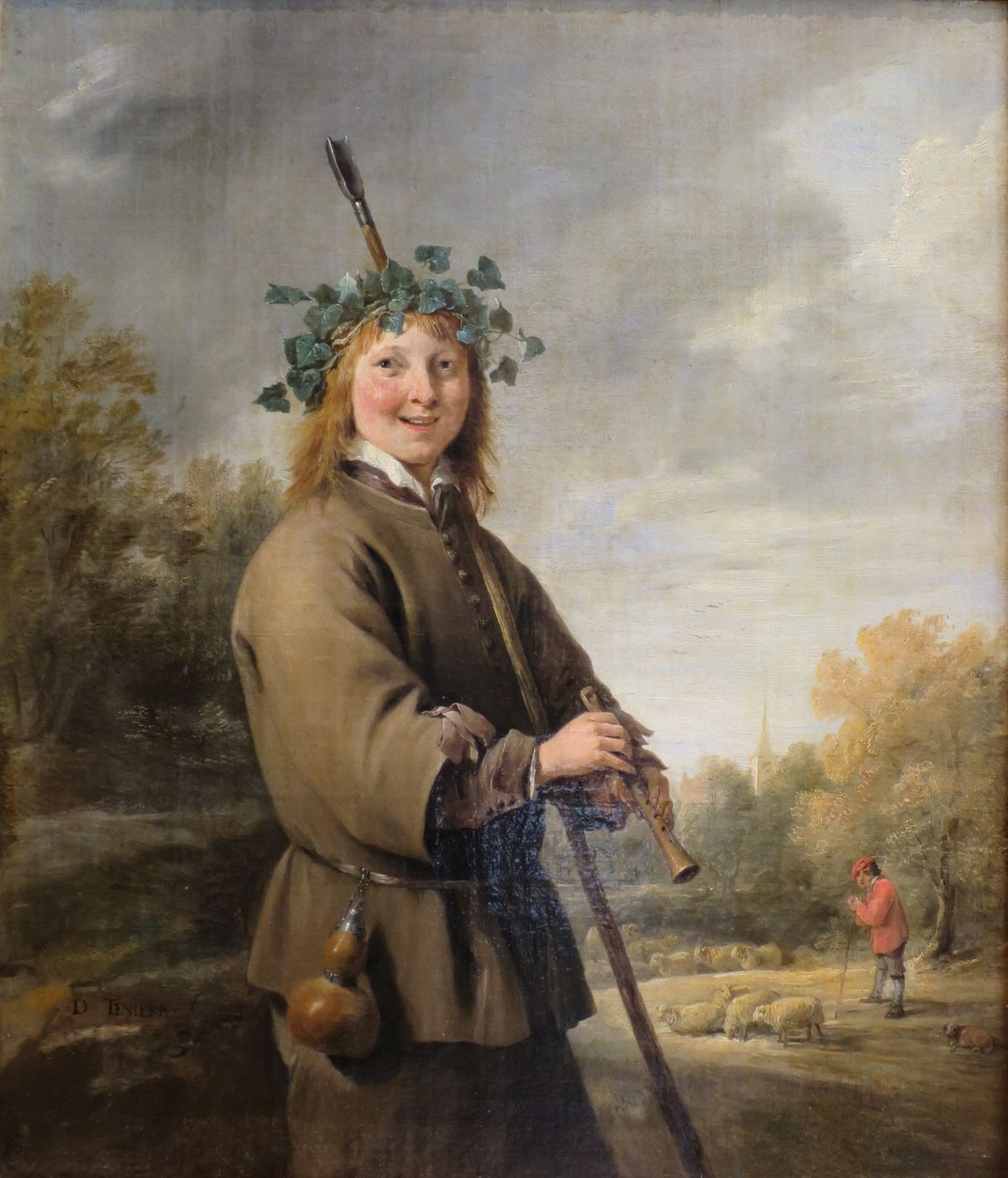
17세기 플랑드르 바로크 풍속화 및 목가적 초상화의 거장 소 다비드 테니어르스(David Teniers le Jeune, 1610–1690)가 1640년대 중후반 안트베르펜과 브뤼셀 시기에 완성한 기념비적 목가 인물 초상 유화 피리를 부는 목동(Shepherd, 또는 담쟁이덩굴 관을 쓴 목동 소년, 러시아어: Пастух, 프랑스어: Le Berger, 소장품 번호: ГЭ-572)은 48.0 cm × 39.5 cm 크기의 단정한 세로형 캔버스에 유채로 그린 대표적인 북유럽 목가 풍경 인물화 최고 걸작입니다.
러시아 예카테리나 2세 대제의 유서 깊은 황실 컬렉션을 거쳐 현재 러시아 상트페테르부르크의 국립 에르미타주 미술관(The State Hermitage Museum, Saint Petersburg)에 영구 소장되어 보존되어 오고 있습니다.
아르카디아의 목가 전통과 순박한 젊음의 환희를 향한 화가의 고뇌
1640년대 플랑드르 화단을 이끌던 삼십 대의 테니어르스는, 고대 그리스 로마 신화에서 유래한 이상향 아르카디아의 목가적 시정을 북유럽 플랑드르의 실제 시골 들판과 결합하는 작업에 깊이 몰두했습니다.
화가는 궁정 귀족들이 동경하던 이상적인 전원생활의 낭만과, 흙을 밟으며 양을 치는 서민 소년의 때 묻지 않은 순수한 생명력을 어떻게 맑고 화사한 은빛 대기(Silvery manner)와 부드러운 자연광 속에 담아낼지 치열하게 번민했습니다.
당시 북유럽 미술에서 머리에 쓴 푸른 담쟁이덩굴 관과 손에 쥔 목동의 피리는 음악과 시, 영원한 청춘과 자연의 풍요를 상징하는 대표적인 목가 문학의 상징이었습니다.
화가는 부드러운 가을 햇살이 비쳐드는 평화로운 초원 언덕에서, 피리를 불다 말고 환한 미소로 관람객을 바라보는 소년 목동의 생동감 넘치는 순간을 화폭에 담았습니다.
화면 전면 중앙에는 머리에 싱그러운 담쟁이덩굴 잎사귀 관을 얹은 밝은 갈색 머리의 소년이 갈색 외투를 단정하게 차려입고 서서, 손에 나무 피리를 쥔 채 장난기 가득하고 티 없이 맑은 미소를 지어 보이고 있습니다.
소년의 어깨 뒤로는 쇠창살이 달린 목동의 긴 지팡이가 비스듬히 솟아 있고, 허리띠에는 맑은 물이나 술을 담는 표주박 형태의 가죽 물병이 대롱대롱 매달려 있습니다.
화면 오른쪽 원경의 들판에서는 붉은 상의를 입은 또 다른 목동이 지팡이를 짚고 서서 풀을 뜯는 순백의 양 떼를 돌보고 있으며, 숲 너머로 희미하게 솟아오른 마을 교회의 뾰족탑과 은빛 뭉게구름은, 자연과 인간이 완벽한 조화를 이루는 17세기 플랑드르 전원의 평화로운 삶을 손에 잡힐 듯 생생하게 웅변합니다.
소년의 싱그러운 미소에서 손에 쥔 피리와 햇살 비치는 양 떼로, 시선의 심리적 여정
그림을 마주하는 순간 관람객의 무의식적 시선은 화면 전면 상단에서 투명한 가을 햇살을 받아 화사하게 빛나는 소년의 붉은 뺨과 살짝 벌어진 입술 사이로 드러난 하얀 치아, 그리고 반짝이는 눈동자로 가장 먼저 빨려 들어갑니다.
연주를 멈추고 친구를 맞이하듯 관람객을 정면으로 바라보는 소년의 천진난만한 얼굴과 머리 위의 싱그러운 담쟁이 관은 보는 이에게 깊은 시각적 온기와 함께 기분 좋은 청량감을 선사합니다.
이어 시선은 소년이 두 손으로 쥐고 있는 매끄러운 나무 피리의 구멍들과 어깨를 가로지르는 묵직한 목동 지팡이, 그리고 허리춤에 매달린 둥근 표주박 물병으로 이동합니다.
소박하지만 당당한 목동의 일상 도구들을 확인하는 순간, 관람객은 풀 내음과 맑은 피리 소리가 귓가를 맴도는 17세기 플랑드르 시골 언덕 한복판 속으로 온몸이 빨려 들어가게 됩니다.
마지막으로 시선은 소년의 갈색 모직 옷자락을 지나, 화면 오른쪽 뒤편 은은한 햇살 아래 한가로이 풀을 뜯는 몽실몽실한 양 떼와 붉은 옷을 입은 동료 목동, 그리고 푸른 하늘을 가득 채운 은빛 구름에 멈춥니다.
전면의 생생한 인물 초상과 후면의 아늑한 목가 풍경이 빚어내는 완벽한 공간적 조화를 마주하며, 관람객은 순수한 자연이 건네는 영혼의 안식과 거장 테니어르스가 건네는 묵직한 인간적 위로를 가슴 깊이 마주하게 됩니다.
17세기 플랑드르 목가 인물화의 정점과 조형미, 미술계의 평가
미술계는 에르미타주 미술관의 피리를 부는 목동을 테니어르스가 인물의 생동감 넘치는 표정 포착과 정통 플랑드르 풍경화를 가장 완벽한 서정성으로 융합해 낸 대표적인 최고봉 단독 초상화로 평가합니다.
단순한 목동 그림을 넘어 고전 목가 시의 정취를 친근한 서민의 얼굴 속에 완벽한 반신상 구도로 구현했을 뿐만 아니라, 담쟁이 잎사귀의 반짝이는 엽맥, 낡은 나무 피리의 반질반질한 질감, 소년의 흩날리는 머리칼, 가을 들판의 촉촉한 대기감을 극도로 섬세한 북유럽 사실주의 유화 기법으로 완벽하게 구현했기 때문입니다.
전원의 순박한 젊음과 음악의 낭만을 가장 품격 높은 시각 서정시로 승화시킨 테니어르스의 이 걸작 화폭은, 오늘날까지도 전 세계 수많은 감상자들에게 깊은 감탄과 잊을 수 없는 시각적 안식을 전해주는 불멸의 명작으로 손꼽히고 있습니다.
Shepherd
Painted in the mid-to-late 1640s by the master of Flemish Baroque genre and pastoral landscape painting David Teniers the Younger (1610–1690), Shepherd (also titled Young Shepherd with a Flute and Ivy Wreath, Russian: Пастух, French: Le Berger, Inventory No. ГЭ-572) is an intimate pastoral portrait masterpiece in oil on canvas measuring 48.0 cm × 39.5 cm (18.9 in × 15.6 in).
Preserved through the historic imperial collections of Empress Catherine the Great of Russia, it is housed today in the celebrated permanent collection of The State Hermitage Museum in Saint Petersburg, Russia.
The Arcadian Pastoral Tradition, Rustic Music, and Youthful Radiance
During the mid-to-late 1640s in Antwerp, David Teniers the Younger explored the timeless literary ideals of Arcadia, uniting the classical pastoral elegance admired by aristocratic patrons with the unvarnished naturalism of Flemish countryside life.
The master meditated deeply on how to capture the joyful vitality, innocent warmth, and musical spontaneity of a rural shepherd boy, orchestrating the luminous bust-length portrait beneath an open, cloud-filled sky bathed in his signature silvery atmospheric daylight.
In Northern Netherlandish and classical iconography, the leafy crown of evergreen ivy paired with the wooden flute served as celebrated emblems of bucolic poetry, eternal youth, and pastoral harmony.
Teniers staged the radiant figure against a rolling pasture on a tranquil autumn morning.
In the center foreground, a youthful shepherd with flowing sandy-brown hair wears a vibrant crown of fresh ivy leaves and a sturdy brown woolen doublet, looking directly at the viewer with an open, beaming smile.
In his hands, he pauses from playing a wooden shawm or pipe, while his long shepherd's crook rises behind his shoulder and a ceramic pilgrim gourd hangs gracefully from his leather belt.
In the sunlit meadow to the right, a second shepherd dressed in a coral-red jacket watches over a grazing flock of white sheep, framed against golden autumn foliage, a distant church steeple, and billowing cumulus clouds, celebrating the peaceful serenity and timeless beauty of rural existence.
Subconscious Trajectory of the Gaze: From the Ivy Wreath to the Distant Meadow Flock
The observer's subconscious gaze is immediately magnetized by the central-upper register, drawn to the luminous, light-struck countenance of the smiling shepherd, his rosy cheeks, sparkling eyes, and the crisp green ivy leaves encircling his brow.
His engaging direct gaze, cheerful expression, and relaxed musical posture establish an instant focal point of physical charm, rustic innocence, and emotional warmth.
The visual path then shifts downward toward his capable hands holding the smooth wooden flute and the iron-shod crook resting against his arm.
Taking in his practical attire and the rustic gourd flask at his waist, the viewer directly experiences the authentic, melody-filled atmosphere of a 17th-century hillside pasture.
Finally, the visual trajectory moves toward the right background, observing the sun-drenched flock of sheep grazing peacefully beneath the watchful eye of the companion shepherd, before lifting toward the church tower silhouetted against the sweeping silvery-gray clouds.
Observing the harmonious equilibrium between foreground portrait immediacy, atmospheric landscape depth, and precise Netherlandish draftsmanship, the spectator perceives the timeless nobility of simple pastoral life and the profound aesthetic brilliance Teniers embedded within the canvas.
The Monument of Flemish Pastoral Portraiture: Critical Legacy
Art historians revere the Hermitage Shepherd as an exceptional achievement in Teniers’s oeuvre, illustrating his consummate ability to elevate rustic genre into an idealized pastoral portrait on a refined cabinet scale.
By orchestrating delicate textural contrasts between glossy ivy leaves, worn wooden instruments, coarse woolen doublets, soft sheep fleeces, and radiant moisture-filled clouds within a unified perspectival space, Teniers transformed an everyday herder into an exquisite aesthetic treatise on human joy and nature's harmony.
This radiant historical canvas endures as an inspiring testament to the master's creative fortitude, celebrating the quiet poetry of everyday existence and the transformative grace of living art.
본 컨텐트의 저작권은 팔렛트제주에 있습니다. 허가없는 무단전제를 금지합니다.
Copyright © Palette Jeju. All rights reserved. Unauthorized reproduction or redistribution is strictly prohibited.