플랑드르 마을 축제 Flemish village festival
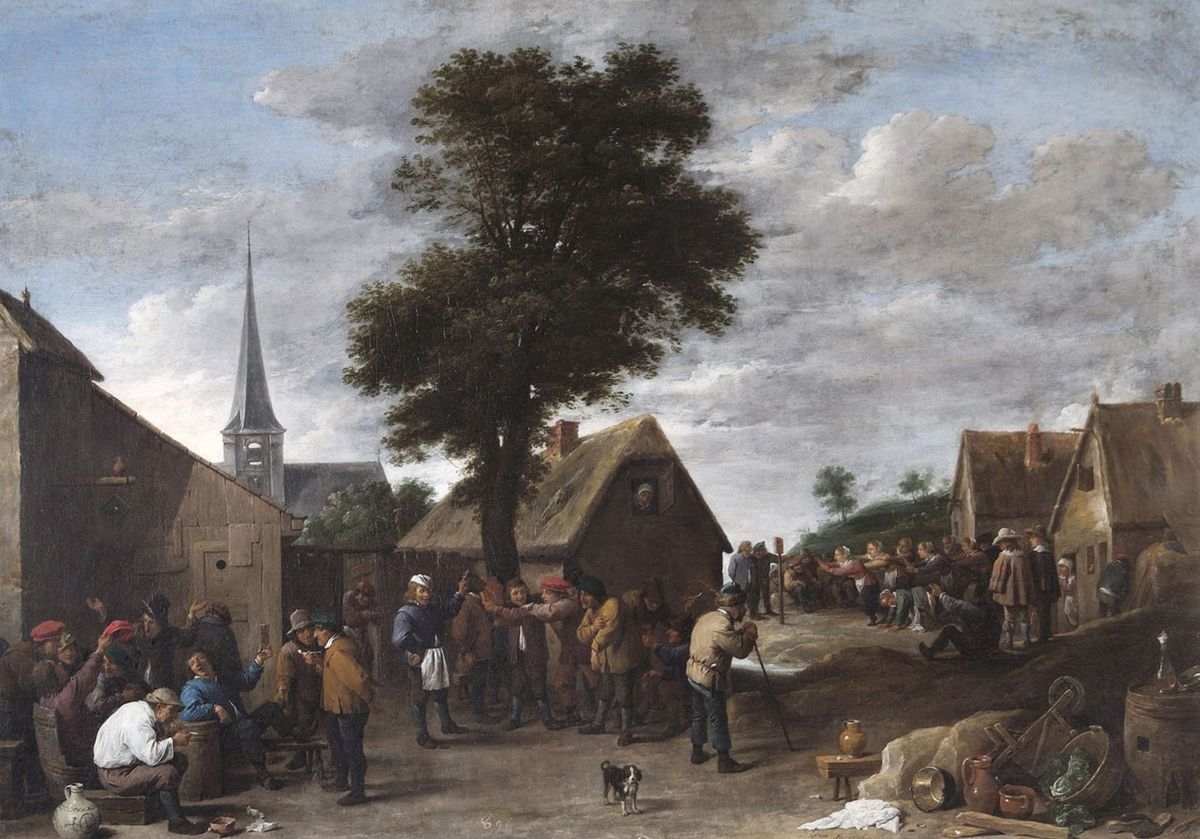
17세기 플랑드르 바로크 풍속화의 거장이자 당대 최고의 궁정 화가 소 다비드 테니어르스(David Teniers le Jeune, 1610–1690)가 1640년대 중반에서 1650년경 안트베르펜 또는 브뤼셀에서 완성한 기념비적 야외 풍속화 유화 플랑드르 마을 축제(Flemish Village Festival, 또는 Village Feast, 프랑스어: Fête de village flamand, 스페인어: Fiesta de aldea flamenca, 소장품 번호: P001797)는 80.0 cm × 109.0 cm 크기의 웅장한 가로형 캔버스에 유채로 그린 대표적인 북유럽 농민 축제화 최고 걸작입니다.
현재 스페인 마드리드의 프라도 미술관(Museo del Prado, Madrid)에 소장되어 있습니다.
피터르 브뤼헐의 농민 축제 전통과 활기찬 일상을 향한 화가의 고뇌
17세기 플랑드르 화단을 이끌던 테니어르스는 자신의 장인이었던 얀 브뤼헐 1세와 북유럽의 거장 피터르 브뤼헐 1세의 유쾌한 농민 축제 전통을 깊이 계승했습니다.
당시 화가는 고된 농사일과 전란의 피로에 지친 보통 시골 사람들의 삶을 어떻게 하면 거칠거나 천박하게 그리지 않고, 은빛 도는 맑은 대기와 따뜻한 인간미가 넘치는 품격 높은 예술로 승화시킬지 치열하게 번민했습니다.
화가는 플랑드르 시골 마을의 선술집 앞마당에서 마을 수호성인의 축일을 맞아 온 동네 사람들이 한데 모여 먹고 마시며 춤추는 흥겨운 잔치 풍경을 화폭에 담았습니다.
화면 왼쪽 주막 앞마당에는 흰 앞치마를 두른 여관 주인이 술병을 높이 들고 건배를 권하고 있으며, 맥주통과 벤치에 둘러앉은 농민들이 파이프 담배를 피우고 노래를 부르며 유쾌하게 취해 있습니다.
마을 한가운데 우뚝 솟은 큰 고목 뒤편 언덕길에서는 젊은 남녀들이 손을 맞잡고 줄을 지어 흥겨운 전통 춤을 추고 있으며, 잘 차려입은 귀족 구경꾼들이 그 곁에서 흐뭇하게 미소를 짓고 있습니다.
초가지붕 창가로 고개를 내밀고 잔치를 구경하는 마을 여인, 마당 한가운데서 관람객을 물끄러미 바라보는 충직한 얼룩 강아지, 그리고 저 멀리 솟아오른 뾰족한 교회 첨탑과 은빛 구름은 소박한 삶 속에서 피어나는 공동체의 따뜻한 행복을 손에 잡힐 듯 생생하게 웅변합니다.
술잔을 든 여관 주인의 손짓에서 춤추는 남녀 행렬과 교회 첨탑으로, 시선의 심리적 여정
그림을 마주하는 순간 관람객의 무의식적 시선은 화면 앞쪽 중앙 선술집 마당에서 푸른 옷에 흰 앞치마를 두르고 오른손으로 술병을 번쩍 치켜든 여관 주인의 당당한 자태와 정면을 응시하는 작은 얼룩 강아지에게로 가장 먼저 빨려 들어갑니다.
손님들을 향해 호탕하게 술을 권하는 주인의 활기찬 몸짓과 꼬리를 흔드는 강아지의 귀여운 눈망울은 보는 이에게 깊은 시각적 친근함과 함께 잔칫집 특유의 들뜬 설렘을 선사합니다.
이어 시선은 화면 왼쪽 주막 그늘 아래로 이동하여, 나무통에 걸터앉아 담배를 피우거나 술잔을 든 채 큰 소리로 노래를 부르는 농부들의 붉은 모자와 익살스러운 얼굴 표정들로 옮겨갑니다.
어깨동무를 하고 회포를 푸는 시골 사람들의 정겨운 웃음소리를 확인하는 순간, 관람객은 맥주 향기와 흙냄새가 가득한 17세기 플랑드르 마을 축제의 한복판 속으로 온몸이 빨려 들어가게 됩니다.
마지막으로 시선은 마당 중앙의 거대한 고목을 지나, 오른쪽 완만한 언덕 위에서 손을 잡고 둥글게 춤을 추는 마을 처녀 총각들의 경쾌한 발걸음과 저 멀리 회색빛 은빛 하늘 위로 솟아오른 고딕 양식의 뾰족한 성당 첨탑에 멈춥니다.
수평으로 넓게 펼쳐진 대지와 수직의 나무, 성당 첨탑이 빚어내는 완벽한 공간적 조화를 마주하며, 관람객은 노동의 피로를 씻어내는 순수한 삶의 기쁨과 거장 테니어르스가 건네는 묵직한 서민적 위로를 가슴 깊이 마주하게 됩니다.
17세기 플랑드르 야외 농민 풍속화의 정점과 조형미, 미술계의 평가
미술계는 프라도 미술관의 플랑드르 마을 축제를 테니어르스가 플랑드르 풍속화의 전통을 가장 세련된 야외 풍경화와 결합해 완성한 대표적인 최고봉 걸작으로 평가합니다.
수십 명에 달하는 등장인물들의 다채로운 동작을 복잡하지 않고 질서정연하게 화면 전체에 분산 배치했을 뿐만 아니라, 짚으로 엮은 초가지붕의 거친 질감, 바닥에 놓인 토기 항아리와 채소 바구니의 디테일, 맑은 은회색 대기의 투명한 빛을 극도로 섬세한 북유럽 사실주의 유화 기법으로 완벽하게 구현했기 때문입니다.
보통 사람들의 가장 활기찬 일상을 따뜻하고 품격 높은 시각 교향곡으로 승화시킨 테니어르스의 이 걸작 화폭은, 오늘날까지도 전 세계 수많은 감상자들에게 깊은 감탄과 잊을 수 없는 시각적 안식을 전해주는 불멸의 명작으로 손꼽히고 있습니다.
Flemish Village Festival
Painted between the mid-1640s and 1650 in Antwerp or Brussels by the master of Flemish Baroque genre and landscape painting David Teniers the Younger (1610–1690), Flemish Village Festival (also titled Village Feast, French: Fête de village flamand, Spanish: Fiesta de aldea flamenca, Inventory No. P001797) is a pastoral genre masterpiece in oil on canvas measuring 80.0 cm × 109.0 cm (31.5 in × 42.9 in).
It is preserved in the distinguished permanent collection of the Museo del Prado in Madrid, Spain.
The Bruegelian Kermesse Heritage, Rustic Revelry, and Atmospheric Silver Tones
Leading the flourishing artistic scene in Flanders, David Teniers the Younger inherited the celebrated peasant kermesse tradition established by Pieter Bruegel the Elder and carried forward by his father-in-law, Jan Brueghel the Elder.
Rather than portraying rural life with grotesque crudeness, Teniers sought to capture the joyful dignity, genuine camaraderie, and festive traditions of ordinary villagers within an expansive outdoor landscape defined by silvery atmospheric light.
The composition captures a rural kermesse celebrated outside a rustic tavern on the saint's feast day.
In the left foreground, the innkeeper, dressed in blue with a white apron, raises a jug of ale to welcome guests, while patrons seated around barrels and benches smoke long clay pipes, drink beer, and sing merrily.
In the center, a towering oak tree anchors the composition, leading the eye toward the grassy slope on the right where village youths hold hands and dance in an exuberant procession while elegant town visitors observe from the sidelines.
A woman leans from an upper cottage window to watch the celebration, a small dog stands calmly in the sunlit square, and the gothic church spire rises in the distance beneath shimmering cumulus clouds, celebrating the peaceful harmony of rural community life.
Subconscious Trajectory of the Gaze: From the Welcoming Innkeeper to the Church Spire
The observer's subconscious gaze is immediately magnetized by the central-left foreground, drawn to the upright figure of the innkeeper raising his earthenware jug and the charming spotted dog standing in the sunlit open square.
The innkeeper's hospitable greeting and the canine figure looking directly outward establish an instant focal point of narrative warmth, everyday cheer, and festive celebration.
The visual path then moves into the lively tavern yard on the left, lingering over the colorful red caps, white aprons, and expressive faces of the drinking and pipe-smoking peasants.
Taking in their joyful songs, shared conversations, and unhurried contentment, the viewer directly experiences the authentic rustic atmosphere of a 17th-century Flemish village holiday.
Finally, the visual trajectory moves past the massive central oak tree toward the joyful line of dancers circling the green hill on the right, before ascending toward the distant village rooftops and the slender gothic church steeple beneath the breezy sky.
Observing the harmonious equilibrium between expansive aerial perspective, cool silvery tones, and precise Netherlandish draftsmanship, the spectator perceives the timeless nobility of communal joy and the profound aesthetic solace Teniers embedded within the canvas.
The Monument of Flemish Peasant Genre: Critical Legacy
Art historians revere the Prado Flemish Village Festival as one of Teniers’s most accomplished and balanced outdoor narrative paintings, illustrating his complete mastery of human interaction within a sweeping landscape.
By orchestrating delicate textural contrasts between thatched cottage roofs, glazed earthenware pottery, woven wicker baskets, coarse woolen garments, and soft cloud reflections within a unified perspectival space, Teniers elevated a local village fair into an exquisite aesthetic treatise on pastoral harmony.
This grand historical canvas endures as an inspiring testament to the master's creative fortitude, celebrating the triumph of community spirit and the transformative grace of living art.
본 컨텐트의 저작권은 팔렛트제주에 있습니다. 허가없는 무단전제를 금지합니다.
Copyright © Palette Jeju. All rights reserved. Unauthorized reproduction or redistribution is strictly prohibited.