파리아타의 오두막과 열대 식생 (Pariata, 18 avril 1853)
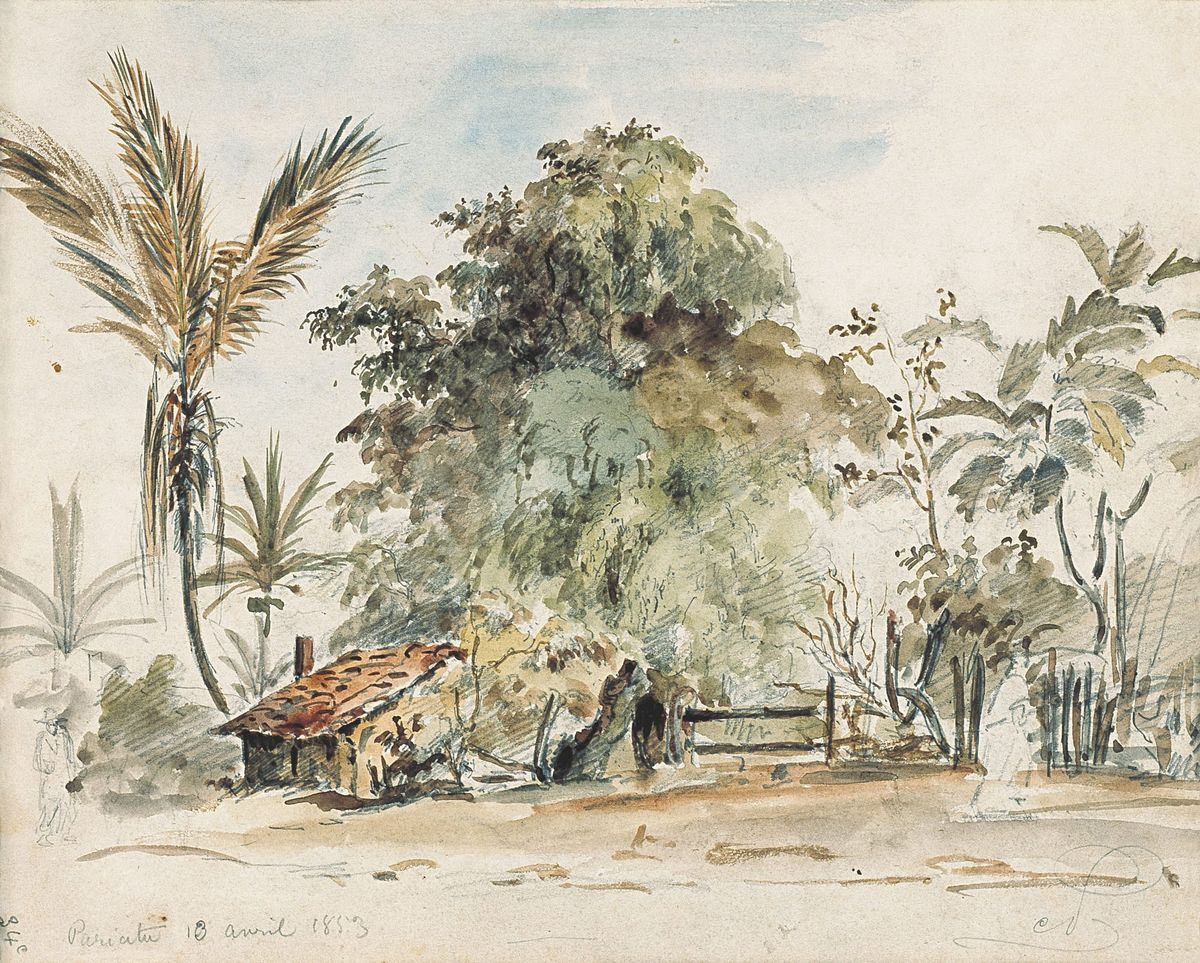
인상주의의 위대한 스승 카미유 피사로는 본격적으로 유럽 화단에 발을 들이기 전, 1852년부터 1854년까지 덴마크 화가 프리츠 멜비와 함께 베네수엘라 전역을 여행하며 자연을 직접 사생하는 귀중한 청년기를 보냈습니다. 1853년 4월 18일 베네수엘라의 해안 마을 파리아타(Pariata)에서 현장 사생으로 제작된 이 수채 드로잉은, 청년 피사로가 열대의 강렬한 태양과 원시 식생의 에너지를 마주하며 화가로서의 독자적인 시각을 벼려가던 가장 순수한 순간을 담고 있습니다.
종이 위에 연필과 잉크, 그리고 투명 수채 물감으로 완성된 이 작품은 가로 29.5cm, 세로 22.8cm 크기의 귀중한 소품으로, 현재 베네수엘라 카라카스의 갈레리아 데 아르테 나시오날(National Art Gallery) 등에 보존되어 초기 피사로 연구의 핵심적인 사료로 평가받고 있습니다. 당시 스물두 살의 청년이었던 피사로는 가족의 상업적 기대를 뒤로하고 자유로운 예술가의 삶을 찾아 떠난 방랑의 길목에서, 현장의 대기와 식생의 질감을 놀랍도록 경쾌하고 즉흥적인 필치로 종이 위에 봉인했습니다.
관람자의 시각 인지 체계는 화면 좌측 하단에서 홀로 붉은 기와지붕을 얹고 조용히 자리 잡은 소박한 오두막의 형태감에 가장 먼저 안착합니다. 주변을 둘러싼 무성하고 짙은 녹음과 오두막 지붕의 따뜻한 붉은 갈색 톤이 이루는 뚜렷한 색채 대비는 시각 피질의 중심와를 즉각 포획하며 시각적 탐색의 안정적인 구심점을 확립합니다.
이어서 시선은 오두막 바로 좌측에서 하늘을 향해 시원하게 뻗어 올라간 거대한 야자나무의 우아한 깃털 모양 잎사귀들을 타고 상승하여, 화면 중앙을 거대한 초록빛 돔처럼 가득 채운 울창한 열대림의 풍성한 볼륨감으로 자연스러운 도약 안구 운동을 진행합니다.
나무 꼭대기의 짙은 음영을 스친 시선은 잎사귀 틈새로 드러난 은은한 하늘빛과 흰 여백의 대기감을 확인한 뒤, 화면 우측으로 하강하여 나지막한 나무 울타리와 열대 관목들, 그리고 좌우 가장자리에 연필로 가볍게 스케치된 소박한 인물들의 희미한 윤곽선을 차례로 훑어냅니다.
종이의 자연스러운 질감 위에 스며든 맑은 수채 물감의 투명함과 잉크 선의 생동감이 망막 위에서 하나의 완성된 열대의 정취로 통합되는 순간, 관조자는 번잡한 일상의 긴장을 내려놓고 청량한 바닷바람과 따스한 햇살이 머무는 미지의 해변 마을에 서 있는 듯한 깊은 심리적 안도감과 내면의 평온을 체험하게 됩니다.
이 시기 베네수엘라에서 경험한 생생한 야외 사생 훈련은 훗날 피사로가 파리로 건너가 카미유 코로의 조언을 흡수하고 모네, 르누아르 등과 함께 인상주의의 '야외 사생(En plein air)' 원칙을 확립하는 데 결정적인 회화적 뿌리가 되었습니다.
그는 유럽 살롱이 답습하던 인위적인 명암법에 물들기 전, 열대의 생생한 햇살 아래서 자연을 직접 관찰하고 기록하는 직관적인 시각을 먼저 체화했습니다. 좌측 하단에 적힌 'Pariata 18 avril 1853'이라는 날짜와 지명, 그리고 우측 하단의 모노그램 서명은 대지와의 첫 교감을 기록한 청년 거장의 가슴 벅찬 숨결을 고스란히 증명합니다.
근대 미술사학자들은 피사로의 이 초기 베네수엘라 연작을 두고 "훗날 인상주의 혁명으로 만개하게 될 대자연에 대한 절대적인 경외심과 정직한 관찰력이 원형 그대로 보존된 기적 같은 기록"이라며 찬사를 아끼지 않고 있습니다.
원시의 싱그러운 생명력과 맑은 대기의 숨결을 거침없는 필치와 투명한 수채의 울림으로 포착한 피사로의 파리아타 풍경은, 현대 미술사에서 거장의 예술적 기원과 자연을 향한 영원한 사랑을 증언하는 매우 소중하고 독보적인 유산으로 확고하게 평가받고 있습니다.
Hut and Tropical Foliage in Pariata (Pariata, 18 avril 1853)
Before establishing his commanding presence within the French avant-garde, Camille Pissarro spent a formative period between 1852 and 1854 traveling across Venezuela alongside the Danish painter Fritz Melbye. Executed on site on April 18, 1853, in the coastal settlement of Pariata, this luminous watercolor and graphite drawing captures the young artist confronting the raw solar brilliance and lush flora of the tropics, forging the intuitive observational foundation of his lifelong career.
Rendered on paper with graphite, pen and ink, and fluid watercolor washes, this exquisite work measures 22.8 by 29.5 cm and is preserved within the collection of the Galería de Arte Nacional in Caracas, serving as a primary cornerstone for the study of Pissarro's youth. At twenty-two years old, having abandoned his family's mercantile trade in Saint Thomas to pursue the calling of an independent painter, Pissarro recorded the ambient warmth and untamed vegetation of the Caribbean coast with spontaneous calligraphic freedom.
The observer’s perceptual framework instantly grounds itself upon the rustic earthen cottage nestled in the lower-left foreground, crowned with a weathered terracotta-tiled roof. The warm chromatic resonance of the reddish-brown masonry against the surrounding verdant greenery arrests the fovea, establishing an intuitive and emotionally reassuring anchor for spatial navigation.
From this architectural core, the ocular trajectory tracks upward along the dynamic trunk of the soaring palm tree, sweeping through its feathered fronds before expanding across the dense, towering canopy of tropical foliage that commands the center of the sheet.
Scanning through the layered washes of olive and sage greens, the gaze encounters the pale blue atmospheric expanse of the sky, before descending across the rustic wooden fence on the right and lingering upon the faint, delicate graphite outlines of figures lightly sketched along the margins.
As the raw paper support and the transparent layers of watercolor coalesce into a harmonious sensory continuum within the visual cortex, active scanning dissolves into profound contemplative stillness, immersed in the restorative warmth of the tropical haven.
This intensive period of outdoor sketching in Venezuela provided the empirical foundation that later enabled Pissarro to pioneer open-air Impressionist painting in France alongside Claude Monet and Auguste Renoir.
Long before being subjected to conservative academic salon conventions, the master cultivated a pure, unmediated relationship with direct natural light and organic terrain. Inscribed with the precise date and location alongside his early monogram, this drawing stands as an unvarnished testament to the master's formative creative awakening.
Art historians universally celebrate Pissarro’s Venezuelan works, praising them as rare and miraculous archives where the future patriarch's uncompromised truthfulness and profound reverence for the living earth are preserved in their nascent purity.
Masterfully uniting energetic draftsmanship with delicate atmospheric transparency, Pissarro's view of Pariata remains celebrated across art history as an enduring testament to the humanist and environmental roots of modern landscape art.
본 콘텐츠의 저작권은 저작권자에게 있으며, 무단 전재 및 재배포를 금합니다.