팔의 골격과 회전 해부학 연구 (Anatomical Studies of the Bones of the Arm)
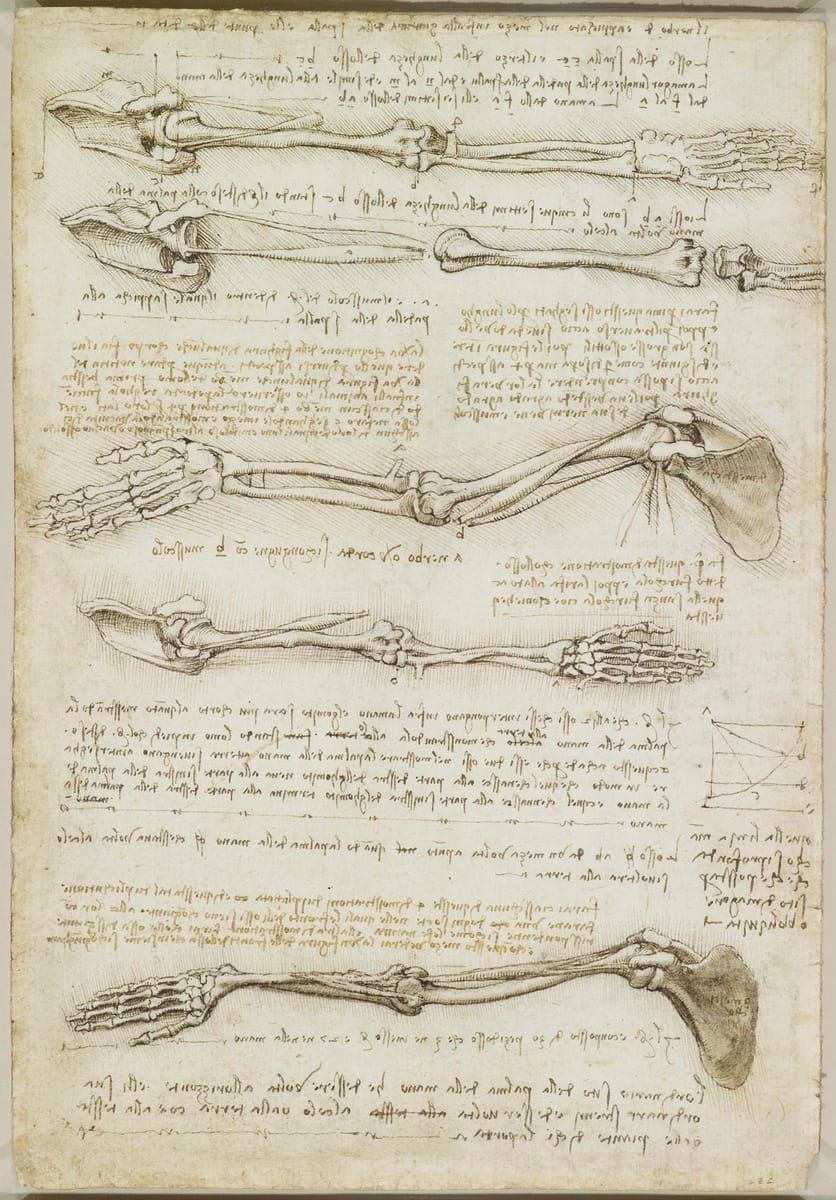
이 작품은 르네상스 시기 천재 거장 레오나르도 다 빈치(Leonardo da Vinci, 1452–1519)가 1510년경 완성한 의학 해부학 드로잉 명작 <팔의 골격과 회전 해부학 연구 (Anatomical Studies of the Bones of the Arm)>로, 실제 규격은 가로 20.2cm, 세로 28.8cm 크기이며 현재 영국 로열 컬렉션(Royal Collection Trust, Windsor Castle)에 소장되어 있습니다. 종이 위에 펜과 잉크, 브라운 워시 기법을 사용하여 인간 팔의 골격 구조와 척골, 요골의 회전 운동 메커니즘을 다각도에서 정교하게 탐구한 해부학 유작입니다.
미술사학계 및 의학사학계의 도상학적 분석에 따르면, 레오나르도는 상완골(위팔뼈), 노뼈(요골), 자뼈(척골), 그리고 어깨뼈(견갑골)와 손가락 뼈 마디에 이르는 연결 구조를 입체적으로 정밀 분석했습니다. 손바닥을 위로 향하게 하는 회외 운동(Supination)과 아래로 향하게 하는 회내 운동(Pronation) 시 두 뼈가 서로 교차하는 생체 역학적 원리를 기하학적이고 체계적으로 시각화했습니다. 우측 중앙의 사각형과 대각선 기하학 도면은 뼈의 회전 각도와 역학적 힘의 분배를 수학적으로 증명하려는 시도로, 인체를 자연이 만든 완벽한 기계적 구조물로 바라본 르네상스 인문주의 관점의 정수를 보여줍니다.
작품 곳곳에 적힌 글씨는 레오나르도 특유의 거울 쓰기(Mirror Writing, 오른쪽에서 왼쪽으로 거꾸로 쓰는 기법)로 작성되었습니다. 드로잉 사이사이에 적힌 이탈리아어 주석에는 "손을 바깥으로 돌릴 때 노뼈가 자뼈 위로 어떻게 교차하여 넘어가며 근육과 뼈의 축을 이루는지", "어깨 관절의 와요(Glena)에 상완골 헤드가 어떻게 맞물려 회전 반경을 만들어내는지"에 대한 관찰 기록이 담겨 있습니다. 하단 주석에는 "뼈의 기하학적 형태는 힘을 전달하는 레버와 같으며, 인간의 팔은 신이 설계한 가장 유연한 기계적 연구"라는 거장의 깊은 의학적 분석과 논리적 추론이 세밀하게 기재되어 있습니다.
이 화폭에는 서양 의학사를 한 단계 앞당긴 비하인드 스토리와 역사적 평가가 담겨 있습니다. 이 시기 레오나르도는 파비아 대학의 해부학 교수 마르칸토니오 델라 토레(Marcantonio della Torre)와 협력하여 인간 시체를 직접 해부하며 연구를 이어갔습니다. 단순한 외부 형태 묘사에 그치지 않고 각 관절의 가동 범위와 회전 기전을 정밀 도면 형태로 시각화한 이 드로잉은, 훗날 19세기 현대 정형외과 및 바이오메카닉스(생체역학)의 기틀을 마련한 서양 의학사상 혁신적인 연구로 평가받습니다. Modern 미술사학자들과 의학자들은 이 작품을 과학적 탐구와 예술적 표현력이 완벽한 조화를 이룬 르네상스 해부학 회화의 최고봉으로 높이 평가합니다.
이 그림을 가만히 바라보고 있으면 보는 이의 무의식 속에서 은은한 수직·수평적 시선 순환 구조가 부드럽게 작동합니다. 가장 먼저 상단의 곧게 뻗은 팔뼈와 손가락 마디의 정교한 필선에 시선이 닿은 뒤, 중앙의 뼈가 교차하는 회전 골격 구조와 우측의 기하학적 사각형 도면으로 이동합니다. 이후 하단에 수평으로 길게 놓인 견갑골과 팔 전체의 입체적 골격 구조를 거쳐, 여백에 빼곡히 적힌 거장의 거울 쓰기 글씨 라인을 타고 다시 상단의 골격 스케치로 되돌아오는 유연한 시선 흐름을 완성합니다. 이러한 시각적 순환 유도는 대뇌 인지 영역에서 찰나의 긴장감을 해쇄하고, 거장의 날것 그대로의 필선 속에서 깊은 내면의 평온과 안식을 선사합니다.
This masterpiece, titled Anatomical Studies of the Bones of the Arm, was created around 1510 by Renaissance genius Leonardo da Vinci (1452–1519). Measuring 20.2 cm in width by 28.8 cm in height, this detailed pen, ink, and wash drawing on paper is currently preserved in the Royal Collection Trust at Windsor Castle, United Kingdom. Depicting the skeletal structure of the human arm from multiple perspectives to analyze pronation and supination, the sheet stands as a monumental milestone in the history of biomechanics and anatomical illustration.
Art and medical historical scholarship highlights the brilliant mechanical architecture embedded within the drawing. Leonardo meticulously mapped how the radius rotates over the ulna during forearm rotation, isolating the leverage mechanics of the humerus, radius, ulna, and scapula. The geometric diagram on the right illustrates the rotational vectors and angular forces acting upon the elbow joint, demonstrating Leonardo's visionary ability to model human anatomy through rigorous mathematical and kinetic principles.
The annotations surrounding the skeletal studies are written in Leonardo's famous mirror script (backwards writing read from right to left). His detailed Italian notes explicitly describe "how the radius crosses over the stationary ulna during the rotation of the palm," and analyze "the exact ball-and-socket articulation of the humerus within the glenoid cavity of the scapula." In the lower marginal notes, Leonardo concludes that "the skeletal framework operates precisely like mechanical levers designed by nature," offering a revolutionary mechanical explanation for human movement and structural flexibility.
Fascinating historical backstories and glowing evaluations surround this iconic technical sheet. Created during his collaborative research with Marcantonio della Torre, professor of anatomy at the University of Pavia, Leonardo executed over thirty human dissections to achieve this level of unprecedented empirical accuracy. Modern medical historians and art critics revere this sheet as a visionary masterpiece that anticipated modern orthopedic biomechanics by centuries, celebrating its peerless synthesis of artistic beauty, scientific rigor, and mechanical depth.
Gazing upon this intricate anatomical sheet gently awakens a subtle subconscious visual rhythm. The viewer’s eye originates at the horizontal arm bones at the top, glides down toward the rotated skeletal studies and geometric square diagram in the middle, and sweeps across the complete arm and shoulder assembly at the bottom. The gaze then ascends fluidly along the dense columns of mirror-written script back to the top drawings, completing a soft, circular loop. This harmonious visual movement dissolves inner cognitive tension, inviting the mind into a quiet sanctuary of artistic wonder and serene contemplation.
본 리뷰에서 작품을 제외한 컨텐츠의 저작권은 팔렛트제주에 있습니다.
"퍼블릭도메인 고전명화"를 제외한 모든 창작 콘텐츠는 저작권법 제4조 및 제10조에 의거하여 보호됩니다. 무단 도용시 저작권법 제136조(벌칙)에 의거, 당사의 사전 서면 승인 없는 저작권 침해 행위를 금지합니다.