파이프를 문 자화상 - Self-Portrait with Pipe
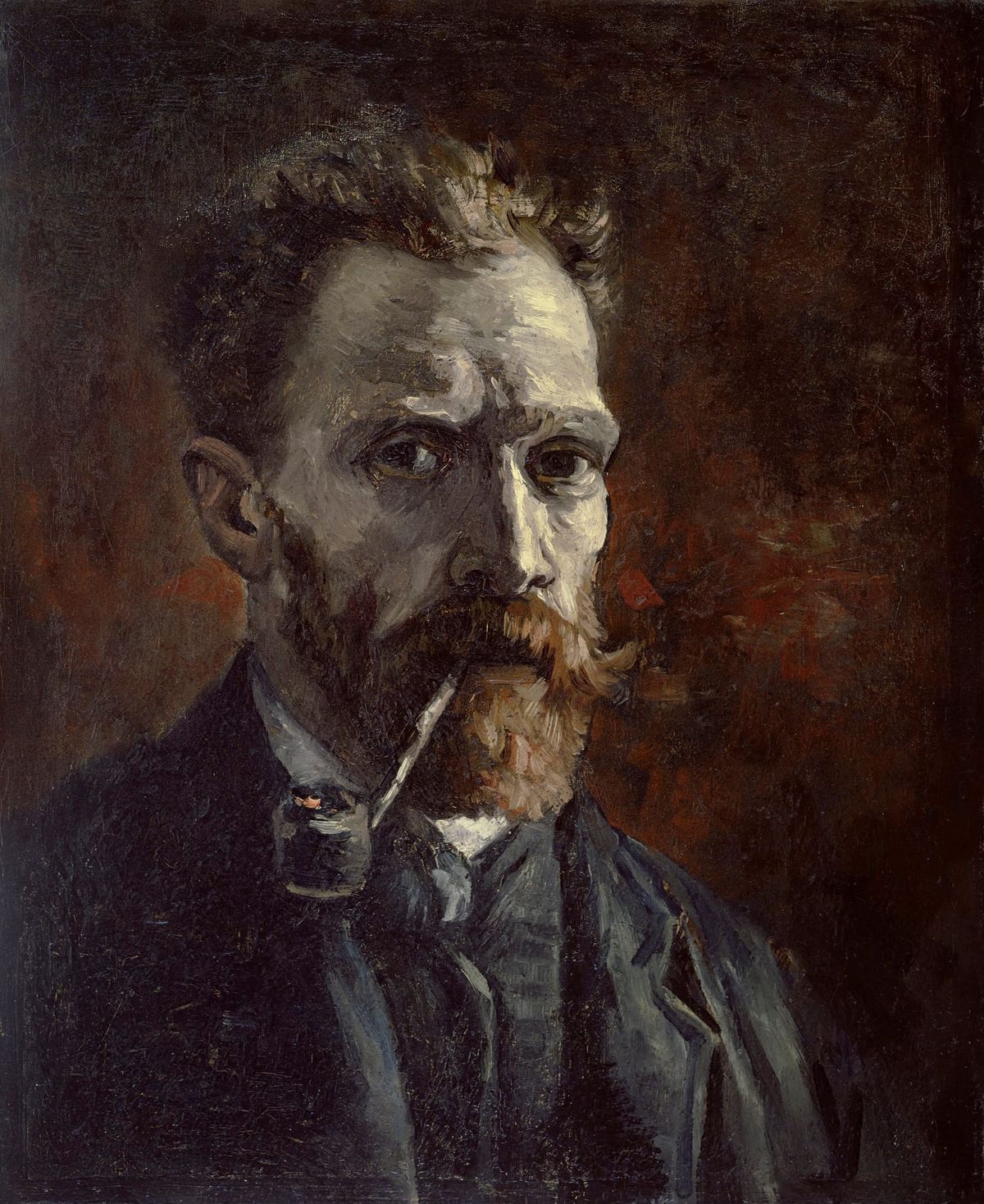
빈센트 반 고흐(Vincent van Gogh, 1853–1890)가 1886년 가을 프랑스 파리 체류 시절 완성한 '파이프를 문 자화상(Self-Portrait with Pipe)'은 캔버스에 유채(Oil on canvas)로 제작된 인물화입니다. 작품의 실제 규격은 세로 46.0cm, 가로 38.0cm이며, 현재 네덜란드 암스테르담의 반 고흐 미술관(Van Gogh Museum)에 영구 소장되어 있습니다.
고흐는 이 작품에서 어둡고 묵직한 적갈색 배경 위에 얼굴의 굴곡과 골격을 드러내는 강렬한 명암 대비(Chiaroscuro)를 구사했습니다. 네덜란드 시절의 어두운 토속적 색조를 유지하면서도 이마와 뺨, 코끝에 닿는 빛의 반사를 두터운 임파스토(Impasto) 기법으로 표현했으며, 붉은빛 수염과 파이프의 하얀 연기 흔적, 그리고 관람자를 꿰뚫어 보는 듯한 날카로운 눈빛을 거칠고 단단한 필치로 직조해 냈습니다.
이 그림에는 파리에 갓 입성한 무명 화가 반 고흐의 지독한 고투와 인간적인 에피소드가 짙게 배어 있습니다. 1886년 초, 고흐는 파리 몽마르트르에 있던 동생 테오의 아파트에 불쑥 찾아와 더부살이를 시작했습니다. 당시 고흐는 새로운 미술 사조였던 인상주의와 점묘주의의 물결을 목격하며 큰 충격을 받았으나, 당장 파리의 화려한 모델을 고용할 돈이 단 한 푼도 없었습니다.
돈이 없어 모델을 구할 수 없었던 고흐는 몽마르트르 시장에서 싸구려 거울 하나를 사 왔습니다. 그리고 햇볕도 잘 들지 않는 좁은 방구석에서 거울 속 자신의 얼굴을 끝없이 응시하며 20여 점이 넘는 자화상을 미친 듯이 그려나갔습니다. 당시 고흐에게 파이프 담배는 단순한 기호품을 넘어, 지독한 가난과 굶주림 속에서 헛헛한 배를 채우고 신경을 달래주던 유일한 위로이자 영혼의 친구였습니다.
고흐는 훗날 아를과 생레미의 병상에 누워 있을 때도 "파이프를 물고 연기를 뿜어낼 때 비로소 내 마음의 지옥이 잠시 잠잠해진다"고 고백할 만큼 파이프에 강박적인 애착을 보였습니다. 몽마르트르의 화가들은 낡은 코트를 걸치고 입에 파이프를 문 채 눈을 번뜩이며 거울을 노려보던 붉은 수염의 고흐를 보며 괴짜 이방인이라 여겼지만, 고흐는 거울 속 자신의 피폐한 외형 속에서 예술을 향해 타오르는 원초적인 내면의 불꽃을 집요하게 포착해 냈습니다.
후대의 미술사학자들과 평단은 이 작품을 반 고흐가 어두운 네덜란드 리얼리즘 화풍에서 파리의 현대적 색채 감각으로 전환해 가던 과도기의 심리적 긴장감을 가장 정직하게 드러낸 명작으로 평가합니다. 대상의 아름다움을 꾸며내지 않고, 가난과 고독에 맞서 싸우는 화가 자신의 실존적 고뇌와 예술적 야망을 타협 없이 담아낸 19세기 자화상 회화의 기념비적인 성취로 인정받고 있습니다.
관람자의 시선은 가장 먼저 어둠 속에서 빛을 받아 번뜩이는 고흐의 강렬한 눈매와 단단하게 다문 입술, 그리고 입에 문 파이프의 하얀 자루에 사로잡힙니다. 이어 이마와 콧날을 따라 굵고 거칠게 내려앉은 빛의 양감을 훑은 뒤, 붉은빛과 금빛이 뒤섞인 턱수염의 거친 결을 타고 어두운 남색 재킷과 붉은 갈색 배경으로 이동합니다. 마지막으로 인물의 얼굴을 에워싼 깊은 그림자의 공간감을 따라 화면 전체로 유려하게 순환하게 됩니다.
심리적으로 관람자는 어둠 속에서도 꺾이지 않는 인물의 결연한 눈빛과 굳게 다문 입술에서 깊은 전율과 함께 강인한 실존적 에너지를 경험하게 됩니다. 곤궁한 현실 속에서도 자신과의 처절한 대면을 피하지 않았던 화가의 진솔한 시선은 현대인의 내면에 잠재된 불안과 고독을 어루만져 주며, 삶의 어떠한 시련 속에서도 결코 흔들리지 않는 내면의 단단한 용기와 회복의 힘을 풍성하게 채워줍니다.
Self-Portrait with Pipe
Painted by Vincent van Gogh (1853–1890) in Paris during the autumn of 1886, Self-Portrait with Pipe is an oil on canvas portrait measuring 46.0 cm in height and 38.0 cm in width. This historic masterwork is permanently preserved in the renowned collection of the Van Gogh Museum in Amsterdam, Netherlands.
Van Gogh structured this psychological study through dramatic chiaroscuro, setting the sculptural mass of his head against a brooding, reddish-brown background. While still retaining the dark tonalities of his Dutch period, he deployed thick, directional impasto across the forehead, cheekbones, and nose to register the striking collision of light and shadow, capturing his piercing gaze and the rustic pipe with unvarnished, tactile honesty.
The canvas holds an intimate history of artistic survival and emotional resilience. In early 1886, Van Gogh arrived unannounced in Paris to live with his brother Theo in Montmartre. Confronted by the vibrant palettes of the Impressionists, Van Gogh was eager to experiment with modern portraiture but lacked the funds to hire professional models.
Resourceful yet impoverished, Van Gogh purchased a cheap mirror and turned his intense scrutiny upon himself, producing dozens of self-portraits in rapid succession. During these solitary sessions, the pipe became an indispensable companion—a humble grounding tool that soothed his nerves and suppressed physical hunger amidst grinding poverty.
Years later, while confined to hospital beds in the south of France, Van Gogh reflected that smoking his pipe remained his solitary sanctuary against internal turmoil. Fellow Montmartre painters often viewed the eccentric red-bearded Dutchman in his worn coat with curious detachment, unaware that this relentless self-examination was laying the foundation for a profound revolution in modern psychological portraiture.
Art historians and scholars celebrate this Paris self-portrait as a crucial transitional milestone. Capturing the tension between his somber Northern roots and the luminous modernism of Paris, the canvas serves as an uncompromised existential document that elevates the genre of self-portraiture into a raw visual testament of creative endurance.
A viewer’s gaze is instantaneously locked upon the luminous, penetrating eyes and the resolute angle of the pipe clenched between the artist's lips. The eyes then follow the sculpted ridge of the nose and the textured, fiery contours of his reddish beard, before descending across the heavy, dark coat and dissolving into the atmospheric warmth of the surrounding amber shadows.
Psychologically, the unyielding intensity of the artist's gaze against the shadowy void evokes an immediate sense of visceral focus, fortitude, and cathartic grounding. Witnessing this unflinching confrontation with the self gently dissolves subconscious doubts and fatigue, instilling the observer with enduring courage, emotional resilience, and a profound appreciation for the unyielding power of the human spirit.
본 리뷰에서 작품을 제외한 컨텐츠의 저작권은 팔렛트제주에 있습니다.
"퍼블릭도메인 고전명화"를 제외한 모든 창작 콘텐츠는 저작권법 제4조 및 제10조에 의거하여 보호됩니다. 무단 도용시 저작권법 제136조(벌칙)에 의거, 당사의 사전 서면 승인 없는 저작권 침해 행위를 금지합니다.