오니의 비온 강둑, 흐린 날씨, 겨울 - The banks of the Viosne at Osny in grey weather, winter (Les bords de la Viosne à Osny, temps gris, hiver)
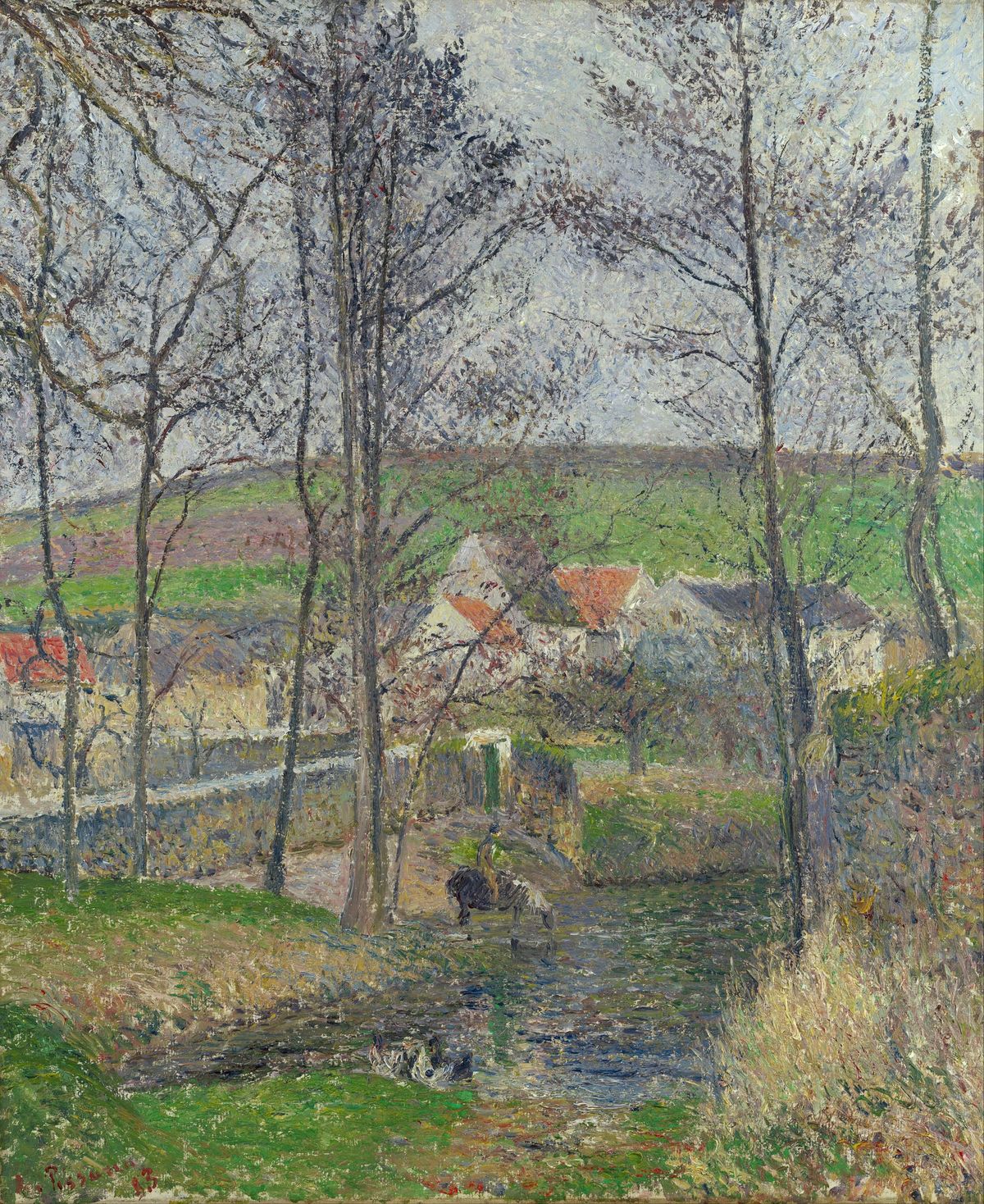
카미유 피사로(Camille Pissarro)가 1883년에 완성한 캔버스 유화 작품입니다. 실제 크기는 약 65.3 x 54.5 cm이며, 현재 호주 멜버른에 위치한 빅토리아 국립미술관(National Gallery of Victoria, Melbourne)에 소장되어 있습니다. 화면 좌측 하단에는 화가의 붉은빛 서명과 연도인 'C. Pissarro 83'이 정갈하게 새겨져 있습니다.
피사로는 특유의 촘촘하고 직조된 듯한 분할 붓터치를 활용해, 늦겨울 흐린 날 특유의 차분하고 은은한 회백색 대기광과 맑은 시냇물의 반짝임을 탁월하게 포착했습니다. 화면을 수직으로 가로지르는 앙상한 나뭇가지들의 섬세한 실루엣, 돌담과 물가의 마른 풀잎들이 만들어내는 유화 물감의 풍부한 마티에르는, 차가운 계절 속에서도 대지가 품고 있는 따뜻한 생명력과 깊은 공간감을 고스란히 전해줍니다.
이 작품의 배경이 된 오니(Osny)는 피사로가 대가족을 이끌고 정착하여 치열하게 예술적 신념을 다졌던 파리 근교의 작은 시골 마을입니다. 1883년 당시 피사로는 그림이 팔리지 않아 끼니와 집세를 걱정해야 할 정도로 극심한 가난에 시달렸지만, 날씨가 궂거나 흐린 날에도 결코 이젤을 접지 않고 비온강 어귀로 나갔습니다.
개울물에 말을 세우고 물을 먹이는 시골 일꾼, 맑은 물살 위를 유유히 헤엄치는 오리들, 그리고 돌담 너머로 옹기종기 모여 있는 주황빛 지붕의 시골 가옥들은 당시 피사로가 매일 마주하던 가장 정직하고 소박한 이웃들의 삶이었습니다. 특히 이 시기에는 젊은 폴 고갱이 피사로의 곁을 지키며 함께 야외 작업을 진행했고, 피사로의 흔들리지 않는 뚝심과 소박한 자연관에 깊은 감화를 받았습니다. 생활고의 시련 속에서도 세상의 화려함 대신 묵묵히 제 자리를 지키는 시골 풍경을 온화한 시선으로 보듬었던 대가의 따스한 휴머니즘이 캔버스 구석구석에 깃들어 있습니다.
미술사적으로 이 작품은 빛의 강렬한 반짝임에만 기대지 않고, 흐린 날의 미묘한 회색조(Temps gris) 대기 속에서 형태와 색채의 구조적 안정감을 완벽하게 직조해 낸 피사로 중기 풍경화의 수작으로 평가받습니다. 모네가 빛에 의해 형태가 용해되는 찰나의 환영에 집중했다면, 피사로는 겨울 나무의 뼈대와 견고한 돌담, 그리고 대지의 영속성을 화면에 단단하게 정초 시켰습니다.
평단과 후대의 비평가들은 화려한 과장 없이도 고요한 겨울 전원의 풍경에서 삶의 진솔한 안식과 숭고한 평화를 길어 올린 피사로의 깊은 예술혼에 아낌없는 찬사를 보내고 있습니다.
관람자의 무의식적인 시선은 화면 하단의 맑은 비온강 수면 위를 한가롭게 유영하는 오리들과 투명하게 반사되는 푸른 물빛에서 편안하게 출발합니다.
이어 시선은 물가에 말을 세우고 쉬어가는 일꾼의 정겨운 실루엣을 지나, 하늘을 향해 곧고 시원하게 솟아오른 앙상한 겨울 나무줄기들을 타고 자연스럽게 수직 상승합니다.
이 유려하고 안정적인 시각적 흐름은 복잡한 일상과 도심의 피로에 짓눌려 있던 관람객의 뇌파를 순식간에 차분한 알파파 상태로 이끌며, 맑고 서늘한 겨울 숲속에 홀로 서 있는 듯한 깊은 심리적 안도감과 정서적 정화를 선사합니다.
마지막으로 돌담 너머 포근하게 자리 잡은 주황빛 지붕의 마을 가옥들과 완만하게 솟은 푸른 언덕 능선을 돌아 다시 잔잔한 개울물로 순환하는 시선의 흐름은, 번잡한 생각을 내려놓고 고요한 시골 시냇가에서 맑은 공기를 깊게 들이마시는 듯한 깊은 이완과 온전한 평온을 안겨줍니다.
The banks of the Viosne at Osny in grey weather, winter - The banks of the Viosne at Osny in grey weather, winter (Les bords de la Viosne à Osny, temps gris, hiver)
Painted in 1883 by Camille Pissarro, this oil on canvas measures approximately 65.3 by 54.5 centimeters and is housed in the permanent collection of the National Gallery of Victoria in Melbourne, Australia. The artist's red signature and date, 'C. Pissarro 83', are inscribed with quiet refinement in the lower left corner.
Employing a dense, woven network of divided and textured brushstrokes, Pissarro masterfully captures the soft, diffused light of a grey winter day and the crisp clarity of a rural waterway. The slender, vertical silhouettes of bare trees, the rugged textures of the stone walls, and the weathered grasses along the bank coalesce to evoke the brisk yet gentle atmosphere of the French countryside with remarkable sensory intimacy.
The setting of Osny, a modest rural commune northwest of Paris, served as an essential sanctuary of artistic resolve during an acutely difficult chapter in Pissarro's life. Facing relentless financial hardship and critical neglect while providing for his large family, Pissarro nevertheless stepped outside daily with his easel, undeterred by the cold or overcast skies.
A lone rider pausing to water his horse in the shallow brook, ducks gliding across the cool current, and the cluster of terracotta roofs nestled behind stone walls reflect the unpretentious cadence of daily village life. During this period, a young Paul Gauguin worked closely alongside Pissarro, drawing profound inspiration from the venerable master's humble reverence for the natural world. Amidst severe personal trials, Pissarro embraced the quiet dignity of the countryside, infusing this secluded riverbank with enduring humanist warmth.
Art historians celebrate this painting as a masterwork of Impressionist tonal nuance, where the delicate palette of overcast weather (temps gris) achieves tectonic structural stability. While Claude Monet frequently pursued the optical dissolution of forms under intense sunlight, Pissarro anchored the enduring architecture of nature—from bare branches to living earth—with palpable permanence.
Modern critics honor the work for its authentic emotional resonance, praising Pissarro’s lifelong ability to discover timeless solace, gentle peace, and spiritual refuge within the quiet winter landscapes of rural France.
The viewer's subconscious gaze is first welcomed by the cool, clear surface of the Viosne in the foreground, where ducks swim peacefully amidst the shimmering water reflections.
The eye then glides naturally upward toward the rider watering his horse, ascending along the rhythmic, vertical contours of the slender tree trunks reaching into the soft winter sky.
This grounding and expansive visual journey immediately relieves accumulated mental stress, guiding the mind into a state of meditative calm and deep emotional stability.
As the visual path wanders past the warm terracotta roofs nestled against the rolling green hillside before returning to the cooling stream below, the observer experiences a soothing sensory escape, enveloped in the lasting serenity and quiet grandeur of a peaceful afternoon in Osny.
본 리뷰에서 작품을 제외한 컨텐츠의 저작권은 팔렛트제주에 있습니다.
"퍼블릭도메인 고전명화"를 제외한 모든 창작 콘텐츠는 저작권법 제4조 및 제10조에 의거하여 보호됩니다. 무단 도용시 저작권법 제136조(벌칙)에 의거, 당사의 사전 서면 승인 없는 저작권 침해 행위를 금지합니다.