올리브 나무와 알피유 산 - The Olive Trees (Olive Trees with the Alpilles in the Background)
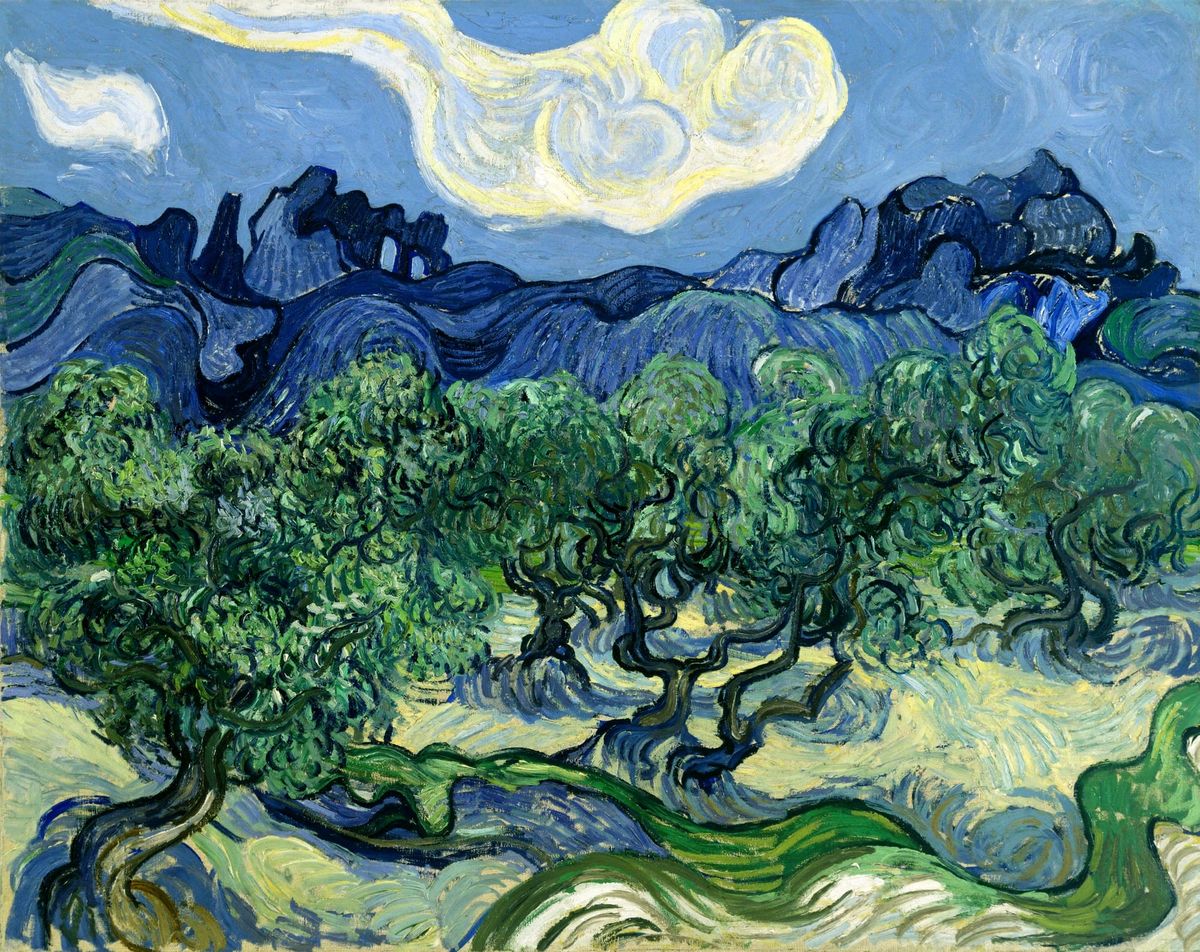
빈센트 반 고흐(Vincent van Gogh, 1853–1890)가 1889년 6월 프랑스 남부 생레미 드 프로방스(Saint-Rémy-de-Provence)의 생폴 드 모졸 수도원 정신병원에 머물던 시절 완성한 '올리브 나무와 알피유 산(The Olive Trees)'은 캔버스에 유채(Oil on canvas)로 제작된 풍경화입니다. 작품의 실제 규격은 세로 72.6cm, 가로 91.4cm이며, 현재 미국 뉴욕의 현대미술관(Museum of Modern Art, MoMA)에 영구 소장되어 있습니다.
고흐는 이 작품에서 살아 움직이는 듯한 유기적 곡선과 캔버스 위에 물감을 조각하듯 두텁게 얹는 특유의 임파스토(Impasto) 기법을 밀도 높게 구사했습니다. 은빛과 올리브 그린이 감도는 나뭇잎의 질감, 용틀임하듯 뒤틀린 고목의 줄기, 거대한 해일처럼 굽이치는 알피유(Alpilles) 산맥의 짙푸른 코발트 톤, 그리고 소용돌이치는 백색과 황금빛 구름의 궤적은 서로 맞물리며 온 대지가 하나의 거대한 생명체처럼 숨을 쉬는 역동적인 시각적 파동을 뿜어냅니다.
이 그림에는 반 고흐의 치열했던 예술적 논쟁과 흥미진진한 비하인드 스토리가 얽혀 있습니다. 1889년 6월, 고흐는 미술사의 전설적인 걸작 '별이 빛나는 밤'을 완성한 바로 그 주에, 그와 짝을 이루는 '낮의 빛'을 포착하기 위해 병원 밖 올리브 숲으로 달려나갔습니다.
당시 파리에 있던 폴 고갱과 에밀 베르나르는 작업실에 앉아 상상력만으로 '겟세마네 동산의 그리스도' 같은 종교화를 그리며 고흐에게도 함께할 것을 부추겼습니다. 하지만 고흐는 이에 격분하며 "성경 속 신화에 매달려 추상적인 환상을 날조하는 것은 예술에 대한 기만이다. 신의 진짜 위로와 고통은 바람과 흙, 척박한 바위틈을 뚫고 솟아난 올리브 나무의 뼈마디에 살아 숨 쉬고 있다"라며 친구들의 제안을 단호히 거절했습니다.
실제로 당시 고흐가 올리브 숲에서 작업할 때, 캔버스 위로 거센 미스트랄 바람이 몰아쳐 흙먼지와 메뚜기, 마른 솔잎들이 젖은 유화 물감 위에 사정없이 달라붙었습니다. 고흐는 이를 떼어내지도 않은 채 붓으로 짓이기며 "대자연이 직접 내 그림에 서명하고 있다"며 광기 어린 희열 속에서 붓질을 이어갔습니다. 심지어 2017년 미국 넬슨 앳킨스 미술관의 보존 과학팀이 고흐의 올리브 나무 연작을 현미경으로 정밀 분석하던 중, 130여 년 전 고흐가 캔버스에 물감을 바르던 순간 날아들어 그대로 굳어버린 실제 메뚜기의 몸통과 다리 파편을 발견하여 전 세계 미술계를 놀라게 한 일화는 화가의 야외 사생이 얼마나 치열했는지를 증명합니다.
후대의 미술사학자들과 평단은 이 작품을 20세기 현대 표현주의의 문을 연 위대한 이정표로 극찬합니다. 사물의 외형을 단순히 재현하는 것을 넘어 자연의 원초적인 생명력과 화가의 격동하는 내면 심리를 완벽하게 일체화시킨 조형적 성취는, 풍경화를 순수한 인간 영혼의 거룩한 고백의 경지로 끌어올린 불멸의 걸작으로 평가받고 있습니다.
관람자의 시선은 가장 먼저 화면 전면에서 대지를 움켜쥐듯 뒤틀리며 솟아오른 올리브 고목들의 강인한 줄기와 은녹색 잎사귀의 율동감에 머뭅니다. 이어 나무들 사이를 굽이치는 황금빛 대지의 물결을 타고 화면 중단의 거대한 푸른 알피유 산맥의 능선으로 상승한 뒤, 마침내 하늘 위에서 살아 숨 쉬는 유기체처럼 소용돌이치는 백색 구름의 찬란한 광휘로 부드럽게 확산됩니다.
심리적으로 관람자는 대지와 산맥, 하늘이 한 몸처럼 요동치는 거대한 자연의 파동 속에서 일상의 억압된 긴장감이 단숨에 해체되는 깊은 정서적 해방감을 경험하게 됩니다. 척박한 바위산 아래에서도 은빛 잎을 흔들며 살아 숨 쉬는 올리브 나무들의 강인한 생명력은 무의식중에 내재된 불안과 고독을 보듬어주며, 어떠한 시련 속에서도 묵묵히 버텨낼 수 있는 깊은 내적 평온과 회복 탄력성의 에너지를 풍성하게 채워줍니다.
The Olive Trees (Olive Trees with the Alpilles in the Background)
Painted by Vincent van Gogh (1853–1890) in June 1889 while staying at the Saint-Paul de Mausole asylum in Saint-Rémy-de-Provence, The Olive Trees is an iconic oil on canvas landscape measuring 72.6 cm in height and 91.4 cm in width. This masterwork is permanently preserved in the renowned collection of the Museum of Modern Art (MoMA) in New York, United States.
Van Gogh articulated the composition through continuous undulating contours and a dense, sculpted impasto that turns the surface into a tactile relief. The shimmering silver-greens of the olive foliage, the contorted dark trunks, the surging cobalt rhythm of the Alpilles mountain range, and the swirling vortex of the golden-tinged cloud interact seamlessly, transforming the landscape into a grand, pulsating manifestation of living cosmic energy.
The canvas holds a fascinating behind-the-scenes history born from Van Gogh's fierce artistic convictions. In June 1889, during the exact same week he painted his iconic nocturnal masterpiece The Starry Night, Van Gogh ventured out into the surrounding groves to capture its daylight counterpart.
At the time, his contemporaries Paul Gauguin and Émile Bernard were urging him to paint religious subjects purely from imagination, sending him sketches of Christ in the Garden of Olives. Van Gogh vehemently rejected their abstract mysticism, arguing passionately in his letters that true divinity and spiritual consolation resided in the raw reality of nature itself—in the gnarled bark, resilient roots, and shifting silver foliage weathering the rocky terrain.
During these open-air sessions, the ferocious Provençal Mistral winds battered his canvas, embedding wind-blown debris and insects into the wet pigment. Undeterred, Van Gogh worked through the tempest, declaring that nature itself was participating in the creation of the piece. This tactile intensity was famously validated in 2017 when conservators at the Nelson-Atkins Museum of Art discovered the microscopic remains of a grasshopper embedded within the paint layers of one of his Olive Grove canvases, frozen in time since the summer of 1889.
Modern art historians celebrate this masterpiece as a foundational milestone of Expressionism. By transcending conventional topographic documentation to channel the raw vitality of nature and the turbulence of the human psyche, Van Gogh elevated landscape painting into an enduring testament to spiritual endurance and creative resilience.
A viewer’s gaze instinctively settles upon the muscular, twisting trunks and expressive silver-green crowns of the foreground olive trees. From this grounding anchor, the eyes follow the rhythmic currents of the golden earth upward toward the muscular blue waves of the Alpilles mountains, before ascending effortlessly into the dramatic, swirling cloud that illuminates the vibrant blue expanse above.
Psychologically, the organic unity and chromatic harmony between terrestrial ochres, olive greens, and atmospheric blues evoke a liberating sensation of emotional release and deep grounding. Confronting the resilient energy of the grove eases underlying anxieties and mental exhaustion, enveloping the observer in an enduring atmosphere of spiritual fortitude, profound peace, and restorative hope.
본 리뷰에서 작품을 제외한 컨텐츠의 저작권은 팔렛트제주에 있습니다.
"퍼블릭도메인 고전명화"를 제외한 모든 창작 콘텐츠는 저작권법 제4조 및 제10조에 의거하여 보호됩니다. 무단 도용시 저작권법 제136조(벌칙)에 의거, 당사의 사전 서면 승인 없는 저작권 침해 행위를 금지합니다.