올리브 나무들 (빛나는 태양 아래 올리브 과수원) - Olive Trees (Olive Orchard with Sun)
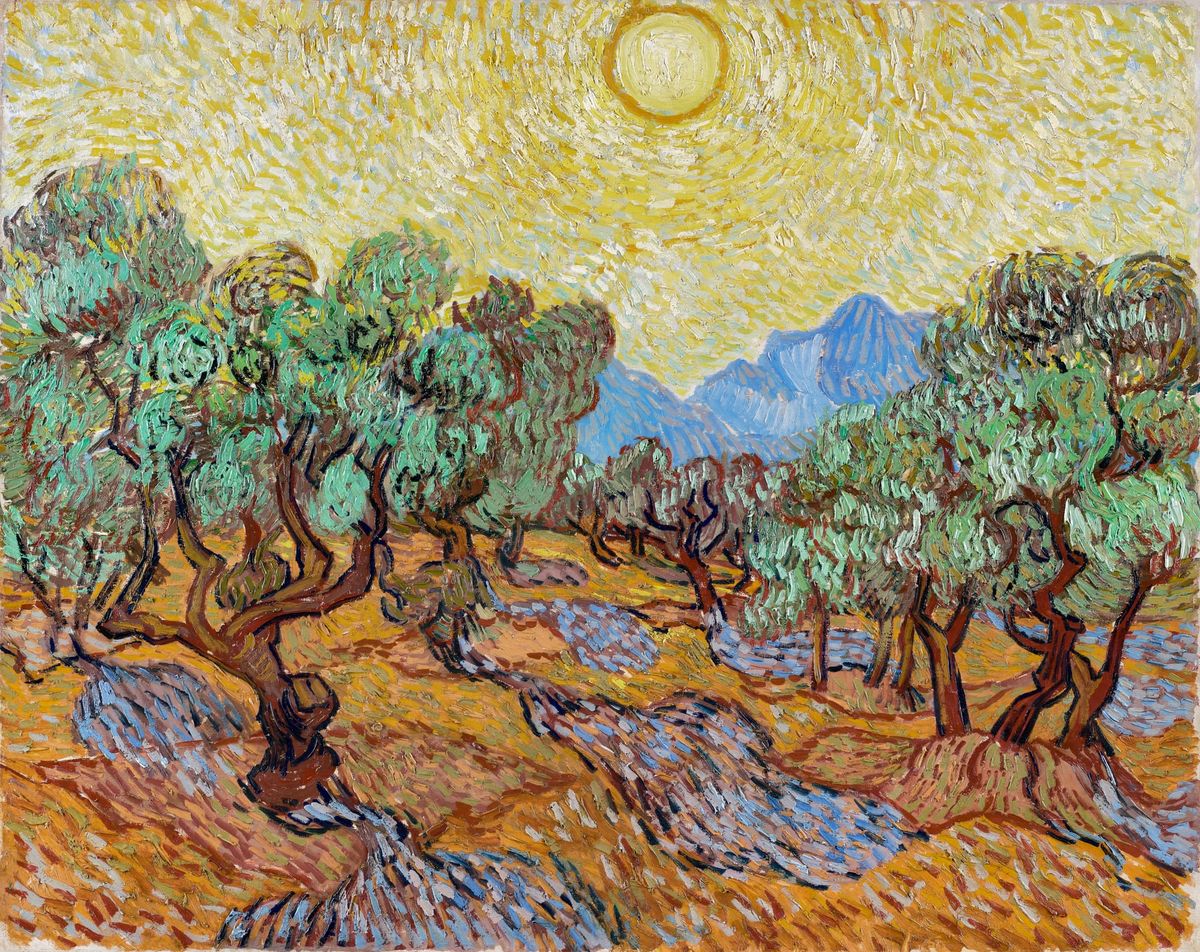
빈센트 반 고흐(Vincent van Gogh, 1853–1890)가 1889년 11월 프랑스 남부 생레미 드 프로방스(Saint-Rémy-de-Provence)의 생폴 드 모졸 수도원 정신병원에 머물던 시절 완성한 '올리브 나무들(Olive Trees)'은 캔버스에 유채(Oil on canvas)로 제작된 풍경화입니다. 작품의 실제 규격은 세로 73.0cm, 가로 92.0cm이며, 현재 미국 미니애폴리스 미술관(Minneapolis Institute of Arts)에 영구 소장되어 있습니다.
고흐는 이 작품에서 화면 상단 중앙에 타오르는 거대한 황금빛 태양과 그로부터 뿜어져 나오는 동심원 형태의 눈부신 광채를 압도적인 붓 터치로 구현했습니다. 레몬 옐로와 백색으로 이글거리는 태양빛 아래, 청록빛과 은회색 잎사귀를 두른 올리브 나무들의 비틀린 줄기는 마치 대지 위에서 고뇌하며 춤추는 인간의 형상처럼 꿈틀거립니다. 흙과 그림자를 가로지르는 황토색 오커와 서늘한 보랏빛 푸른 그림자의 보색 대비, 그리고 두텁게 얹어 올린 임파스토(Impasto) 선묘는 화면 전체에 우주적 생명력과 영적인 진동을 불어넣습니다.
이 그림에는 정신병원의 엄격한 격리와 지독한 발작 속에서도 올리브 나무를 통해 자신의 상처를 치유하고 종교적 구원을 갈망했던 반 고흐의 눈물겨운 인간적 에피소드가 깃들어 있습니다. 1889년 가을, 고흐는 병원 벽 너머로 보이는 프로방스의 오래된 올리브 과수원에 깊이 매료되었습니다. 척박하고 메마른 바위투성이 땅에 뿌리를 깊게 내린 채 비바람을 견뎌온 올리브 나무의 옹이진 줄기는, 고난 속에서도 묵묵히 버텨내는 인간의 숭고한 영혼이자 겟세마네 동산에서 기도하던 그리스도의 고뇌를 연상시켰습니다.
당시 고흐의 친구였던 폴 고갱과 에밀 베르나르는 파리에서 그리스도의 수난을 다룬 전통적인 성서화를 상상으로 그려 고흐에게 보내왔습니다. 하지만 고흐는 상상 속의 종교화를 강하게 거부하며, "진정한 성스러움은 눈앞에 살아 숨 쉬는 자연의 고통과 빛을 직접 마주할 때만 포착할 수 있다"고 반박했습니다. 고흐는 병원 측의 특별 허가를 받아 무거운 화구를 짊어지고 올리브 과수원으로 매일같이 걸어 나갔습니다.
고흐는 차가운 가을바람과 뜨거운 햇살이 교차하는 들판에 서서 거칠게 붓을 휘둘렀습니다. 그는 동생 테오에게 보낸 편지에서 "올리브 잎사귀들은 은빛과 청록빛 사이에서 끊임없이 변하며, 그 아래 흙은 햇빛을 받아 보랏빛과 황금빛으로 물든다. 나는 성서 속 겟세마네를 상상으로 그리는 대신, 타오르는 태양 아래 거칠게 비틀린 올리브 나무들을 통해 신의 고뇌와 위로를 캔버스에 담고 있다. 이 나무들을 그리고 있을 때 비로소 내 내면의 폭풍이 잦아든다"고 고백했습니다. 과수원을 지나던 마을 사람들과 수도사들은 뙤약볕과 바람을 온몸으로 맞으며 물감을 짓이기듯 칠하던 붉은 머리의 고흐를 넋을 잃고 바라보았고, 훗날 캔버스 표면에서는 당시 야외에서 작업하던 중 바람에 날려 붙은 실제 메뚜기 날개 파편이 보존 처리 과정에서 발견되기도 했습니다.
후대의 미술사학자들과 평단은 이 미니애폴리스 미술관 소장본을 반 고흐가 생레미 시기에 완성한 '올리브 연작' 중에서도 가장 조형적 웅장함과 영적 순도가 높은 최고의 마스터피스로 평가합니다. 자연의 형태를 화가의 격정적인 심리적 상태와 영적 승화의 매개체로 변용한 이 성취는, 20세기 독일 표현주의와 현대 종교적 상징주의 회화의 문을 활짝 연 불멸의 유산으로 극찬받고 있습니다.
관람자의 시선은 가장 먼저 화면 상단 중앙에서 태초의 빛처럼 타오르는 황금빛 태양과 사방으로 회전하며 퍼져나가는 동심원 붓 터치의 광채에 압도됩니다. 이어 원초적인 생명력을 뿜어내며 비틀린 전면 올리브 나무들의 굵은 줄기와 은청색 잎사귀들의 율동감을 타고 내려와, 대지 위로 물결치듯 깔린 황토빛 흙과 보랏빛 푸른 그림자의 사선 패턴에 머물게 됩니다. 마지막으로 배경에 아스라이 솟아오른 알피유 산맥의 푸른 능선을 지나 화면 전체로 유려하게 순환하게 됩니다.
심리적으로 관람자는 온 세상을 환하게 비추는 찬란한 태양의 온기와 대지에 단단히 뿌리박은 고목의 숭고한 생명력 속에서 깊은 영적 정화와 내적 카타르시스를 경험하게 됩니다. 척박한 고통을 딛고 끝내 찬란한 빛을 향해 뻗어 나가는 올리브 나무의 의연한 자태는 현대인의 마음에 쌓인 불안과 지친 감정을 따스하게 보듬어주며, 어떤 시련 앞에서도 다시 일어설 수 있는 강인한 회복의 용기와 깊은 평온을 풍성하게 채워줍니다.
Olive Trees (Olive Orchard with Sun)
Painted by Vincent van Gogh (1853–1890) in Saint-Rémy-de-Provence in November 1889 during his stay at the Saint-Paul de Mausole asylum, Olive Trees is an iconic oil on canvas landscape measuring 73.0 cm in height and 92.0 cm in width. This celebrated masterwork is permanently preserved in the prestigious collection of the Minneapolis Institute of Arts in Minnesota, United States.
Van Gogh constructed the landscape around a commanding celestial core, placing an incandescent golden sun high in the heavens that radiates pulsating concentric halos of lemon yellow and cream. Beneath this divine illumination, the ancient olive trees writhe with muscular, expressive vitality, their gnarled trunks rendered in deep terracotta and Prussian blue. The shimmering canopy of silvery-green and viridian leaves interacts in sharp complementary vibration with the undulating ribbons of ochre soil and lilac shadows below, while the distant blue peaks of the Alpilles mountains anchor the sweeping composition.
The canvas holds an intimate history of spiritual searching and therapeutic resilience amidst severe psychological distress. Confined to the asylum, Van Gogh found profound solace in the ancient olive orchards surrounding Saint-Rémy. To him, the weathered trees, surviving persistently in stony southern soil, served as living emblems of Christ’s agony in the Garden of Gethsemane and human endurance through suffering.
When contemporaries Paul Gauguin and Émile Bernard sent him canvases depicting biblical scenes painted from imagination, Van Gogh firmly rejected abstract religious symbolism. He insisted that true sacred expression must be drawn directly from nature's raw vitality. Securing special permission to paint outside the asylum walls, Van Gogh stood in the wind-swept groves, channeling his emotional turmoil into rhythmic, undulating strokes. Writing to his brother Theo, he reflected that capturing the sacred harmony of the glowing sun and twisted olive boughs brought profound peace to his troubled mind. A remarkable testament to his plein-air devotion was confirmed during modern conservation when the microscopic body of a grasshopper was discovered embedded within the thick impasto layers of the sky.
Modern art historians celebrate this Minneapolis masterpiece as the spiritual and stylistic summit of Van Gogh’s late oeuvre. By transmuting physical landscape into an ecstatic vision of cosmic energy and personal redemption, Van Gogh elevated Post-Impressionist landscape painting into a transcendent visual manifesto that fundamentally shaped twentieth-century Expressionism.
A viewer’s gaze is instantaneously seized by the radiant, vortex-like disk of the golden sun anchoring the upper center of the composition. The eyes then journey downward along the undulating currents of atmospheric light to the twisted, sculptural trunks of the olive trees, tracing the fluttering silver-green crowns across the grove. The gaze descends across the dynamic, corduroy-like furrows of ochre earth and blue shadows in the foreground before rising to the serene silhouette of the Alpilles, circulating effortlessly throughout the unified composition.
Psychologically, immersion in this glowing amber and azure atmosphere induces an immediate sensation of spiritual grounding, clarity, and deep emotional renewal. The indomitable strength of the ancient trees bathed in eternal sunlight dissolves modern anxiety and fatigue, enveloping the observer in an enduring ambiance of sacred purpose, inner fortitude, and restorative peace.
본 리뷰에서 작품을 제외한 컨텐츠의 저작권은 팔렛트제주에 있습니다.
"퍼블릭도메인 고전명화"를 제외한 모든 창작 콘텐츠는 저작권법 제4조 및 제10조에 의거하여 보호됩니다. 무단 도용시 저작권법 제136조(벌칙)에 의거, 당사의 사전 서면 승인 없는 저작권 침해 행위를 금지합니다.