올리브 나무 - Olive Trees
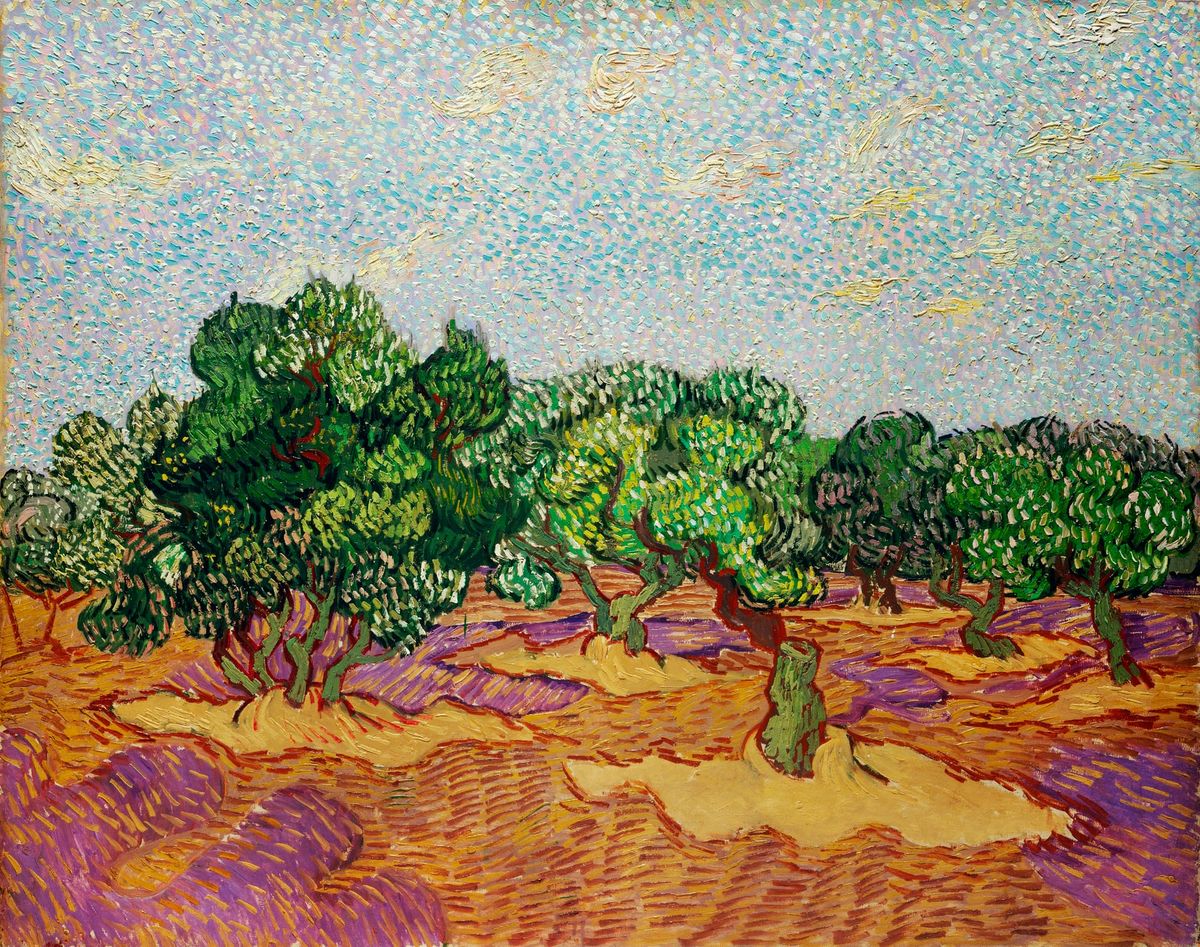
빈센트 반 고흐(Vincent van Gogh)가 프랑스 생레미의 생폴 드 모졸 요양원에 머물던 1889년 11월에 완성한 대표적인 유화 풍경화(Olive Grove / Olive Trees)입니다. 현재 스웨덴 예테보리 미술관(Göteborgs Konstmuseum)에 소장되어 있으며, 캔버스 위에 유채로 제작된 이 작품의 실제 사이즈는 약 73.0 × 92.0 cm입니다. 프로방스의 붉은 흙과 보랏빛 그림자가 깔린 대지 위에 뿌리내린 올리브 나무들의 뒤틀린 생명력과, 점묘파적 필치로 율동하는 화사한 하늘을 두텁고 역동적인 임파스토(Impasto) 기법으로 완벽하게 구현해냈습니다.
고흐는 물감을 캔버스 위에 두껍게 얹어 올리브 나무의 옹이 진 줄기와 은빛이 감도는 짙은 초록 잎사귀, 그리고 대지를 물들인 밭이랑의 결을 조각하듯 입체적으로 빚어냈습니다. 전경의 붉은 황토색 흙과 짙은 보랏빛 그림자는 올리브 나뭇잎의 싱그러운 에메랄드그린과 강렬한 보색 대비를 이루며, 화면 상단을 가득 채운 연하늘빛, 연분홍빛 점묘 터치는 햇살에 부서지는 지중해의 찬란한 대기감을 촉각적으로 전달합니다. 굽이치는 유기적 선묘와 규칙적인 붓 터치의 병치는 정적인 과수원 풍경에 살아 숨 쉬는 우주적 리듬을 불어넣습니다.
1889년 늦가을, 생레미 요양원 주변의 올리브 과수원을 매일같이 찾았던 고흐는 계절의 변화와 바람을 견뎌내며 자라나는 올리브 나무에 깊이 도취되었습니다. 고흐에게 올리브 나무는 단순한 남프랑스의 식생을 넘어, 성서 속 겟세마네 동산의 고난과 인내, 그리고 혹독한 정신적 시련 속에서도 꺾이지 않고 솟아나는 영혼의 부활과 치유를 상징하는 숭고한 존재였습니다. 그는 고갱과 에밀 베르나르가 시도하던 관념적인 종교화 대신, 대자연의 살아 숨 쉬는 올리브 숲을 직접 마주하며 가장 진솔한 영적 구원의 메시지를 캔버스에 담아냈습니다.
대지를 묵묵히 딛고 선 나무들의 다부진 줄기와 따스하게 빛나는 황금빛 토양은 자연의 영원한 순환을 증명합니다. 미술사에서는 고흐가 인상주의의 빛과 신인상주의의 점묘 기법, 그리고 자신만의 표현주의적 마티에르를 완벽하게 종합하여 대자연의 원초적 에너지를 회화적 신념으로 승화시킨 생레미 시기의 최고봉 걸작으로 평가하고 있습니다.
관람객의 무의식적인 시선은 화면 좌측 전면에서 굵은 줄기들을 사방으로 힘차게 뻗어 올린 올리브 나무의 풍성한 짙푸른 잎사귀 군락과 뒤틀린 가지들의 율동적인 붓 터치에서 자연스럽게 출발합니다. 거친 비바람을 견뎌낸 고목의 강인한 생명력과 두터운 물감의 질감에 시선이 머무는 순간, 보는 이는 찰나의 침묵과 함께 프로방스 늦가을 과수원의 따스한 공기 속으로 단숨에 몰입하게 됩니다.
이어 시선은 나무 밑동에 깔린 눈부신 황금빛 햇살 웅덩이와 대지를 가로지르는 짙은 보랏빛 그림자의 리드미컬한 수평 밭이랑을 타고 화면 우측으로 이동하여, 줄지어 서 있는 올리브 나무들의 다부진 줄기들에 도달합니다. 붉은 흙과 보랏빛 대지가 뿜어내는 깊은 온기와 흙냄새를 마주하며, 묵묵히 시련을 버텨내는 대자연의 숭고한 인내를 깊이 체감하게 됩니다.
이후 시선은 캔버스 상단 전체를 눈부신 빛의 입자로 가득 채우며 춤추듯 일렁이는 연하늘색과 연분홍빛 점묘 하늘을 훑은 뒤, 바람에 날리는 깃털 같은 흰 구름의 궤적을 지나 다시금 전경의 붉은 토양으로 부드럽게 내려앉습니다.
대지의 묵직한 보랏빛과 하늘의 찬란한 점묘 빛이 빚어내는 장엄한 색채의 순환을 따라 순환한 시선이 편안히 안착할 때, 관람객의 내면에는 복잡한 일상의 번뇌와 피로가 씻겨 내려가고, 흔들리지 않는 대지의 영혼이 건네는 깊은 위로와 함께 굳건한 심리적 안도감이 가득 차오르게 됩니다.
Olive Trees
Painted by Vincent van Gogh in November 1889 during his stay at the Saint-Paul-de-Mausole asylum in Saint-Rémy-de-Provence, France, this monumental landscape is preserved in the permanent collection of the Göteborgs Konstmuseum in Gothenburg, Sweden. Executed in oil on canvas, the actual size of the work is approximately 73.0 × 92.0 cm. Capturing the gnarled, expressive forms of an olive grove rooted in vibrant reddish-violet earth beneath a shimmering pointillist sky, the composition orchestrates a powerful synthesis of rich impasto, complementary contrasts, and undulating linear rhythms.
Van Gogh applied unmixed paint with dense, directional brushstrokes, sculpting the knotted wooden trunks, the shimmering canopy of sage and emerald-green leaves, and the furrowed ground cast in violet shadows. The radiant yellow-ochre soil and rich magenta shadows establish a vivid complementary vibration against the cool greens of the trees and the luminous pale blue and rose-tinted sky above. The divisionist dabs in the atmosphere, combined with the swirling contours of the grove, impart a pulsating cosmic vitality to the quiet rural landscape.
During the late autumn of 1889, Van Gogh spent endless hours working among the ancient olive orchards surrounding the asylum. For him, the olive tree was not merely a picturesque motif of the Mediterranean countryside, but a profound sacred symbol of endurance, spiritual consolation, and Christ’s agony in the Garden of Gethsemane. Rejecting the abstract, imagined biblical compositions of Paul Gauguin and Émile Bernard, Van Gogh sought spiritual truth directly through the tactile reality and elemental suffering of the living trees.
The enduring presence of the rooted trunks and the rhythmic, plowed earth celebrate the eternal cycles of nature and human labor. Art historians revere this composition as one of the definitive triumphs of Van Gogh's late period, where the optical brilliance of modern French painting was elevated into an intensely subjective, expressive anthem of existential fortitude.
A viewer's subconscious gaze is intuitively anchored first by the muscular, twisting trunk and dense green canopy of the large foreground olive tree on the left. Lingering upon the rich textural impasto that gives the foliage its sculptural weight and vitality, the observer is drawn into an immediate atmosphere of ancient strength, quiet shelter, and emotional clarity.
The eye is then guided across the foreground along the rhythmic striations of the plowed reddish-orange earth and the cool violet shadows cast by the afternoon sun, arriving at the row of companion trees anchored across the middle ground. Absorbing the deep warmth and earthen stability of the soil, the viewer experiences a reassuring sense of natural resilience, harmony, and agrarian peace.
The gaze ascends into the vast, luminous sky woven from thousands of vibrating dabs of pale turquoise, white, and soft coral, taking in the open atmospheric expanse before returning smoothly to the textured ground below.
Completing this visual and psychological circulation, the observer feels a profound release of modern tension. The timeless fortitude and radiant harmony of the landscape leave the viewer restored with a lasting sense of emotional grounding, spiritual renewal, and enduring psychological peace.
본 리뷰에서 작품을 제외한 컨텐츠의 저작권은 팔렛트제주에 있습니다.
"퍼블릭도메인 고전명화"를 제외한 모든 창작 콘텐츠는 저작권법 제4조 및 제10조에 의거하여 보호됩니다. 무단 도용시 저작권법 제136조(벌칙)에 의거, 당사의 사전 서면 승인 없는 저작권 침해 행위를 금지합니다.