오베르의 교회 - The Church at Auvers
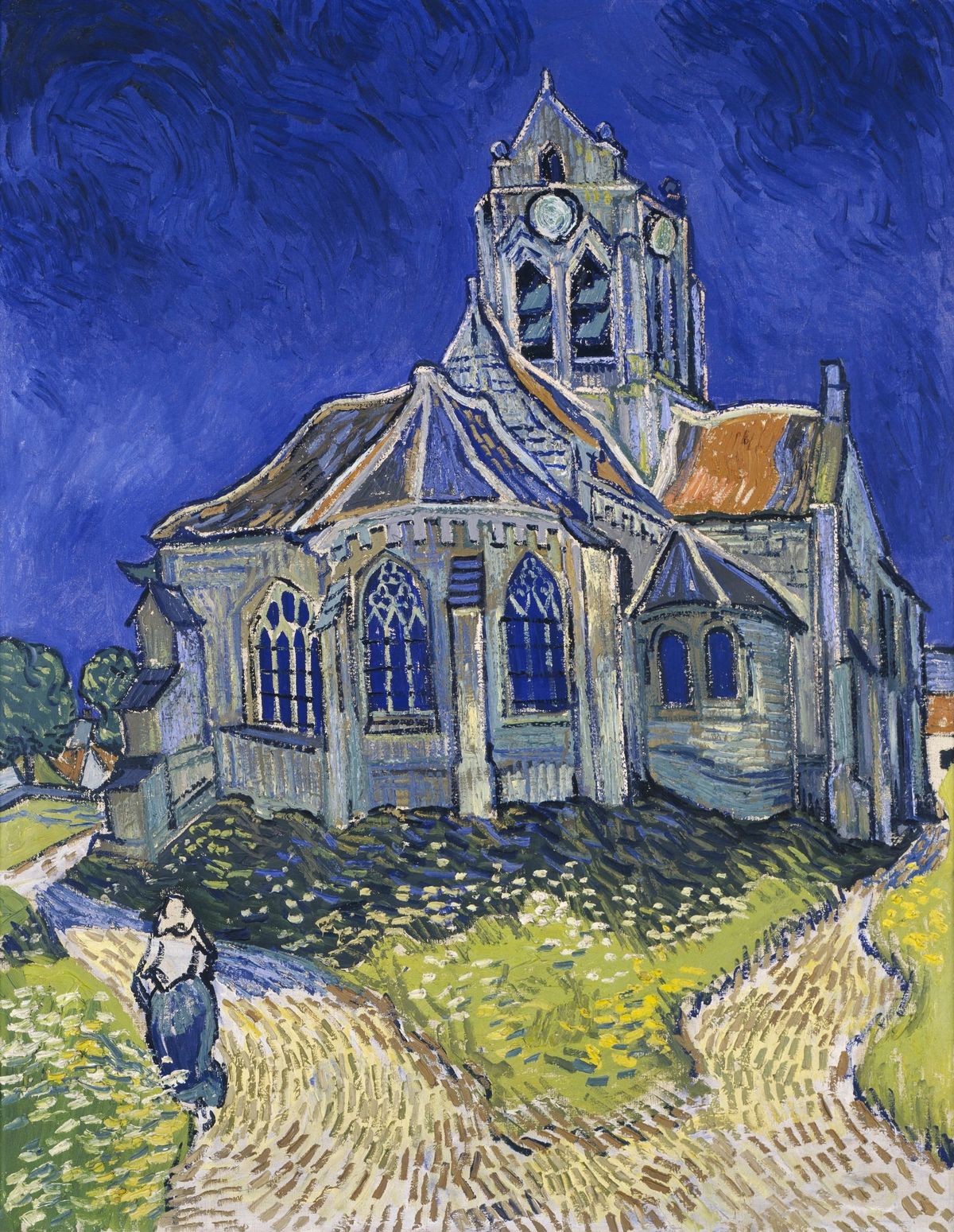
빈센트 반 고흐(Vincent van Gogh, 1853–1890)가 생애 마지막 해인 1890년 6월 프랑스 파리 근교 오베르 쉬르 우아즈(Auvers-sur-Oise)에서 완성한 '오베르의 교회(The Church at Auvers)'는 캔버스에 유채(Oil on canvas)로 제작된 풍경화입니다. 작품의 실제 규격은 세로 94.0cm, 가로 74.0cm이며, 현재 프랑스 파리의 오르세 미술관(Musée d'Orsay)에 영구 소장되어 있습니다.
고흐는 이 작품에서 전통적인 원근법과 고전적 건축 묘사의 틀을 과감히 해체하고, 감정의 파동을 시각화하는 격렬한 붓질과 두터운 임파스토(Impasto) 기법을 구사했습니다. 밤하늘처럼 짙고 어두운 코발트 블루와 울트라마린으로 하늘을 가득 채우고, 지상의 교회 건축물에는 보랏빛 그림자와 타오르는 듯한 주황빛 지붕, 강렬한 노란빛의 풀밭을 병치하여 현실을 초월한 강렬한 보색 대비와 역동적인 에너지를 부여했습니다.
이 그림은 반 고흐가 생을 마감하기 불과 한 달여 전에 제작된 후기 대표 걸작 중 하나입니다. 오베르의 오래된 13세기 고딕 양식 성당을 마주한 고흐는 어린 시절 목사였던 아버지의 엄격한 종교적 규율과 고향 뉘넌(Nuenen) 시절의 묵직한 기억을 떠올렸습니다. 여동생 빌(Wil)에게 보낸 편지에서 그는 이 작품이 과거 뉘넌의 옛 탑과 묘지를 그렸던 연구들과 닮아 있으며, 오직 색채의 표현력만으로 더욱 순수하고 강렬해졌다고 회고했습니다. 요동치는 교회 건물과 그 앞을 무심히 걸어가는 시골 여인의 뒷모습은, 제도권 종교의 엄숙함을 넘어 자연과 생명의 영원한 순환 속에서 내면의 안식을 갈구하던 화가의 영적 고백을 담고 있습니다.
후대의 미술사학자들과 비평가들은 이 작품을 20세기 표현주의(Expressionism)의 탄생을 알린 결정적 이정표로 평가합니다. 건물이 마치 살아 숨 쉬는 유기체처럼 뒤틀리고 호흡하는 듯한 독창적인 공간 구성과 심리적 긴장감은 대상의 외형을 그대로 재현하는 것을 넘어, 화가의 깊은 내면세계를 온전히 캔버스 위에 투영한 위대한 예술적 성취로 극찬받고 있습니다.
관람자의 시선은 가장 먼저 화면 하단에서 두 갈래로 시원하게 갈라지는 황금빛 흙길과 그 길을 걸어가는 농촌 여인의 푸른 실루엣에 머뭅니다. 이어 길을 따라 위로 솟아오르며 뒤틀리듯 웅장한 자태를 드러내는 교회의 뾰족한 첨탑과 푸른 스테인드글라스 창문으로 자연스럽게 상승한 뒤, 소용돌이치듯 깊고 짙푸른 밤빛 하늘의 물결을 따라 화면 전체로 유려하게 확산됩니다.
심리적으로 관람자는 요동치는 건축물의 선형적 긴장감 속에서도 대지를 가득 채운 따뜻한 햇살 같은 노란빛과 깊고 묵직한 푸른빛이 자아내는 색채의 조화 속에서 깊은 정서적 정화와 경외감을 느끼게 됩니다. 삶의 갈림길을 묵묵히 걸어가는 여인의 형상과 우뚝 솟은 교회의 존재감은 무의식중에 내재된 삶의 고독과 방황을 위로하며, 보는 이로 하여금 깊은 내적 성찰과 차분한 마음의 평정을 되찾도록 이끌어줍니다.
The Church at Auvers
Painted by Vincent van Gogh (1853–1890) in Auvers-sur-Oise in June 1890, The Church at Auvers is an oil on canvas landscape measuring 94.0 cm in height and 74.0 cm in width. This iconic masterpiece is permanently housed in the collection of the Musée d'Orsay in Paris, France.
Van Gogh dismantled conventional linear perspective and architectural rigidity, employing undulating contours and heavily textured impasto to translate deep psychological resonance onto the canvas. The sky is saturated with a heavy, nocturnal cobalt and ultramarine blue, which stands in dramatic complementary contrast against the vibrant ochres, warm violet shadows, and glowing earthen tones of the sunlit ground and tiled roof below.
The canvas was completed merely a month before the artist's death, during his final creative resurgence in Auvers. Confronting the ancient thirteenth-century parish church, Van Gogh drew poignant parallels to his earlier Dutch period in Nuenen, where his father had served as a pastor. Writing to his sister Wil, he remarked that this work echoed his early studies of the old church tower, transformed now through pure, vibrating color. The restless, organic distortion of the stone structure alongside the solitary peasant woman walking along the path reflects a deeply spiritual dialogue between earthly transience and transcendent solace.
Art historians and modern scholars celebrate this work as a monumental cornerstone of modern Expressionism. By presenting architecture not as static stone but as a pulsating, living entity charged with emotion, Van Gogh achieved a profound synthesis of external observation and internal psychological truth.
A viewer’s gaze instinctively enters through the bifurcated golden pathway in the foreground, pausing momentarily upon the modest peasant figure in blue. From this earthly anchor, the eyes follow the ascending masonry and rhythmic buttresses toward the towering spire and luminous windows, before gracefully dissolving into the swirling, abyssal expanse of the deep blue sky above.
Psychologically, the dramatic tension conveyed by the undulating architecture is balanced and resolved by the radiant warmth of the sunlit paths and lush green flora. Witnessing the quiet endurance of the solitary traveler beneath the monumental structure evokes a profound emotional catharsis, transforming existential solitude into a grounded sense of spiritual resilience, peace, and contemplative harmony.
본 리뷰에서 작품을 제외한 컨텐츠의 저작권은 팔렛트제주에 있습니다.
"퍼블릭도메인 고전명화"를 제외한 모든 창작 콘텐츠는 저작권법 제4조 및 제10조에 의거하여 보호됩니다. 무단 도용시 저작권법 제136조(벌칙)에 의거, 당사의 사전 서면 승인 없는 저작권 침해 행위를 금지합니다.