눈 덮인 루브시엔의 역마차 역 (Le Relais de poste, route de Versailles, Louveciennes, neige, 1872)
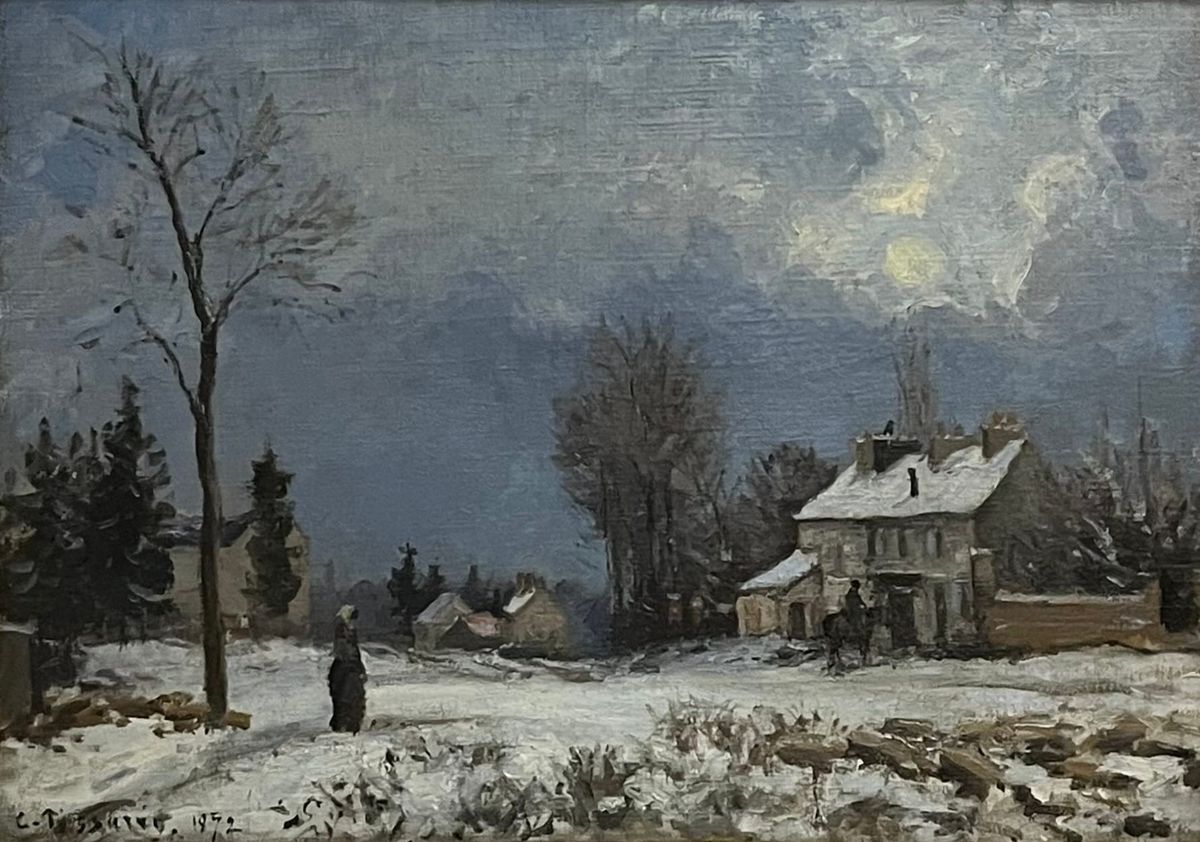
1872년 보불전쟁의 피란 생활을 마치고 루브시엔으로 돌아온 카미유 피사로는, 전쟁의 상흔 속에서도 다시 평온을 되찾아가는 마을의 고요한 겨울 풍경을 화폭에 담았습니다.
당시 프로이센 군대의 점령으로 작업실에 남아 있던 초기작 대부분이 소실되는 참담한 아픔을 겪었지만, 피사로는 좌절하는 대신 차가운 눈 속에 감싸인 대지의 순수한 침묵을 관찰하며 인상주의 화풍을 한층 더 단단하게 벼려나갔습니다. 가로 46cm, 세로 32cm 크기의 캔버스에 유채로 완성된 이 작품은, 먹구름 낀 겨울 하늘 아래 하얗게 얼어붙은 베르사유 길과 역마차 역의 소박한 일상을 촉각적인 설경(雪景)의 마티에르로 포착해 낸 수작입니다.
관람자의 시각 인지 체계는 화면 좌측 중경에서 짙은 검은색 옷을 입고 하얀 눈길 위에 홀로 서 있는 여인의 실루엣에 가장 먼저 닻을 내립니다. 새하얀 눈밭과 인물의 묵직한 어둠이 형성하는 선명한 명암 대비는 시각 피질의 중심와를 즉각 포획하며 화면의 서정적인 구심점을 확립합니다.
이어서 시선은 여인의 곁으로 높게 솟아오른 앙상한 겨울나무의 수직선을 타고 올라가, 화면 상단을 묵직하게 뒤덮은 먹구름과 그 틈새로 부드럽게 번져 나오는 겨울 햇살의 은은한 광륜으로 도약 안구 운동을 진행합니다.
하늘의 대기 질감을 확인한 시선은 우측 중경으로 하강하여, 지붕 위에 두텁게 눈이 쌓인 역마차 역 건물과 그 앞을 지키는 말을 탄 인물의 실루엣을 훑은 뒤, 전경의 거칠게 파헤쳐진 눈 덮인 흙탕길의 촉각적인 붓터치들로 이어집니다.
눈 덮인 대지의 서늘한 촉감과 구름 사이로 스며드는 미세한 빛의 온기가 망막 위에서 하나의 완성된 공간으로 통합되는 순간, 관조자는 번잡한 일상의 번뇌를 내려놓고 눈 내린 시골길의 적막한 침묵 속에 머무는 듯한 깊은 심리적 안도감과 내면의 평온을 체험하게 됩니다.
이 그림을 그릴 당시 피사로는 클로드 모네, 알프레드 시슬레와 함께 눈의 색채를 단순한 흰색으로만 보지 않고, 하늘의 짙푸른 회색빛과 차가운 공기의 반사광이 어우러진 복합적인 광학적 층위로 표현하는 실험을 거듭하고 있었습니다.
그는 눈밭 위에 내려앉은 그림자를 어두운 무채색 대신 미묘한 푸른색과 갈색의 터치로 직조하여, 얼어붙은 대지가 품고 있는 미세한 생명력을 생생하게 증언했습니다.
동시대 비평가들은 화려한 과장을 배제하고 전쟁 이후의 쓸쓸한 계절감을 진실하게 어루만진 피사로의 화폭을 두고 "대지의 차가운 살결 아래 흐르는 가장 따뜻한 숨결을 기록한 명화"라며 높은 찬사를 보냈습니다.
혹독한 겨울의 침묵 속에서도 묵묵히 이어지는 인간의 발걸음과 자연의 영속성을 정직한 조형미로 담아낸 피사로의 루브시엔 설경은, 현대 미술사에서 인상주의 빛의 탐구가 지닌 감각적 깊이와 인간주의적 품격을 증명하는 소중한 유산으로 확고하게 평가받고 있습니다.
The Post Station, Route de Versailles, Louveciennes, Snow (Le Relais de poste, route de Versailles, Louveciennes, neige, 1872)
Returning to Louveciennes in 1872 after seeking refuge in London during the Franco-Prussian War, Camille Pissarro captured the quiet resilience of his adopted village blanketed beneath a heavy layer of winter snow.
Despite suffering the devastating loss of hundreds of his early canvases during the military occupation, the master refused despair, finding renewed creative clarity in the austere beauty of the frosted French countryside. Measuring 32 by 46 cm, this exquisite horizontal oil on canvas depicts the historic coaching station along the road to Versailles beneath an overcast sky, standing as a masterclass in atmospheric subtlety and tactile impasto.
The observer’s perceptual framework instantly anchors upon the dark silhouette of the solitary woman standing quietly along the left side of the snow-covered lane. The sharp tonal contrast between her deep mourning-like attire and the luminous expanse of freshly fallen snow arrests the fovea, establishing an intuitive and emotionally poignant nucleus for the composition.
From this solitary anchor, the ocular trajectory ascends along the slender, bare winter tree, rising into the dense, slate-gray storm clouds where a pale, diffused winter sun gently breaks through the vaporous atmosphere.
Navigating downward to the right midground, the gaze sweeps across the snow-capped roof of the post station and the mounted figure lingering near its entrance, before traversing the tactile, slushy ruts of the foreground earth.
As the crisp chill of the frozen landscape and the delicate ambient warmth filtering from above integrate into a unified visual reality within the visual cortex, active visual scanning dissolves into profound contemplative stillness, wrapped in the restorative quietude of the winter sanctuary.
While executing this canvas, Pissarro collaborated closely with Claude Monet and Alfred Sisley in deciphering the complex optics of winter light, demonstrating that snow was not merely flat white, but a vibrating mirror reflecting azure skies, earthen ochres, and cool ambient shadows.
Rather than relying on academic black for cast shadows, Pissarro applied nuanced touches of cobalt and slate, capturing the living breath beneath the frosted crust of the earth.
Contemporary peers and progressive critics widely revered his unpretentious vision, praising his exceptional gift for discovering monumental solemnity and quiet dignity within the most unadorned corners of rural life.
Masterfully harmonizing structural weight with delicate atmospheric poetry, Pissarro's snow-covered view of Louveciennes remains celebrated across art history as an enduring pinnacle of early Impressionist landscape painting.
본 콘텐츠의 저작권은 저작권자에게 있으며, 무단 전재 및 재배포를 금합니다.