눈 덮인 고산 절벽 위에서 격돌하는 원초적 야만성, 켄타우로스들의 전투 Battle of the Centaurs
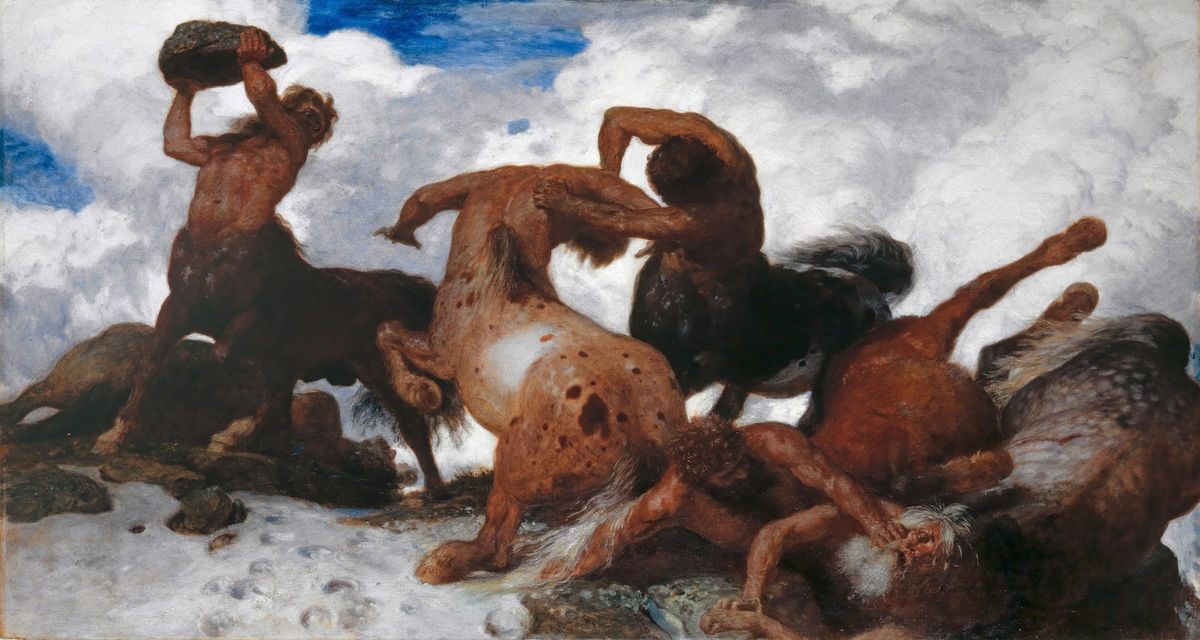
스위스 출신의 상징주의 거장 아놀드 뵈클린(Arnold Böcklin, 1827–1901)이 1873년에 독일 뮌헨에서 완성한 유화 켄타우로스들의 전투(Battle of the Centaurs, 독일어: Kentaurenkampf)는 105.0 cm × 195.0 cm 크기의 캔버스에 유채로 그린 대형 명작입니다. 현재 스위스 바젤 미술관(Kunstmuseum Basel)에 소장되어 있습니다.
뮌헨 화단의 편견에 맞선 거장의 야성적 분노와 도전
1870년대 초반 뵈클린은 독일 뮌헨에서 치열하게 작품 활동을 이어가고 있었으나, 당시 화단을 지배하던 사실주의와 엄격한 역사화풍에 익숙했던 보수적인 비평가들은 그의 신화적이고 상징적인 회화를 거칠게 깎아내렸습니다. 비평가들은 뵈클린의 그림이 지나치게 거칠고 환상에만 치우쳐 있다고 비난했습니다. 잇따른 자식들의 죽음과 가난 속에서도 자신의 예술적 신념을 굽히지 않았던 화가는, 세상의 냉소와 몰이해에 굴복하는 대신 인간 내면에 숨겨진 가장 야생적이고 거친 생명력을 폭발시키는 방식으로 응수했습니다.
뵈클린은 그리스 신화에 등장하는 반인반마 켄타우로스들이 문명의 규칙을 벗어던지고 눈 덮인 높은 산마루에서 오직 힘과 본능만으로 맞부딪히는 처절한 난투극을 화폭에 담았습니다. 거대한 바위를 머리 위로 번쩍 들어 올려 내리치려는 전사, 서로의 목과 어깨를 물어뜯으며 뒤엉킨 무리, 그리고 눈밭 위로 쓰러져 흰 수염을 붉은 피로 물들이며 짓밟히는 늙은 켄타우로스의 모습은 원초적인 생존 경쟁의 냉혹함을 여과 없이 보여줍니다. 화가는 문명화된 사회의 가식을 벗겨내고, 거친 자연 속에서 생존하기 위해 온몸으로 부딪히는 켄타우로스들의 육체적 에너지를 통해 자신이 겪었던 세상과의 치열한 갈등과 저항 의지를 당당하게 표출했습니다.
치켜든 거대한 바위에서 눈밭에 쓰러진 노인으로, 시선의 심리적 여정
그림을 마주하는 순간 관람객의 무의식적 시선은 화면 왼쪽 위에서 푸른 하늘과 뭉게구름을 배경으로 거대한 바윗돌을 번쩍 치켜든 켄타우로스의 팽팽한 근육으로 가장 먼저 빨려 들어갑니다. 두 팔로 무거운 돌을 받쳐 들고 상대를 향해 내리꽂으려는 전사의 폭발적인 긴장감은 보는 이에게 숨 막히는 시각적 압박감을 안겨줍니다.
이어 시선은 화면 중앙에서 얼룩무늬 백마의 몸통을 비틀며 서로의 머리채와 목을 움켜쥐고 격돌하는 두 켄타우로스의 격렬한 몸부림으로 이동합니다. 허공으로 번쩍 들린 말발굽과 핏줄이 곤두선 등 근육의 역동적인 얽힘을 확인하는 순간, 관람객은 귀를 찢는 듯한 거친 숨소리와 포효가 뒤섞인 격투의 한가운데로 빨려 들어갑니다.
마지막으로 시선은 화면 오른쪽 아래, 차가운 눈밭 위에 처참하게 널브러져 얼굴을 짓눌린 채 고통스러워하는 백발 켄타우로스의 일그러진 표정에 멈춥니다. 붉은 핏자국이 번져가는 하얀 눈과 그 위로 쓰러진 패자의 비극적인 모습을 바라보며, 관람객은 문명의 껍데기를 찢고 드러난 자연의 비정한 약육강식 법칙과 유한한 생명체들이 겪어야 하는 원초적 투쟁의 무게를 가슴 깊이 체감하게 됩니다.
신화적 활력과 생명주의의 승리, 미술계의 평가
미술계는 켄타우로스들의 전투를 고대 신화를 박제된 고전 양식에서 해방시켜 살아 숨 쉬는 원시적 에너지와 역동적인 근육질의 회화로 재창조한 기념비적인 걸작으로 평가합니다.
구름이 소용돌이치는 푸른 하늘과 거친 암벽, 그리고 눈 덮인 산등성이를 배경으로 인간과 야수의 본능이 결합된 원초적 생명력을 거침없는 붓 터치로 시각화했기 때문입니다. 현실의 좌절과 세상의 혹평을 딛고 야생의 생명력으로 솟구쳐 오른 뵈클린의 이 웅장한 대작은 훗날 프란츠 폰 슈투크를 비롯한 수많은 독일 상징주의 및 표현주의 화가들에게 거대한 영감을 불어넣었습니다.
The Primordial Ferocity atop the Glacial Ridge, Battle of the Centaurs
Painted in 1873 in Munich by the preeminent Swiss Symbolist master Arnold Böcklin (1827–1901), Battle of the Centaurs (German: Kentaurenkampf) is an oil on canvas measuring 105.0 cm × 195.0 cm (41.3 in × 76.8 in), preserved in the permanent collection of the Kunstmuseum Basel in Switzerland.
The Munich Academic Resistance and the Explosive Surge of Primal Instinct
During the early 1870s in Munich, Arnold Böcklin faced intense aesthetic resistance from conservative art critics who championed academic naturalism and sober historicism. Dismissed by traditionalists who viewed his mythological visions as eccentric and unrefined, the artist channeled his frustration into a monumental display of raw physical force. Refusing to compromise his artistic principles despite chronic financial insecurity and the painful loss of his children, Böcklin responded by unleashing the untamed vitality of nature onto the canvas.
Rejecting conventional neoclassical restraint, Böcklin depicted the wild centaurs of Greek myth locked in a brutal, hand-to-hand brawl upon a snow-swept alpine ridge. Towering beneath turbulent storm clouds, one warrior raises a massive boulder overhead to crush his foe, while others tear at flesh and hair with savage fury. In the foreground, an elder centaur lies trampled upon the melting snow, his white beard spattered with blood. Through this unfiltered collision of sinew and beast, Böcklin cast off the veneer of bourgeois civilization, translating his own existential resistance against institutional hostility into a thrilling celebration of primal survival.
Subconscious Trajectory of the Gaze: From Raised Boulder to the Fallen Patriarch
The observer's subconscious gaze is instantly magnetized by the monumental figure on the upper left, hoisting a colossal boulder against the brilliant blue sky and billowing clouds. The taut, hyper-extended torso and flexed arm muscles poised for a devastating strike deliver an immediate shock of kinetic tension.
The visual path then surges into the epicenter of the brawl, where a dapple-gray centaur violently rears back while grappling in a lethal embrace with a dark-coated adversary. Witnessing the tangled hooves kicking into the air and the explosive torsion of their interlocking flanks, the viewer is thrust directly into the auditory chaos and physical velocity of the clash.
Finally, the trajectory descends to the lower right corner, settling upon the grimacing countenance of the elder centaur pinned against the icy ground, his mouth forced open under the crushing weight of a triumphant rival. Observing the stark contrast between the pure white snow and the crimson trail of defeat, the spectator confronts the unforgiving Darwinian brutality of mortal struggle and the raw drama of existence stripped to its barest essentials.
The Monument of Vitalist Myth: Critical Legacy
Art historians celebrate Battle of the Centaurs as an extraordinary triumph of Symbolist myth-making that fundamentally challenged the dry, moralizing conventions of 19th-century academic art.
By uniting monumental anatomical draftsmanship with the turbulent atmosphere of the high Alps, Böcklin established a visual language that celebrated the Dionysian energy of primal nature. This electrifying canvas served as a crucial catalyst for the Munich Secession, directly inspiring artists such as Franz von Stuck and profoundly shaping the development of modern Central European Expressionism.
본 컨텐트의 저작권은 팔렛트제주에 있습니다. 허가없는 무단전제를 금지합니다.
Copyright © Palette Jeju. All rights reserved. Unauthorized reproduction or redistribution is strictly prohibited.