노란색으로 빚어낸 빛의 성전과 삶의 순환, 열다섯 송이 해바라기 Sunflowers (Fifteen Sunflowers in a Vase)
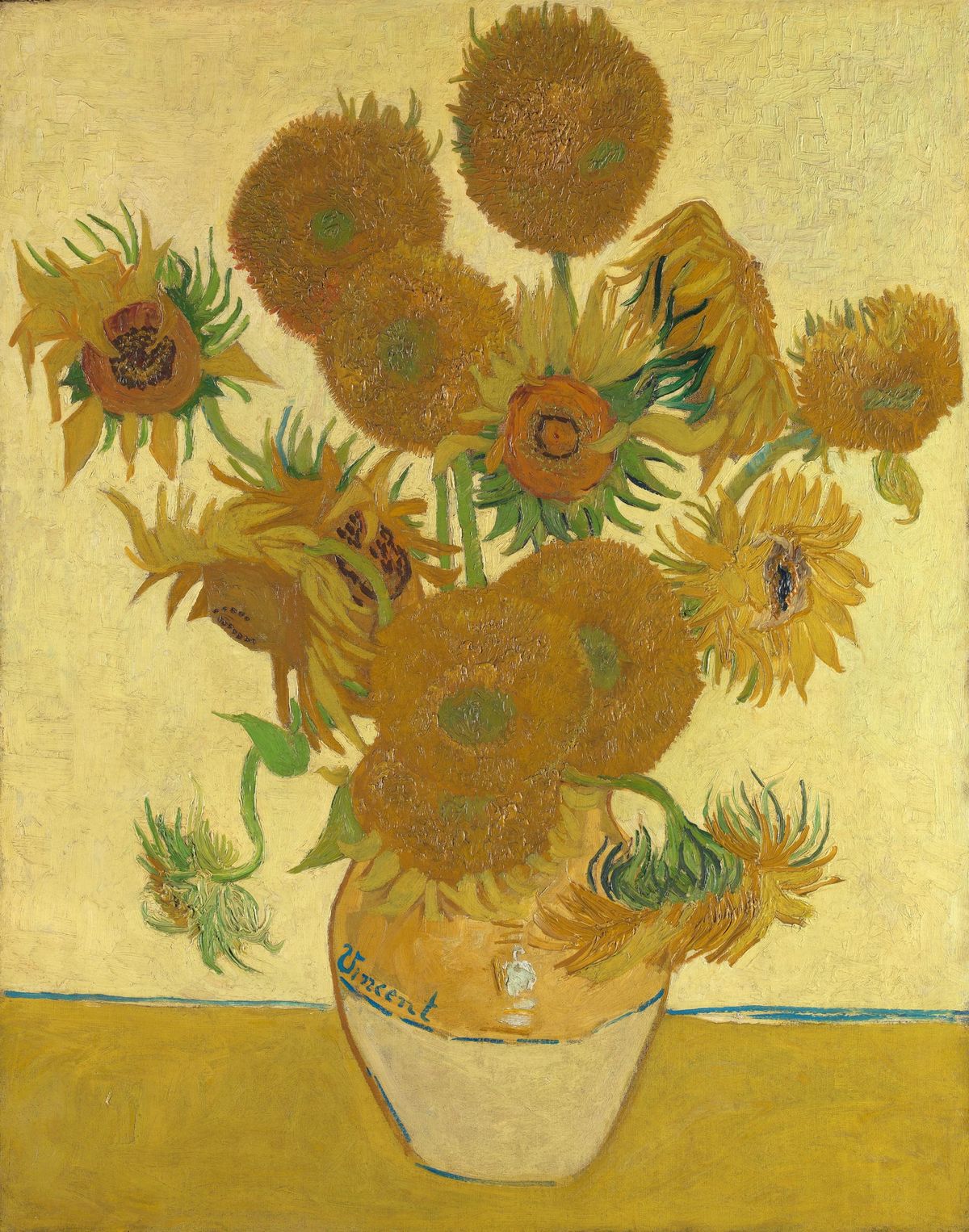
후기 인상주의 거장 빈센트 반 고흐(Vincent van Gogh, 1853–1890)가 1888년 8월 말 프랑스 남부 아를에서 완성한 유화 열다섯 송이 해바라기(Sunflowers)는 92.1 cm × 73.0 cm 크기의 캔버스에 유채로 그린 대표작입니다. 현재 영국 런던 내셔널 갤러리(The National Gallery, London)에 소장되어 있습니다.
단일 색채의 실험과 고흐가 꿈꾼 삼면화의 제단
이 작품은 앞서 제작된 민트색 배경의 열두 송이 해바라기와 뚜렷한 조형적 차이를 지닙니다. 고흐는 배경과 탁자, 꽃병과 꽃잎 전체를 오직 노란색 계열만으로 채우는 파격적인 올-옐로(All-yellow) 실험을 감행했습니다. 그는 단순히 꽃을 예쁘게 그리는 것에 만족하지 않고, 색의 미세한 명도와 질감 차이만으로 화면의 깊이와 형태를 완전히 분리해 내는 고도의 기법을 증명하고자 했습니다.
더불어 이 런던 판본은 고흐가 구상했던 기념비적인 삼면화(Triptych) 프로젝트의 핵심 날개 그림이었습니다. 고흐는 훗날 자신이 그린 룰랭 부인의 자장가 초상화를 중앙에 두고, 그 좌우에 이 노란 바탕의 해바라기들을 배치하여 거친 뱃사람들에게 영혼의 안식을 주는 성당 제단화 같은 공간을 만들겠다는 구체적인 계획을 편지에 스케치로 남겼습니다. 꽃을 단순한 정물이 아니라 고통받는 인간을 보듬는 거룩한 종교적 상징으로 끌어올린 것입니다.
꽃봉오리부터 말라가는 씨앗까지 담긴 무의식 속 시선의 여정
그림을 마주하는 순간 관람객의 무의식적 시선은 화병 상단에서 불꽃처럼 솟구쳐 오르는 싱싱한 꽃잎들의 날카로운 붓 터치로 가장 먼저 진입합니다. 밝은 레몬 옐로 톤의 생기 넘치는 꽃잎들은 보는 이의 마음에 신선한 활력과 즉각적인 시각적 흥분을 일으킵니다.
이어 시선은 화면 가운데로 하강하여 꽃잎을 떨구고 거대한 씨앗을 품은 채 둥글게 뭉쳐진 원형의 꽃술 덩어리들에 닿습니다. 조각칼로 깎아낸 듯 두텁게 얹어진 황토색과 흑갈색 임파스토의 거친 촉감은, 활짝 핀 꽃부터 서서히 말라가는 꽃까지 한 화병 안에서 공존하는 시간의 흐름과 생로병사의 순환을 직관적으로 체감하게 만듭니다.
마지막으로 시선은 화병의 허리를 지나 단단하게 무게를 받쳐주는 테이블의 짙은 노란 평면으로 내려앉으며 시각적 안정을 찾습니다. 차가운 색채의 개입 없이 오직 따스한 황금빛 안에서 펼쳐지는 형태의 리듬을 통해, 감상자는 마음속 깊은 불안을 떨쳐내고 대지가 품어내는 넉넉한 온기 속에서 편안한 정서적 충만을 얻게 됩니다.
색채 자율성의 획득과 모더니즘 정물화의 새 장, 미술계의 평가
미술계는 런던 내셔널 갤러리의 열다섯 송이 해바라기를 반 고흐가 색채의 자율성을 완성한 서양 미술사의 중대한 전환점으로 평가합니다.
명암법과 원근법이라는 전통적인 회화 규칙을 최소화하고, 노란색 하나가 지닌 풍부한 음영과 두터운 붓질의 물리적 두께만으로 공간을 구축했기 때문입니다. 이는 대상을 모사하는 것을 넘어 화가의 내면 상태를 색채 그 자체로 투영한 최초의 시도 중 하나였으며, 훗날 20세기 야수파와 추상표현주의 화가들에게 색채가 독립된 감정의 언어가 될 수 있음을 증명한 위대한 유산으로 평가받습니다.
The Monochromatic Temple of Vitality and Time, Sunflowers
Painted in late August 1888 during his celebrated Arles period by Vincent van Gogh (1853–1890), Sunflowers (Fifteen Sunflowers in a Vase) is an oil on canvas measuring 92.1 cm × 73.0 cm (36.3 in × 28.7 in), preserved in the permanent collection of The National Gallery in London, United Kingdom.
The All-Yellow Revolution and the Vision of a Sacred Triptych
This canvas represents a decisive departure from the contrasting blue-green backgrounds of Vincent's earlier floral studies. Here, Van Gogh launched a radical monochromatic experiment, submerging petals, tabletop, vessel, and background in a luminous continuum of yellow. He sought to prove that minute variations in tone, density, and paint handling could delineate space and structural volume with supreme clarity.
Furthermore, this London canvas was designed as an integral wing of an ambitious decorative triptych. Van Gogh envisioned flanking his portrait of Augustine Roulin, La Berceuse, with these all-yellow sunflower paintings, creating a secular altar designed to comfort weary souls and lonely sailors. For Vincent, the bouquet evolved beyond simple decorative flora into a sacred symbol of maternal comfort and human solace.
Subconscious Trajectory Across the Cycles of Botanical Life
The observer's subconscious gaze is initially captivated by the dynamic, pointed petals radiating from the crown of the arrangement. Painted with sharp, spontaneous strokes of lemon and chrome yellow, these fresh blooms project an immediate sensation of vitality and buoyant energy.
Visual perception then descends toward the center of the bouquet, engaging with the heavy, rounded seed heads that have dropped their petals to mature into textured disks. The thick, sculptural impasto of ochres and raw umbers tactilely communicates the passage of time, presenting the entire arc of organic life—from bud to full bloom and gradual decay—within a single arrangement.
Finally, the gaze settles upon the firm, horizontal division of the golden tabletop, finding structural rest beneath the weight of the ceramic pot. Surrounded entirely by the radiant warmth of yellow without the intrusion of cool tones, the viewer subconsciously internalizes a sense of restorative equilibrium, permanence, and deep psychological reassurance.
Chromatic Autonomy and the Modern Still Life: Critical Legacy
Art historians recognize the London Sunflowers as a monumental turning point in modern art, marking the complete liberation of color from mere optical description.
By constructing an entire visual world through the varied textural frequencies and tonal nuances of yellow, Van Gogh demonstrated that paint itself could function as an emotional and spiritual medium. This radical simplification of form and heightening of hue paved the way for early twentieth-century modernism, directly inspiring the expressive freedoms of Fauvism and abstract art.
본 컨텐트의 저작권은 팔렛트제주에 있습니다. 허가없는 무단전제를 금지합니다.
Copyright © Palette Jeju. All rights reserved. Unauthorized reproduction or redistribution is strictly prohibited.