노인과 여인 The Old Man and the Young Woman
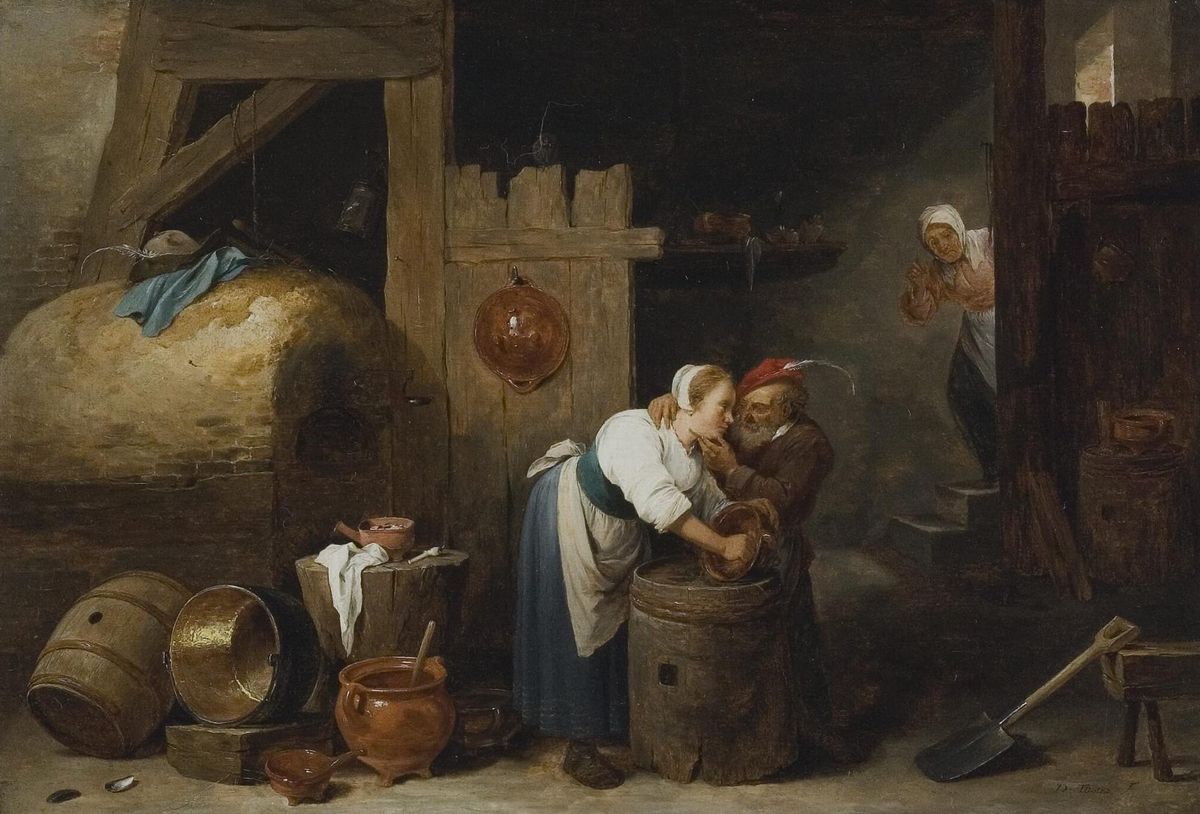
17세기 플랑드르 바로크 풍속화 및 풍자 윤리화의 거장 소 다비드 테니어르스(David Teniers le Jeune, 1610–1690)가 1640년대 중후반 안트베르펜 시기에 완성한 기념비적 실내 희극 풍속화 유화 노인과 젊은 여인(The Old Man and the Young Woman, 또는 부엌의 부적절한 구애, Unequal Match, 프랑스어: Le vieillard et la jeune femme)은 43.5 cm × 64.0 cm 크기의 가로형 패널(목판)에 유채로 그린 대표적인 북유럽 부엌 풍속화 최고 걸작입니다.
유럽 유수의 명문 귀족 컬렉션을 거쳐 프랑스 국립 박물관인 루브르 박물관(Musée du Louvre, Paris)에 소장되어 보존되어 오고 있습니다.
퀜틴 마시스의 어울리지 않는 짝 전통과 인간의 어리석은 욕망을 향한 화가의 고뇌
1640년대 안트베르펜 화단에서 명성을 떨치던 삼십 대의 테니어르스는, 16세기 플랑드르 거장 퀜틴 마시스와 에라스뮈스의 우신예찬 이래 북유럽 미술에서 널리 사랑받은 어울리지 않는 짝(나이 든 노인의 젊은 여인을 향한 헛된 구애)이라는 해학적 도덕 풍자 전통을 깊이 탐구했습니다.
화가는 주방 일을 하던 젊은 하녀에게 엉큼하게 다가가는 늙은 주인의 비뚤어진 애정 행각과 이를 계단 위에서 몰래 훔쳐보는 본처(노파)의 서늘한 시선을 한 화면에 엮어내며, 인간의 덧없는 육욕과 그 뒤에 찾아올 파국의 순간을 어떻게 해학적이면서도 우아한 은빛 명암법 속에 담아낼지 치열하게 번민했습니다.
화가는 커다란 화덕과 조리도구들이 놓인 어두운 시골 저택의 부엌 안에서, 그릇을 닦던 젊은 여인에게 은근슬쩍 다가와 턱을 어루만지는 늙은 사내의 우스꽝스러운 순간을 화폭에 담았습니다.
화면 중앙에는 흰 두건에 순백의 앞치마와 푸른 치마를 두른 젊고 어여쁜 하녀가 나무통 위에 놓인 토기 그릇을 씻고 있고, 붉은 모자에 깃털을 꽂은 흰 수염의 노인이 그녀의 어깨를 감싸 안은 채 손으로 턱을 만지작거리며 귓속말을 속삭이고 있습니다.
하녀는 노인의 뻔뻔한 수작에 짐짓 수줍은 척 고개를 숙이면서도 손으로는 그릇 닦는 일을 멈추지 않고 있습니다.
화면 오른쪽 어두운 문간 계단 위에서는 하얀 두건을 쓴 본처 노파가 문틈으로 얼굴을 내밀고 주먹을 쥐어 올리며 남편의 부정을 똑똑히 목격하고 있습니다.
왼쪽 바닥에 놓인 반짝이는 황동 냄비와 테라코타 항아리, 굴뚝이 달린 흙벽 화덕, 그리고 오른쪽 구석의 쇠삽과 나무 받침대는, 땀 흘려 일하는 부엌의 일상 속에서 벌어진 은밀하고 우스꽝스러운 애정극의 진실을 손에 잡힐 듯 생생하게 웅변합니다.
턱을 만지는 노인의 손길에서 순진한 척하는 하녀와 문간의 성난 노파로, 시선의 심리적 여정
그림을 마주하는 순간 관람객의 무의식적 시선은 화면 중앙 짙은 그늘 속에서 집중된 빛을 받아 화사하게 빛나는 하녀의 순백 앞치마와 흰 셔츠, 그리고 그녀의 턱에 닿은 노인의 거친 손끝으로 가장 먼저 빨려 들어갑니다.
젊은 여인의 환한 살결과 은밀하게 귓가를 맴도는 늙은 호색한의 붉은 깃털 모자는 보는 이에게 깊은 시각적 흥미와 함께 희극적인 긴장감을 선사합니다.
이어 시선은 나무통 안의 둥근 그릇을 만지작거리며 슬며시 미소를 짓는 하녀의 영악한 옆얼굴을 지나, 여인을 품에 안고 넋이 나간 듯한 노인의 주름진 눈가로 이동합니다.
나이와 분수를 잊은 채 헛된 유혹에 빠져든 늙은 사내의 눈빛을 확인하는 순간, 관람객은 웃음과 풍자가 교차하는 17세기 플랑드르 저택 부엌 한복판 속으로 온몸이 빨려 들어가게 됩니다.
마지막으로 시선은 화면 오른쪽 어두운 계단 위로 옮겨가, 문틈을 비집고 나와 손을 치켜들며 남편의 낯뜨거운 현장을 노려보는 본처 노파의 서슬 퍼런 눈망울을 거쳐, 왼쪽 바닥의 황동 냄비와 흙벽 화덕에 멈춥니다.
전면의 은밀한 구애와 후면의 피할 수 없는 발각이 빚어내는 완벽한 심리적 대조를 마주하며, 관람객은 찰나의 쾌락 뒤에 도사린 인간의 어리석음과 거장 테니어르스가 건네는 묵직한 도덕적 해학을 가슴 깊이 마주하게 됩니다.
17세기 플랑드르 풍자 부엌 풍속화의 정점과 조형미, 미술계의 평가
미술계는 루브르 박물관의 노인과 젊은 여인을 테니어르스가 부엌 정물 묘사와 인물 간의 극적인 심리 풍자를 가장 완벽한 기량으로 결합해 완성한 대표적인 최고봉 걸작으로 평가합니다.
단순한 남녀의 희롱 장면을 넘어 에라스뮈스적 교훈과 부엌의 물질적 풍요를 완벽한 대각선 구도 속에 배치했을 뿐만 아니라, 황동 냄비의 매끄러운 금속 광채, 점토 도자기의 질박한 질감, 비단 깃털 모자와 낡은 앞치마의 섬세한 옷주름을 극도로 섬세한 북유럽 사실주의 유화 기법으로 완벽하게 구현했기 때문입니다.
인간 본성의 은밀한 허영과 해학적인 순간을 가장 품격 높은 시각 드라마로 승화시킨 테니어르스의 이 걸작 화폭은, 오늘날까지도 전 세계 수많은 감상자들에게 유쾌한 웃음과 잊을 수 없는 시각적 전율을 전해주는 불멸의 명작으로 손꼽히고 있습니다.
The Old Man and the Young Woman
Painted in the mid-to-late 1640s in Antwerp by the master of Flemish Baroque genre and moral satire painting David Teniers the Younger (1610–1690), The Old Man and the Young Woman (also titled Unequal Match, The Temptation in the Kitchen, French: Le vieillard et la jeune femme) is a moralizing interior genre masterpiece in oil on panel measuring 43.5 cm × 64.0 cm (17.1 in × 25.2 in).
Preserved in prestigious European royal and noble collections, it is housed today in the distinguished permanent collection of the Musée du Louvre in Paris, France.
The Unequal Match Tradition, the Erasmus Folly, and Kitchen Satire
During the 1640s in Antwerp, David Teniers the Younger engaged deeply with the celebrated Netherlandish motif of the Unequal Match—a venerable satirical tradition tracing back to Quentin Metsys and Desiderius Erasmus’s Praise of Folly, which ridiculed the foolish infatuation of aged men pursuing youthful maidens.
Rather than portraying the scene with grotesque exaggeration, the master meditated deeply on how to orchestrate the comic suspense between the lecherous master, the demurely scheming maidservant, and the jealous wife witnessing the betrayal from the threshold beneath a refined domestic chiaroscuro.
Teniers staged the comedic drama within a spacious country kitchen furnished with a massive bread oven and scattered culinary utensils.
In the center foreground, a pretty young kitchen maid in a white bonnet, white linen chemise, and blue skirt washes an earthenware dish upon a wooden tub, feigning modesty while allowing her elderly master to fondle her chin.
Beside her, the grey-bearded old master, wearing a jaunty red cap trimmed with a white feather, wraps his arm around her shoulder and whispers sweet flatteries into her ear.
To the upper right, upon the stone stairs of the doorway, the elderly mistress of the house peeks through the wooden doorframe, raising her clenched fist in furious discovery.
Scattered across the floorboards, a lustrous brass cauldron, glazed ceramic cooking pots, an iron spade, and wooden barrels celebrate the tactile richness and narrative vitality of 17th-century household life.
Subconscious Trajectory of the Gaze: From the Maid's White Chemise to the Vengeful Wife
The observer's subconscious gaze is immediately magnetized by the central foreground, drawn to the luminous white chemise and crisp apron of the kneeling maidservant illuminated by focused indoor light.
Her lowered eyelashes, calculated coyness, and the old man’s wrinkled fingers gently lifting her chin establish an instant focal point of physical intimacy, comic deception, and narrative tension.
The visual path then shifts toward the amorous profile of the aged suitor, taking in his infatuated gaze, grey beard, and the ridiculous plumed cap crowning his vanity.
Absorbing the classic comedy of age seduced by youth, the viewer directly experiences the theatrical wit and human frailty celebrated in Netherlandish domestic folklore.
Finally, the visual trajectory retreats toward the upper-right shadows, discovering the outraged face of the wife peering down from the doorway with her raised fist, before descending past the gleaming brass basin and earthenware pots in the left foreground.
Observing the harmonious equilibrium between focused domestic chiaroscuro, multi-character psychological tension, and precise Netherlandish draftsmanship, the spectator perceives the timeless folly of human desire and the profound aesthetic brilliance Teniers embedded within the panel.
The Monument of Flemish Satirical Genre: Critical Legacy
Art historians revere the Louvre's Old Man and the Young Woman as an extraordinary achievement in Teniers’s oeuvre, illustrating his consummate ability to unite still-life accuracy, character psychology, and comedic narrative on a cabinet panel.
By orchestrating delicate textural contrasts between polished copper pots, porous terracotta glazes, soft feather plumes, coarse linen aprons, and weathered masonry within a unified interior space, Teniers elevated a moral farce into an exquisite aesthetic treatise on human vanity.
This delightful historical panel endures as an inspiring testament to the master's creative fortitude, celebrating the quiet poetry of everyday existence and the transformative grace of living art.
본 컨텐트의 저작권은 팔렛트제주에 있습니다. 허가없는 무단전제를 금지합니다.
Copyright © Palette Jeju. All rights reserved. Unauthorized reproduction or redistribution is strictly prohibited.