니베르네에서의 밭갈기 - Plowing in the Nivernais (Labourage nivernais / 니베르네의 밭갈기)
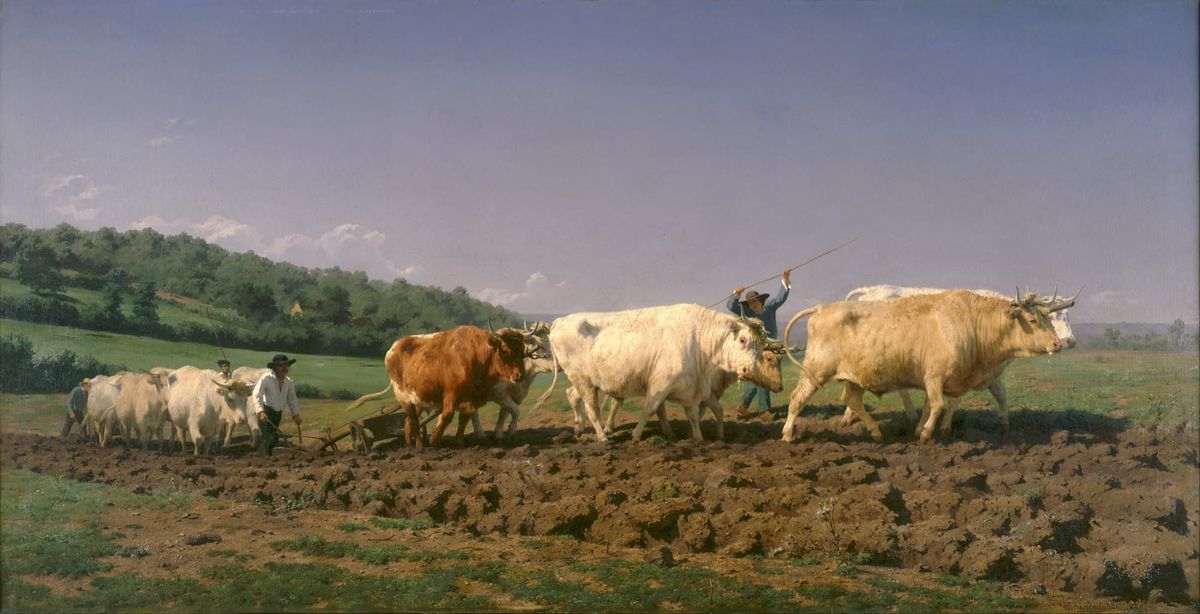
1849년 19세기 프랑스 사실주의 및 자연주의 회화의 위대한 거장 로자 보뇌르(Rosa Bonheur)가 제작한 유화 작품 《니베르네에서의 밭갈기》는 농경 사회의 숭고한 노동과 대지의 풍요로움을 파노라마적 대화폭에 정교한 빛과 필치로 포착해 낸 회화사의 불멸의 명작으로, 현재 프랑스 파리 오르세 미술관(Musée d'Orsay)에 원본 유화가 소장되어 있으며 실제 크기는 약 134 × 260 cm의 압도적인 대형 화폭입니다.
이 화면은 가을날 청명한 하늘 아래 프랑스 중앙부 니베르네(Nivernais) 지방의 능선에서 두 조로 나뉜 샤롤레(Charolais) 품종의 육중한 소들이 쟁기를 끌며 대지의 붉고 비옥한 흙을 일구는 숭고하고 정숙한 순간을 정교한 유화 기법으로 포착해 낸 명작입니다. 화가는 화면 전경을 가로지르며 힘차게 발걸음을 옮기는 백색 및 황토빛 황소들의 단단한 근육과 가죽 질감, 쟁기를 단단히 잡고 소들을 독려하는 농부들의 강직한 포즈, 그리고 수평선 너머로 아득히 펼쳐진 완만한 언덕 수목 배경의 명암 대조를 정밀하게 부각시켰습니다.
작품 속에는 1848년 프랑스 제2공화국 정부의 위촉을 받아 완성된 후 1849년 파리 살롱(Paris Salon)에서 1등상을 수상하며 로자 보뇌르를 세계적인 거장의 반열에 올린 전설적인 예술 비하인드 스토리가 흐릅니다. 조르주 상드(George Sand)의 소설 《마의 못(La Mare au Diable)》속 농촌 풍경에 영감을 받은 보뇌르는 밭을 가르는 쟁기 소리와 흙냄새, 그리고 소들의 거친 숨소리를 화폭에 온전히 담기 위해 니베르네 현장을 찾아 직접 관찰하고 스케치했습니다. 파헤쳐진 비옥한 황토빛 흙이랑과 햇살을 받아 화사하게 빛나는 소들의 백색 가죽 윤택, 그리고 맑고 투명한 가을 하늘의 스펙트럼은 당대 사실주의 회화가 도달한 극상의 조형적 완성도를 생생하게 증명합니다.
후대 평단과 관객들은 이 대형 유화를 19세기 근대 풍속 및 동물 회화가 도달한 최고의 사실성과 전원주의 미학의 결정체로 평가합니다. 황토빛 대지와 푸른 들판, 그리고 백색 소들의 든든한 몸체가 이루는 조화로운 색채 스펙트럼은 관객에게 시대를 초월한 서정적 감동과 깊은 평온함을 선사합니다.
이 그림을 마주하는 관람객의 무의식적 시선은 가장 강렬한 빛을 받아 밝게 부각되는 화면 중앙 우측, 선두에서 힘차게 발을 내딛는 백색 황소와 붉은 황황소의 육중한 몸체, 그리고 우아하게 솟아오른 뿔 윤곽으로 가장 먼저 끌려갑니다. 대지를 갈아엎는 동물의 단단한 생명력은 관람객의 마음에 묵직한 시각적 중심과 정숙한 평온함을 안겨줍니다.
이어 시선은 막대를 들어 올려 소들을 독려하는 농부의 동적인 포즈를 거쳐, 나무 쟁기를 잡고 묵묵히 뒤따르는 농부들과 좌측 뒤편에서 밭을 일구며 따라오는 두 번째 소 무리의 기다란 사선 대열, 그리고 그들의 발밑에서 선명하게 파헤쳐진 붉은 흙이랑의 사실적인 질감으로 자연스럽게 이동합니다. 섬세한 유화 물감층이 만들어낸 빛의 반사와 대지의 깊이감은 화면 전체에 든든한 조형적 안정감과 품격을 더해줍니다.
마지막으로 시선은 화면 좌측 상단에 포근하게 펼쳐진 녹음 짙은 언덕 수목선과, 아득하게 퍼져나가는 청명한 가을 하늘 여백, 그리고 우측 하단 대지 위에 정교하게 새겨진 'Rosa Bonheur 1849' 화가의 서명 속으로 낙하하여 정착합니다. 이러한 무의식적 시선의 흐름은 대지의 순수한 풍요로움과 묵직한 삶의 현장이 교차하는 고요하고 아늑한 성소로 감상자를 자연스럽게 인도하며, 마음에 닿는 차분하고 정갈한 여운을 오래도록 남깁니다.
In 1849, Rosa Bonheur, one of the most celebrated Realist masters of Western art history, created the monumental panorama canvas titled "Plowing in the Nivernais" (Labourage nivernais). Preserved in the Musée d'Orsay in Paris, France, this original oil-on-canvas measures approximately 134 × 260 cm. This artwork finely captures the quiet dignity of agricultural labor, the tactile richness of freshly turned soil, and the grounded strength of working Charolais oxen through an extraordinary, unmatched mastery of Realist naturalism.
The painting visually manifests two teams of six oxen pulling heavy wooden plows across a sloping field in the Nivernais region under a clear autumn sky, turning over rich, dark furrows of earth. Historical context highlights the government commission Bonheur received following the Revolution of 1848, which debuted at the 1849 Paris Salon to overwhelming critical acclaim and established her international fame. Inspired in part by George Sand's rustic novel La Mare au Diable, Bonheur recorded the authentic physical strain of the laborers, the rhythmic, muscular power of the white cattle, and the crisp, sunlit atmosphere of the French countryside with scientific accuracy and painterly warmth.
Art historians and critics continuously extol this monumental canvas as a supreme triumph of 19th-century French animal and landscape painting, celebrating Bonheur's ability to combine anatomical precision with rich, atmospheric light. The striking contrast between the sunlit white coats of the leading oxen, the deep reddish-brown soil, the verdant background hills, and the vast open sky creates an enduring atmosphere of quiet sanctity and emotional permanence.
The moment an observer encounters this artwork, their gaze is subconsciously drawn straight to the sharply illuminated, muscular forms of the leading white ox and its tawny companion pulling the front plow on the right. Their powerful, deliberate posture immediately diffuses tension, instilling a comforting sense of strength and quiet composure.
Next, the eye glides smoothly along the long wooden beam of the plow toward the farmer raising a stick to encourage the team, before tracing back across the procession to the second team of oxen following in the left background. The rich, tactile definition of every turned sod and gleaming hide endows the agrarian scene with profound physical weight and structural clarity.
Finally, the viewer's gaze drifts up into the soft green rolling hills and clear blue sky framing the horizon before coming to rest upon the signature "Rosa Bonheur 1849" inscribed at the lower right corner. This natural visual journey guides the spectator into a state of quiet, reverent reflection, leaving a lasting impression of labor, nature, and timeless peace.
본 리뷰에서 작품을 제외한 컨텐츠의 저작권은 팔렛트제주에 있습니다.
"퍼블릭도메인 고전명화"를 제외한 모든 창작 콘텐츠는 저작권법 제4조 및 제10조에 의거하여 보호됩니다. 무단 도용시 저작권법 제136조(벌칙)에 의거, 당사의 사전 서면 승인 없는 저작권 침해 행위를 금지합니다.