나사로의 부활 Raising of Lazarus
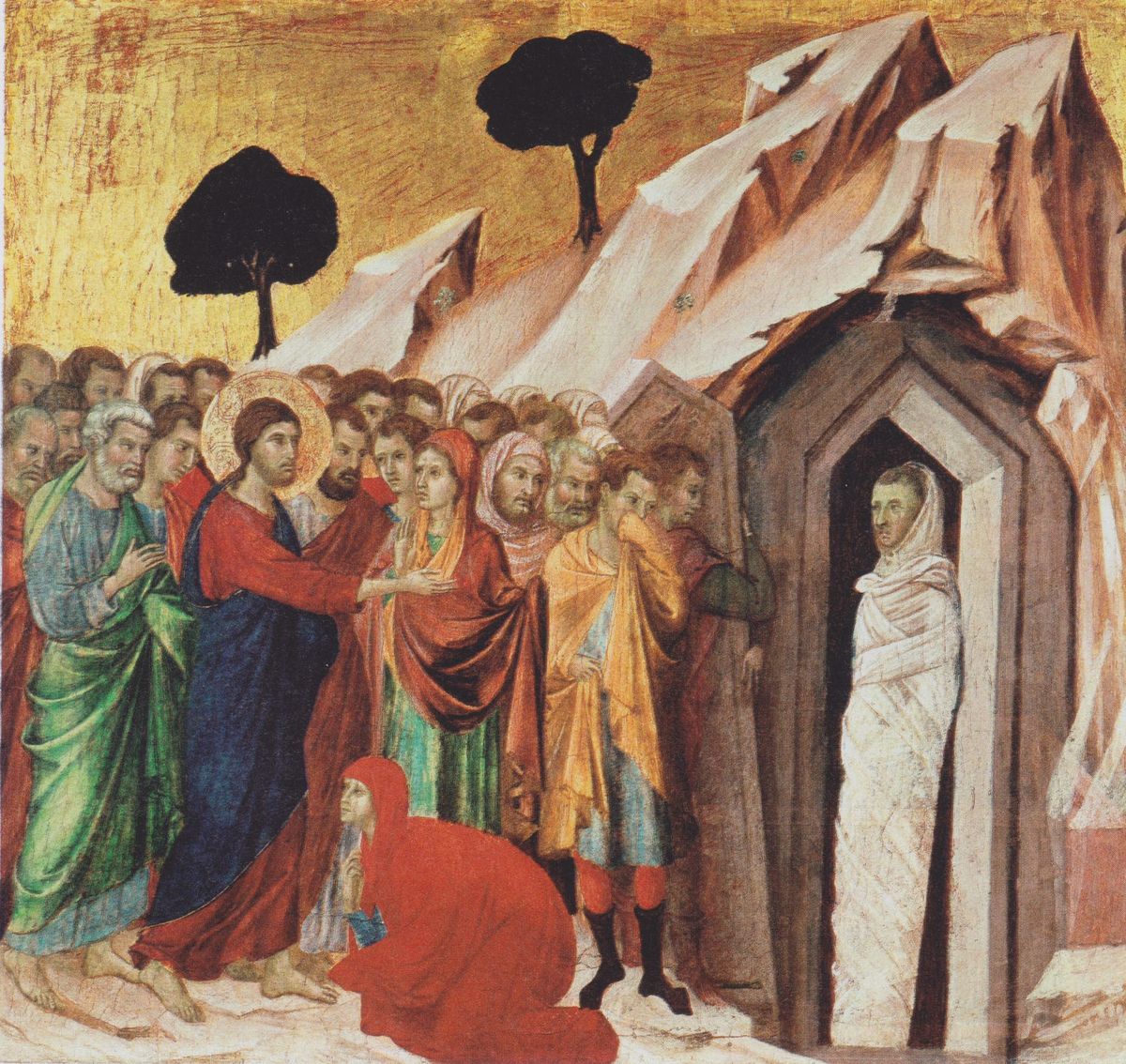
13세기 후반부터 14세기 초반까지 이탈리아 시에나 회화의 지평을 열며 비잔틴 미술의 경직된 틀을 깨고 인물에게 깊은 생명력을 불어넣은 거장 두치오 디 부오닌세냐가 1308년에서 1311년 사이에 제작한 작품으로, 그는 평생 동안 수많은 종교적 걸작을 남기며 시에나 화파를 예술적 정점에 올려놓은 위대한 혁신가였습니다.
이 작품은 시에나 대성당의 대형 제단화인 마에스타의 프레델라 패널 중 하나이며, 공식 소장품 등록번호는 1937.1.8이고 실제 실측 규격은 높이 43.5cm, 너비 46cm의 목판 위에 템페라와 금박 기법으로 정교하게 그려진 작품으로 현재 미국 뉴욕의 프릭 컬렉션에 소장되어 있습니다.
시에나 대성당과의 공식 계약 문서와 회계 장부에 기록된 제작 기록에 따르면, 작가는 당시 급증하는 대규모 제단화 주문을 처리하기 위해 공방의 도공 및 조수들과 함께 체계적인 분업 체계를 갖추고 엄격한 계약 조건 속에서 패널 작업을 수행했습니다.
작가의 고뇌와 비하인드
당대 이탈리아 미술은 비잔틴의 엄격한 전통에서 벗어나 인물의 자연스러운 부피감과 공간적 깊이를 탐구하던 중요한 과도기에 놓여 있었습니다.
두치오는 죽은 지 나흘이 지난 나사로를 살리시는 그리스도의 신비로운 기적 사건을 화폭에 생생하게 담아내기 위해 수많은 밤을 지새우며 깊은 고뇌를 거듭했습니다. 그러한 그의 고뇌는 배경을 가득 채운 눈부신 금박의 화려하지만 단순한 장식을 넘어 세속의 공간과 완전히 차단된 천상의 빛과 신의 절대적인 현존을 상징합니다.
화면 전면에는 푸른 옷을 입고 손을 뻗어 나사로를 부르는 그리스도와 그의 발치에 엎드려 간절히 비는 마르다, 그리고 수의를 입은 채 무덤 입구에 서 있는 나사로가 자리하며, 그 주변으로 놀라움과 경외를 금치 못하는 제자와 군중들이 배치되어 있습니다.
중경에는 나사로의 무덤인 어두운 바위 동굴의 입구와 이를 둘러싼 인물들의 술렁이는 동작이 생동감 있게 펼쳐집니다.
원경의 험준한 바위산 능선 위로 솟아오른 두 그루의 둥근 나무와 금빛 대기감이 조화롭게 어우러지며 공간의 깊이감을 극대화합니다. 작가는 이 전경과 중경 그리고 원경의 유기적인 구성을 통해 성경 속 거룩한 생명의 서사를 시각적으로 완벽하게 구현해 냈습니다.
무의식 속 시선 및 심리 흐름
작품을 마주할 때 관람객의 시선은 가장 먼저 화면 중앙에서 손을 뻗어 기적을 행하는 그리스도의 위엄 있는 모습으로 자연스럽게 이끌립니다. 평온하면서도 확신에 찬 그의 표정은 인간의 시선을 즉각적으로 사로잡으며 깊은 경외감과 믿음을 불러일으킵니다.
이어지는 시선은 그리스도 발치에 엎드린 인물의 절박한 몸짓과 수의를 입은 채 무덤 문에 서 있는 나사로의 충격적인 모습으로 확장되어 극적인 기적의 현장으로 깊이 몰입하게 만듭니다.
마지막으로 시선은 오른쪽 배경의 험준한 바위산과 상단의 나무들이 자아내는 차분한 원경으로 향하게 됩니다. 이 과정에서 관람객은 신성한 부름의 순간에서 시작해 죽음을 초월한 경이로움을 거쳐, 마침내 자연과 대기가 전하는 엄숙한 여운으로 이어지는 심리적 여정을 온전히 경험하게 됩니다.
미술계의 평가 및 조형미
두치오의 이 작품은 중세 예술의 장식적 전통을 계승하면서도 인간의 감정과 극적인 공간 구성에 대한 새로운 시각을 열어주어 르네상스 회화의 초석을 다진 위대한 걸작으로 평가받습니다. 수많은 템페라 층을 겹겹이 쌓아 올려 완성한 깊이 있는 색감과 세밀한 금박 세공은 빛을 머금은 듯한 영롱한 입체감을 부여하며 작품 전체에 신비로운 숨결을 불어넣습니다.
인물들의 손동작과 신체 비례에서 드러나는 절제된 사실성은 당시 회화의 수준을 한 단계 끌어올린 혁신적인 성취입니다. 화면을 가로지르는 인물들의 자연스러운 배치와 정교하게 표현된 무덤 건축 및 자연 배경이 조화로운 대비를 이루며 시각적 안정감을 선사하고, 이로써 영원히 바래지 않는 종교적 예술의 진수를 보여줍니다.
Raising of Lazarus
Painted between 1308 and 1311 by Duccio di Buoninsegna, a pioneering master of the Sienese school who broke away from the rigid constraints of Byzantine art to infuse medieval painting with unprecedented emotional resonance, Raising of Lazarus originally served as a predella panel within the monumental Maestà altarpiece created for the Siena Cathedral, leaving behind numerous monumental religious masterpieces as a great innovator who breathed human warmth and deep vitality into his figures.
It carries the official accession number 1937.1.8 and measures 43.5 cm in height and 46 cm in width, executed in tempera and gold leaf on a wooden panel, and is currently housed in The Frick Collection in New York.
According to historical records and guild contracts associated with the Siena Cathedral, the artist managed a structured workshop alongside assistants and collaborators to fulfill massive altarpiece commissions under strict professional and legal obligations.
The Artist's Agony and Behind-the-Scenes
During a transitional era when Italian art was beginning to break away from rigid Byzantine traditions to explore human emotion and spatial depth, Duccio wrestled deeply with how to translate the theological mystery of Christ raising Lazarus from the dead after four days into visual reality.
Duccio wrestled deeply to vividly capture on canvas this profound miraculous event. His profound agony is symbolized by the dazzling gold leaf filling the background, which transcends simple, ornate decoration to represent celestial light completely separated from the secular space and the absolute presence of the divine.
In the foreground, Christ stands extending His hand to call forth Lazarus, accompanied by a kneeling figure in deep supplication and Lazarus standing wrapped in burial shrouds at the tomb entrance, surrounded by astonished disciples and onlookers.
Moving into the midground, the dark rocky entrance of the tomb and the restless gestures of the crowd unfold with vivid realism.
In the background, two rounded trees rising above the rugged ridge of the rocky mountains harmonize with the golden atmosphere, maximizing a sense of spatial depth. Duccio perfectly and visually realized the sacred narrative of life through this organic composition of the foreground, midground, and background.
Unconscious Gaze and Psychological Flow
Encountering the piece for the first time immediately draws the eye to the central figure of Christ performing the miracle, capturing the viewer's psychological focus with His serene yet commanding expression. From there, attention naturally sweeps toward the desperate gesture of the kneeling figure and the shocking presence of Lazarus standing at the tomb, drawing the observer deeper into the unfolding miracle.
Finally, the gaze moves toward the background and the upper right, where the rugged rocky mountains and trees create a calm, atmospheric horizon. This visual trajectory choreographs an inner pilgrimage from the moment of divine calling down to transcendent wonder and solemn emotional resonance across a richly layered space.
Art Historical Evaluation and Formal Beauty
Duccio's work stands as a vital bridge connecting Byzantine artistic traditions to the dawn of Renaissance naturalism through its innovative handling of narrative space and human psychology. The rich chromatic depth achieved by layering tempera glazes, paired with sophisticated gold tooling, maximizes reflective luminance to envelop the scene in an ethereal atmosphere.
Subtle psychological nuances expressed through facial features and hand gestures reveal a level of realism rarely seen in period panel painting. From a formal standpoint, the architectural framing of the tomb, dynamic foreground figures, and expansive natural background create a stable yet dramatic composition. This panel remains an enduring testament to Duccio's unrivaled genius and holds a permanent place of honor in the history of art.
본 컨텐트의 저작권은 팔렛트제주에 있습니다. 허가없는 무단전제를 금지합니다.
Copyright © Palette Jeju. All rights reserved. Unauthorized reproduction or redistribution is strictly prohibited.