나무 뿌리와 줄기 Tree Roots and Trunks
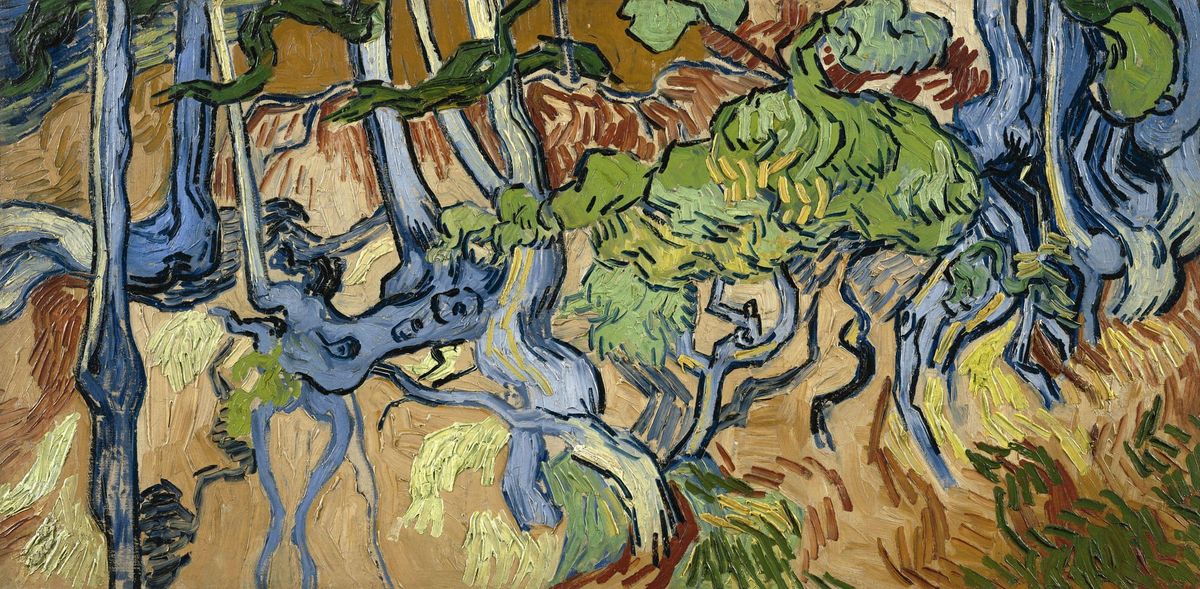
빈센트 반 고흐(Vincent van Gogh, 1853–1890)는 1890년 7월 프랑스 파리 근교의 오베르슈르우아즈에서 생애 마지막 시기를 보내며 대지의 생명력을 탐구하는 파격적인 풍경화를 그려냈습니다.
이 작품은 그가 사망하기 직전인 1890년 7월에 제작된 유채화로, 야콥 바르트 드 라 파이유의 전작 도록 기준 공식 등록번호는 F816이며 실제 작품의 실측 규격은 50.0 × 100.0 cm입니다.
현재 네덜란드 암스테르담에 위치한 반 고흐 미술관에서 소장하고 있습니다.
작가의 고뇌와 비하인드
작품을 제작할 당시 오베르의 들녘에는 한여름의 뜨거운 태양이 내리쬐고 있었지만, 화가의 마음속에는 삶의 무게와 끝없는 정신적 고통이라는 서늘하고 무거운 그늘이 깊게 드리워져 있었습니다.
세상을 떠나기 직전 벼랑 끝에 선 심정으로 마주한 오베르의 언덕 비탈에서, 그는 거칠게 얽히고설킨 나무 뿌리와 줄기가 땅크기를 뚫고 솟구쳐 오르는 원초적인 생명력을 붙잡으며 마지막 혼신을 다해 붓을 움직였습니다.
화면 전면에는 흙빛과 황토빛 대지 위로 굵고 힘차게 뻗어 나가는 나무 뿌리들의 거친 결이 두터운 붓질로 생생하게 표현되어 있습니다.
중경에는 짙은 푸른빛과 보랏빛이 감도는 꺾인 나무 줄기들이 서로 얽혀 화면 전체에 강력한 긴장감을 부여하고 있습니다.
원경의 배경에는 눈부신 햇살을 받으며 타오르는 듯한 연두빛과 초록빛 잎사귀들이 어우러져, 생명의 끈질긴 투지와 죽음의 경계가 교차하는 강렬한 대기의 깊이감을 완성합니다.
무의식 속 시선 및 심리 흐름
관람객의 시선은 가장 먼저 화면 전면을 가득 채운 황토색 대지와 꿈틀거리듯 엉켜 있는 푸른빛 나무 뿌리의 역동적인 질감에 닿으며 시각적 전율을 느끼게 됩니다.
이어지는 시선은 화면을 가로지르는 굵은 줄기들의 꺾인 기세와 그 사이사이를 메운 초록빛 잎사귀들의 강렬한 대비를 따라 자연스럽게 이동합니다.
마지막으로 화면 상단의 밝고 환한 대기감 속으로 시선이 넓게 퍼져나가며, 삶과 죽음의 문턱에서 화가가 마주했던 영혼의 치열한 울림과 묵직한 카타르시스를 체감하게 됩니다.
미술계의 평가와 조형미
미술사학계에서는 이 작품을 두고 고흐가 생애 마지막 순간에 전통적인 풍경의 재현을 완전히 뛰어넘어, 형태의 해체와 대담한 색채 대비를 통해 추상 미술과 표현주의의 서막을 연 위대한 유작으로 평가합니다.
화면을 지배하는 강렬한 푸른색과 황토색, 그리고 초록빛의 충돌은 시각적 에너지를 극대화합니다.
눈에 보이는 나무의 재현을 넘어, 화가가 극한의 고통 속에서도 대지와 생명을 향해 마지막까지 짜내었던 영혼의 뜨거운 호흡을 캔버스 위에 영원히 아로새긴 불후의 명작입니다.
Tree Roots and Trunks
Vincent van Gogh captured the raw, pulsing vitality of the earth in the French village of Auvers-sur-Oise during the final, tumultuous weeks of his life in July 1890.
Created in July 1890, this oil on canvas is cataloged as F816 in J.B. de la Faille's catalogue raisonné and measures 50.0 × 100.0 cm.
The painting is currently housed in the Van Gogh Museum in Amsterdam.
During the period of its creation, a blazing summer sun beat down upon the hills of Auvers, yet an overwhelming burden of psychological exhaustion and the crushing weight of isolation pressed relentlessly against the artist's fragile spirit.
Standing on the precipice of his tragic end, he found a desperate, primal mirror for his own struggle in a sunlit slope where ancient tree roots and trunks writhed violently out of the sandy earth, driving his brush with an urgent, unbridled intensity.
The foreground is anchored by the rugged, undulating forms of woody roots breaking through the warm earthen soil, rendered in thick, expressive impasto brushwork.
In the middle ground, twisting trunks in striking shades of blue and violet lock together in a powerful composition that conveys an intense psychological friction.
In the distant background, patches of vibrant green foliage illuminated by bright sunlight establish a luminous atmospheric depth where the relentless drive of life confronts the impending shadow of death.
The viewer's gaze is initially drawn toward the twisting blue roots and the textured earthen ground dominating the lower register.
The perspective then follows the jagged alignment of the interlocking trunks inward across the double-square canvas, resting upon the dense flashes of green foliage.
Finally, the eye diffuses into the bright upper register, allowing the observer to experience a profound psychological transition from physical observation to an overwhelming sense of visionary transcendence.
Art historians regard this canvas as a defining masterpiece of Van Gogh's final days, where the radical dissolution of conventional form and the bold synthesis of color herald the dawn of abstract art and expressionism.
The striking interplay between cool blues, warm earthen tones, and bright greens generates an unmatched optical vibration and emotional power.
It stands as an enduring artistic monument that immortalizes the artist's final, defiant communion with the earth and the unyielding pulse of life itself right before the silence.
본 컨텐트의 저작권은 팔렛트제주에 있습니다. 허가없는 무단전제를 금지합니다.
Copyright © Palette Jeju. All rights reserved. Unauthorized reproduction or redistribution is strictly prohibited.