남자의 초상 Portrait d'homme
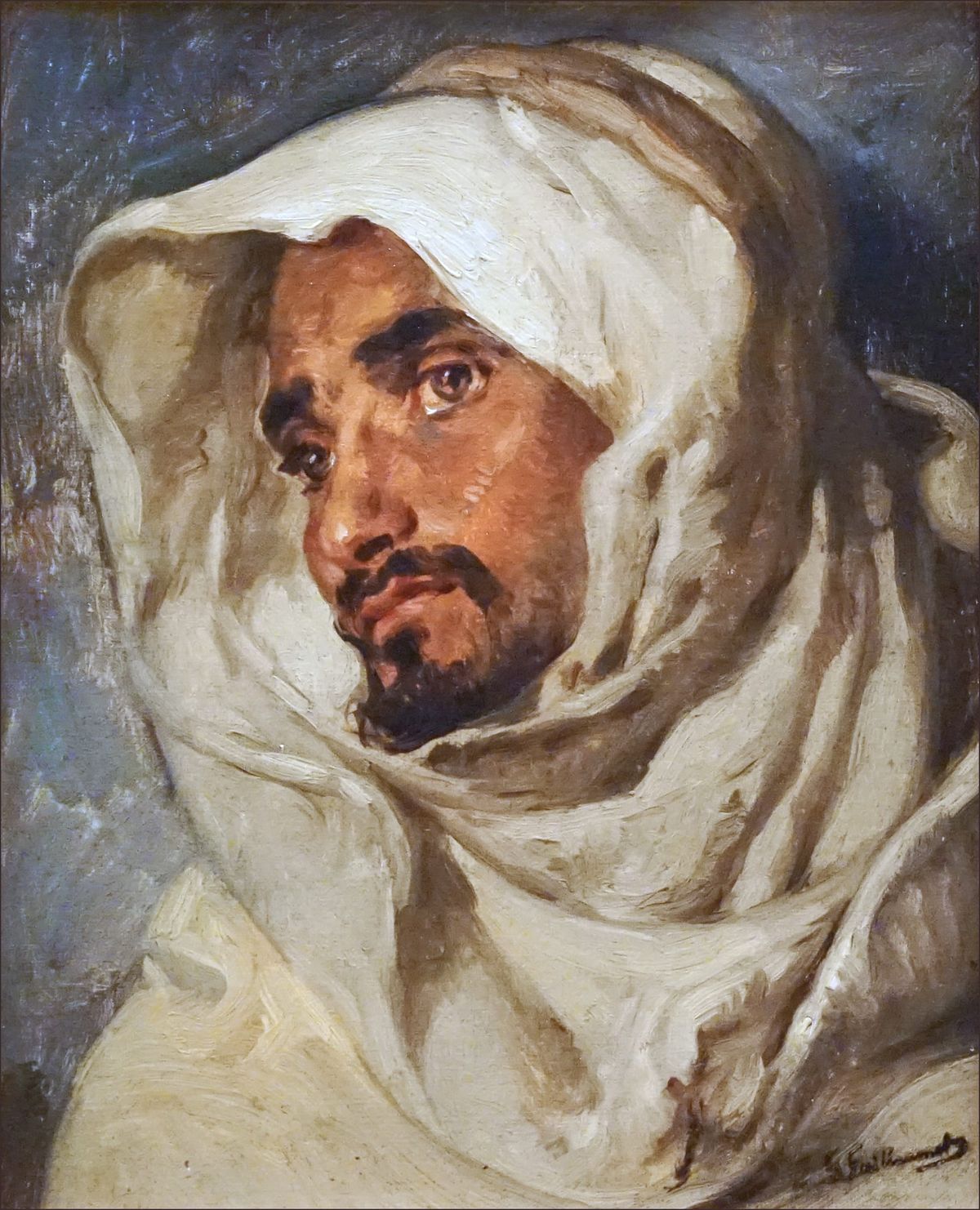
19세기 프랑스 오리엔탈리즘 리얼리즘의 독보적인 거장 귀스타브 기요메(Gustave Guillaumet, 1840–1887)가 1870년대경 완성한 유화 남자의 초상(Portrait of a Man, 또는 Head of an Arab, 프랑스어: Portrait d'homme)은 46.0 cm × 38.0 cm 크기의 캔버스에 유채로 그린 대표적인 알제리 인물 초상화 최고 걸작입니다. 현재 프랑스 루베의 라 피신 앙드레 딜리장 미술산업박물관(La Piscine - Musée d'Art et d'Industrie André Diligent, Roubaix)에 소장되어 있습니다.
사하라 사막의 뜨거운 태양 아래서 마주한 현지인의 깊은 눈망울과 화가의 고뇌
1860년대부터 알제리를 수없이 오가며 북아프리카의 진솔한 삶을 화폭에 담았던 기요메는, 당시 파리 화단에서 유행하던 화려한 궁정 오리엔탈리즘의 거짓된 장식성을 단호히 거부했습니다. 그는 사하라 사막의 거친 모래바람과 뜨거운 햇살을 온몸으로 견뎌내며 살아가는 현지 베두인 남성의 그을린 얼굴이야말로 어떤 보석보다 값지고 숭고한 인류의 원초적 아름다움이라고 확신했습니다. 기요메는 편안한 파리의 아틀리에를 벗어나 사막의 천막 곁에서 현지인 모델과 오랜 시간 눈을 맞추며, 척박한 땅에서 피어난 인간의 깊은 내면과 말 못 할 슬픔을 캔버스 위에 담아내기 위해 치열하게 번민했습니다.
화가는 두터운 흰색 털 모직 부르누스(후드가 달린 전통 외투)를 머리 위로 둘러쓴 아랍 남성의 상반신을 화면 가득 클로즈업했습니다. 거친 붓 터치로 두껍게 얹힌 하얀 모직 천의 질감과 그 안에서 강렬한 대비를 이루는 구릿빛 피부는, 사막의 혹독한 기후를 이겨낸 한 인간의 강인한 생명력을 여실히 드러냅니다. 깊게 패인 눈매 속에서 촉촉하게 빛나는 남자의 눈망울은 오랜 방황과 고난을 겪은 자만이 품을 수 있는 깊은 성찰과 애수를 머금고 있습니다. 오른쪽 아래에 단정하게 새겨진 기요메의 친필 서명은, 이국적인 대상을 관찰의 도구가 아닌 동등한 인간으로서 존중하고 교감했던 화가의 따뜻한 인도주의적 시선을 감동적으로 증명합니다.
촉촉한 눈망울의 깊은 슬픔에서 구릿빛 피부와 두터운 흰 천의 결로, 시선의 심리적 여정
그림을 마주하는 순간 관람객의 무의식적 시선은 화면 중앙 짙은 어둠 속에서 은은한 자연광을 받아 애절하게 반짝이는 남자의 깊고 촉촉한 눈동자와 짙은 눈썹으로 가장 먼저 빨려 들어갑니다. 먼 곳을 응시하며 깊은 사색에 잠긴 남자의 슬프면서도 흔들림 없는 눈빛은 보는 이에게 깊은 시각적 숙연함과 함께 마음을 울리는 묵직한 인간적 교감을 선사합니다.
이어 시선은 사막의 태양에 붉게 그을린 콧날과 굳게 다문 입술, 그리고 턱을 덮고 있는 단정한 검은 수염의 어두운 음영을 따라 이동합니다. 모진 풍파를 견뎌낸 남자의 단단한 골격과 이마에 드리운 그늘을 확인하는 순간, 관람객은 문명의 화려함 뒤에 숨겨진 사하라 사막 원주민의 고단하지만 존엄한 삶의 무게 속으로 온몸이 빨려 들어가게 됩니다.
마지막으로 시선은 남자의 머리와 어깨를 둥글게 감싸고 있는 거친 흰색 모직 천의 두터운 붓 자국들을 지나, 푸른빛과 잿빛이 감도는 차분한 배경과 화면 오른쪽 아래에 선명하게 새겨진 화가의 서명에 멈춥니다. 서늘한 배경과 따스한 인물의 온기가 빚어내는 완벽한 조화를 마주하며, 관람객은 편견을 넘어선 순수한 인간애의 위대한 가치와 기요메가 건네는 묵직한 영혼의 위로를 가슴 깊이 마주하게 됩니다.
19세기 프랑스 오리엔탈리즘 초상화의 정점과 조형미, 미술계의 평가
미술계는 라 피신 미술관의 남자의 초상을 기요메가 완성한 수많은 인물화 중에서도 가장 뛰어난 심리적 사실주의와 대담한 유화 기법을 성취한 대표작으로 평가합니다.
단 하나의 인물 두상만으로 거친 사막의 공기와 인물의 내면적 고뇌를 완벽하게 구현했을 뿐만 아니라, 임파스토 기법을 활용한 두터운 물감의 마티에르와 섬세한 명암법을 결합하여 모직 천의 촉각적 물질감을 극도로 생생하게 포착했기 때문입니다. 이국적인 대상을 향한 왜곡된 호기심을 배격하고 북아프리카인의 숭고한 존엄성을 장엄한 시각 예술로 완성해 낸 기요메의 이 걸작 화폭은, 오늘날까지도 전 세계 수많은 감상자들에게 깊은 감동과 잊을 수 없는 시각적 전율을 전해주는 불멸의 명작으로 손꼽히고 있습니다.
Portrait of a Man
Painted around the 1870s by the preeminent nineteenth-century French Orientalist realist master Gustave Guillaumet (1840–1887), Portrait of a Man (also titled Head of an Arab, French: Portrait d'homme) is an oil on canvas measuring 46.0 cm × 38.0 cm (18.1 in × 15.0 in), preserved in the distinguished permanent collection of La Piscine - Musée d'Art et d'Industrie André Diligent in Roubaix, France.
Saharan Naturalism, Unembellished Humanity, and the Painter's Empathy
Throughout his repeated journeys across the Algerian interior from the 1860s onward, Gustave Guillaumet consciously rejected the theatrical and exoticized fantasies manufactured for fashionable Parisian salons. He believed that the supreme dignity of North Africa resided in the weathered features of its people, whose sun-scorched skin and resilient spirit reflected generations of life under an unforgiving desert sky. Working directly in close communion with indigenous models, Guillaumet sought to capture the psychological truth and quiet melancholy of the desert dweller with unvarnished honesty.
Guillaumet framed the head and shoulders of an Algerian man enveloped in the thick, gathered folds of a traditional off-white woolen burnous. The artist applied rich, impasto brushwork to construct the sculptural weave of the hooded garment, creating a powerful textural foil to the warm, luminous ochre tones of the subject's sun-baked complexion. The man's moist, introspective eyes, gazing slightly upward and away from the viewer, convey a profound sense of stoic endurance, emotional vulnerability, and inner nobility. Signed distinctly by the artist in the lower right corner, this intimate bust stands as an enduring visual monument to Guillaumet’s deep humanism and artistic integrity.
Subconscious Trajectory of the Gaze: From Reflective Eyes to the Heavy Hooded Burnous
The observer's subconscious gaze is immediately magnetized by the central-upper register, drawn to the luminous, glistening eyes and arched dark eyebrows of the subject emerging from the shadows of his hood. His moist, contemplative gaze and the subtle highlights on his eyelids establish an instant focal point of psychological depth, unspoken sorrow, and quiet spiritual resilience.
The visual path then travels down the firm, sunlit bridge of his nose across his weathered cheeks to his trimmed dark moustache and beard. Taking in the warm amber undertones of his skin and the sculptural modeling of his cheekbones, the viewer directly experiences the physical reality of a life lived under the desert sun and the dignified calm of his countenance.
Finally, the visual trajectory sweeps outward into the heavy, rhythmic ridges of the white woolen hood framing his face, cascading across his wrapped shoulders before resting upon the cool greyish-blue background and the artist’s signature G. Guillaumet in the lower-right corner. Observing the harmonious equilibrium between bold impasto brushwork, delicate chiaroscuro, and emotional truth, the spectator perceives the timeless dignity of the human spirit and the profound aesthetic solace Guillaumet embedded within the canvas.
The Monument of French Ethnographic Realism: Critical Legacy
Art historians revere this Roubaix Portrait of a Man as a quintessential masterpiece among Guillaumet’s painted portraits, illustrating his total mastery of close-up human observation and expressive oil technique.
By orchestrating delicate textural contrasts between thick impasto wool, smooth sunlit flesh, and atmospheric ambient shadow within a unified composition, Guillaumet elevated an ethnographic study into an exquisite psychological meditation. This magnificent portrait endures as an inspiring testament to the master's creative fortitude, celebrating the unyielding dignity of North African life and the transformative grace of living art.
본 컨텐트의 저작권은 팔렛트제주에 있습니다. 허가없는 무단전제를 금지합니다.
Copyright © Palette Jeju. All rights reserved. Unauthorized reproduction or redistribution is strictly prohibited.