몽마르트의 언덕과 채석장 The Hill of Montmartre with Stone Quarry
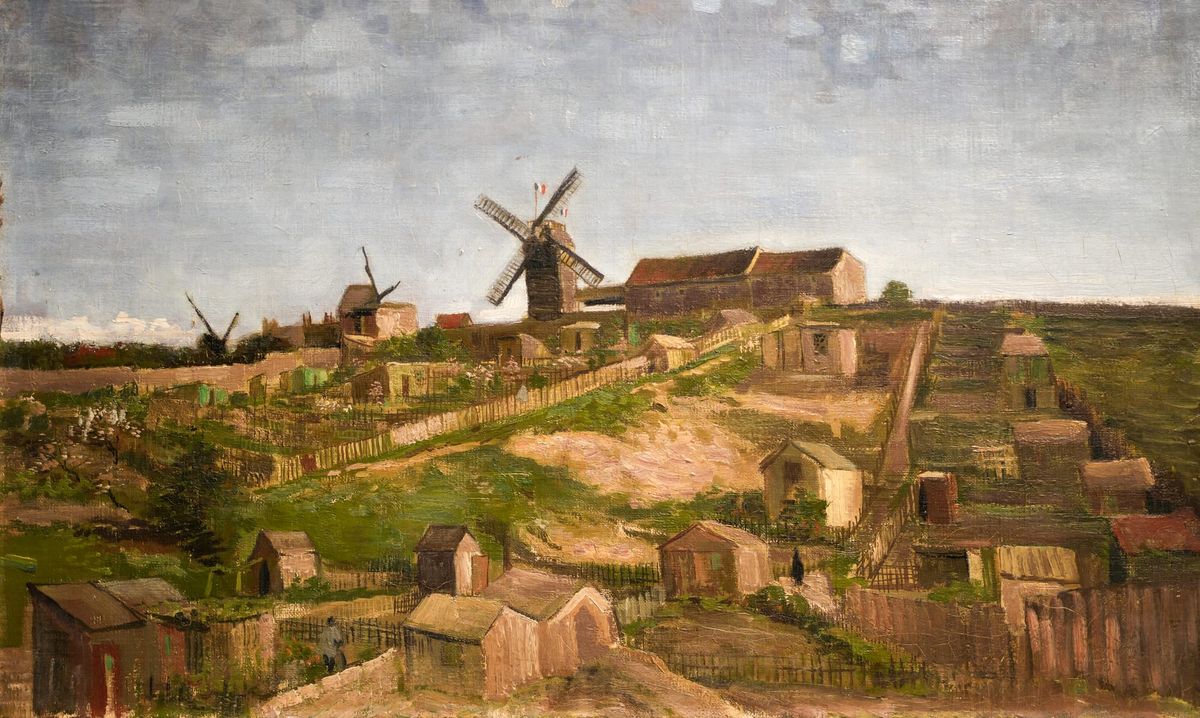
빈센트 반 고흐(Vincent van Gogh, 1853–1890)는 1886년 파리에 도착하여 동생 테오와 함께 거주하기 시작했으며, 이 시기 파리 북부의 낙후된 풍경과 활기찬 도시 변두리의 삶에 깊이 매료되었습니다. 이 작품은 그가 파리에 체류하던 1886년 6월에서 7월 사이에 제작된 유채화로, 야콥 바르트 드 라 파이유의 전작 도록 기준 공식 등록번호는 F229이며, 실제 작품의 실측 규격은 높이 56 센티미터, 너비 62.5 센티미터입니다. 현재 네덜란드 암스테르담에 위치한 반 고흐 미술관(Van Gogh Museum)에서 소장하고 있습니다.
작가의 고뇌와 비하인드
파리로 이주하기 전 고흐의 화풍은 네덜란드 시기의 어둡고 무거운 색채에 머물러 있었습니다. 그러나 파리에서 폴 고갱, 에밀 베르나르 등 당대 전위적인 화가들과 교류하고 인상주의의 밝은 색채 과학을 접하면서 그의 예술 세계는 거대한 전환점을 맞이하게 됩니다. 당시 몽마르트는 완전히 도시화된 시가지가 아니라, 오래된 풍차와 채석장, 그리고 가난한 노동자들의 작은 오락실과 밭이 공존하는 독특한 변두리 공간이었습니다.
화면 중앙에 당당하게 솟아오른 목재 풍차와 프랑스 국기가 휘날리는 모습은 과거의 농경 사회와 다가오는 산업화의 물결이 교차하던 현장을 가감 없이 보여줍니다. 고흐는 가파른 언덕 지형을 따라 촘촘하게 들어선 초가와 판잣집, 그리고 척박한 채석장의 단면을 거칠면서도 밝아진 붓질로 담아내며, 파리의 빛이 자신의 팔레트에 가져다준 새로운 생명력을 실험했습니다.
무의식 속 시선 및 심리 흐름
관람객의 시선은 가장 먼저 화면 하단 전경에 밀집된 작은 오락실과 정원 가옥들 사이를 거니는 단정한 실루엣의 인물들에게 닿게 됩니다. 이 소박한 일상의 공간에서 시선은 완만한 경사진 대각선 오솔길을 따라 중경으로 자연스럽게 유도되며, 언덕 꼭대기에 우뚝 솟은 풍차와 그 주변의 투박한 농가 건물들로 향합니다.
최종적으로 화면 상단을 가득 채운 역동적인 회색빛 하늘과 대기감으로 시선이 넓게 확장되면서, 파리 변두리의 황량하면서도 소박한 풍경이 안겨주는 묘한 해방감과 깊은 고요를 동시에 체감하게 됩니다.
미술계의 평가와 조형미
미술사학계에서는 이 작품을 두고 고흐가 네덜란드 시절의 어둠을 완전히 떨쳐내고 인상주의의 빛과 색채를 자신만의 조형 언어로 흡수해 가는 과도기의 중요한 학술적 성취로 평가합니다. 대상을 단호하게 잘라내는 구도와 흙빛, 녹색, 하늘색의 유기적인 조화는 단순한 풍경 묘사를 넘어 당시 파리 변두리가 지닌 시대적 공기와 화가의 생동하는 시선을 완벽하게 결합해 냈습니다. 눈에 보이는 풍경의 기록을 넘어 새로운 예술적 자아를 구축하려던 청년 화가의 뜨거운 열정과 예술적 진화 과정을 보여주는 소중한 명작입니다.
The Hill of Montmartre with Stone Quarry
Vincent van Gogh arrived in Paris in 1886 to live with his brother Theo, quickly becoming captivated by the raw, unpolished landscapes and vibrant working-class life of the city's northern outskirts. Created between June and July 1886 during his early Paris period, this oil on canvas is cataloged as F229 in J.B. de la Faille's catalogue raisonné. Measuring 56 by 62.5 centimeters, the painting is currently housed in the Van Gogh Museum in Amsterdam.
Before moving to Paris, Van Gogh's palette was dominated by the somber, earthy tones of his native Netherlands. However, immersion into the Parisian art scene—surrounded by the luminous color theories of the Impressionists and contemporaries like Camille Pissarro and Paul Signac—sparked a radical transformation in his brushwork and vision.
At this time, Montmartre was not yet a fully urbanized metropolis, but rather a semi-rural borderland characterized by historic windmills, active stone quarries, and rustic allotment gardens. The prominent wooden windmill rising sharply against the horizon anchors the composition, symbolizing the lingering agrarian past colliding with the creeping urbanization of the French capital. Van Gogh meticulously maps the steep, terraced slopes, crude wooden fencing, and sparse vegetation, using a brighter and more varied palette to capture the changing atmospheric light of the French sky.
The viewer's gaze is initially drawn toward the lower foreground, where small rustic cabins and quiet figures navigate the partitioned garden plots.
The perspective then follows the upward diagonal slope of the hillside into the middle ground, resting upon the towering silhouette of the windmill and the surrounding stone structures. Finally, the eye ascends toward the upper register of the canvas, where heavy, expressive strokes of gray and blue skies evoke a sweeping sense of open air and expansive space.
Art historians regard this canvas as a crucial transitional milestone, marking the precise moment Van Gogh shed his dark Dutch aesthetic and embraced the luminous possibilities of Impressionism. Through dynamic brushwork and a newly awakened sensitivity to natural light, he transcends simple topographical illustration. The painting stands as a vital psychological and historical document, recording both the physical transformation of fin-de-siècle Paris and the artist's rapid stylistic evolution.
본 컨텐트의 저작권은 팔렛트제주에 있습니다. 허가없는 무단전제를 금지합니다.
Copyright © Palette Jeju. All rights reserved. Unauthorized reproduction or redistribution is strictly prohibited.