메마른 토탄밭에 피어오르는 연기와 고단한 삶의 쉼표, 불을 피우고 토탄을 캐는 농부들 Peasant Burning Weeds and Peasant Woman on a Wheelbarrow
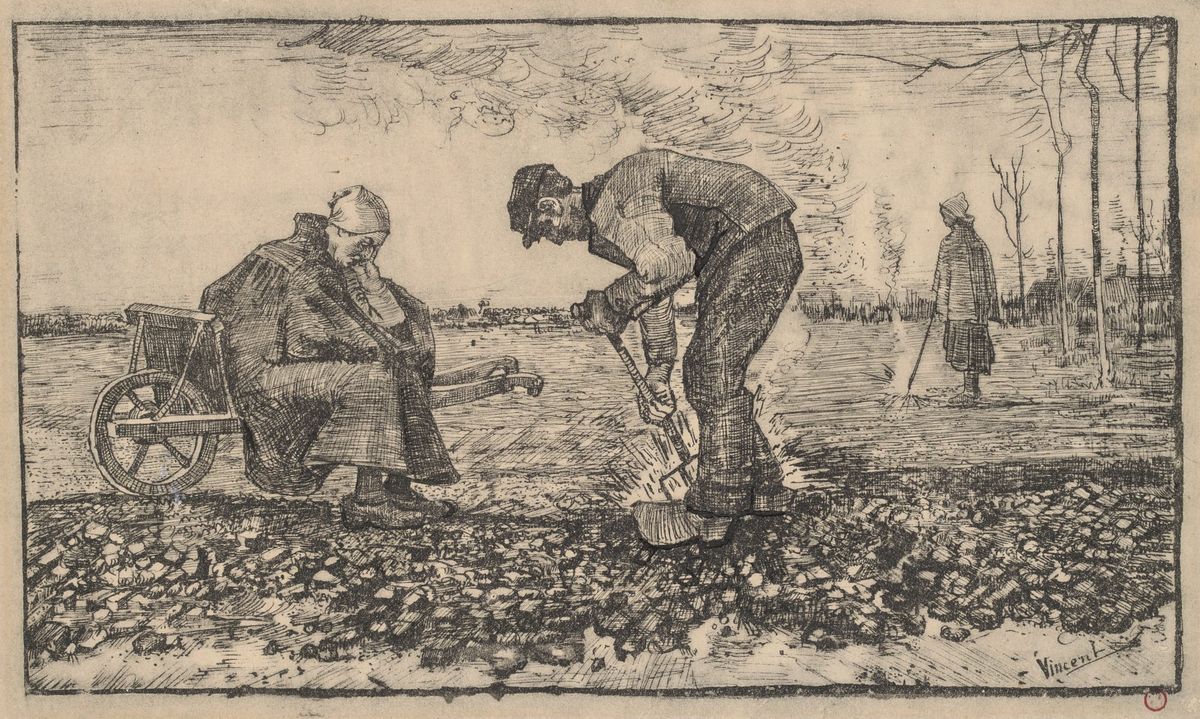
네덜란드 출신의 후기 인상주의 거장 빈센트 반 고흐(Vincent van Gogh, 1853–1890)가 1883년 10월에 네덜란드 북부 드렌터(Drenthe) 시절 완성한 석판화 불을 피우고 토탄을 캐는 농부들(Peasant Burning Weeds and Peasant Woman on a Wheelbarrow, 네덜란드어: Veldarbeid)은 19.0 cm × 33.7 cm 크기의 종이에 석판 인쇄(Lithograph)로 제작한 대표적인 초기 판화 명작입니다. 현재 네덜란드 암스테르담의 반 고흐 미술관(Van Gogh Museum, Amsterdam) 등에 소장되어 있습니다.
굴뚝 연기 자욱한 드렌터의 황무지와 외상 석판으로 찍어낸 첫 판화
1883년 가을, 헤이그를 떠나 네덜란드 북부의 외딴 시골 드렌터의 황무지에 도착한 반 고흐는 짙은 갈색 흙과 척박한 토탄밭에 온 마음을 빼앗겼습니다. 당시 도시 화상들은 어둡고 칙칙한 시골 풍경화는 돈이 되지 않는다며 반 고흐를 외면했고, 화가는 밥을 굶어가며 물감과 종이를 사야 할 정도로 극심한 가난에 시달렸습니다. 하지만 반 고흐는 가난한 농부들에게 조금이라도 저렴한 가격에 자신의 그림을 나누어주고 싶다는 따뜻한 열망을 품고, 여러 장을 찍어낼 수 있는 석판화 기술에 독학으로 매달렸습니다.
이 판화를 제작할 당시 인근 석판 인쇄소에서는 유쾌하면서도 눈물겨운 실랑이가 벌어졌습니다. 반 고흐는 무거운 석판을 인쇄소에서 외상으로 빌려와 여관 방 침대 위에 올려놓고, 하루 종일 밭에서 관찰했던 농부들의 모습을 기름진 크레용으로 긁어가며 밤을 지새웠습니다. 밭에서 잡초를 태우는 매캐한 연기와 흙먼지를 표현하기 위해 화가는 잉크를 묻힌 손가락으로 석판을 사정없이 문지르고 심지어 자신의 외투 소매로 석판을 닦아내며 거친 질감을 만들어냈습니다.
다음 날 아침 시커멓게 잉크 범벅이 된 손으로 인쇄소로 달려간 반 고흐는 기술자들에게 당장 시험 인쇄를 해보자며 재촉했습니다. 기술자들은 화가의 기괴하고 거친 판화 기법을 보고 전통적인 인쇄 규칙을 다 망쳐놓았다며 혀를 찼지만, 막상 종이 위에 찍혀 나온 짙은 검은 흙과 자욱한 잡초 연기의 생생함을 보고는 입을 다물지 못했습니다. 화면 속에서 외바퀴 수레에 걸터앉아 턱을 괴고 조는 지친 아내와, 그 곁에서 묵묵히 쇠스랑으로 흙을 파헤치는 남편의 모습은 거친 대지 위에서 살아가는 이름 없는 민초들을 향한 젊은 반 고흐의 눈물겨운 헌사와 따스한 인간애가 고스란히 각인된 결실입니다.
수레에 기댄 여인의 깊은 침묵에서 쇠스랑을 꽂는 남편의 손끝으로, 시선의 심리적 여정
그림을 마주하는 순간 관람객의 무의식적 시선은 화면 왼쪽 낡은 외바퀴 수레 손잡이에 비스듬히 걸터앉아 손으로 턱을 괴고 깊은 생각에 잠긴 여인의 둥근 등과 하얀 두건으로 가장 먼저 빨려 들어갑니다. 고된 노동에 지쳐 무거운 침묵 속에 잠겨 있는 여인의 쓸쓸한 자세는 보는 이에게 뭉클한 연민과 고요한 안식의 무게를 선사합니다.
이어 시선은 여인의 곁에서 허리를 깊숙이 굽힌 채 두 손으로 쇠스랑을 쥐고 굳은 땅을 내리찍는 남편의 각진 모자와 단단한 어깨선으로 이동합니다. 팽팽하게 당겨진 남자의 거친 멜빵바지와 발밑에서 파헤쳐지는 울퉁불퉁한 토탄 덩어리들의 묵직한 질감을 확인하는 순간, 관람객은 대지를 파고드는 날카로운 쇠 소리와 함께 농부의 거친 숨소리를 공감각적으로 느끼게 됩니다.
마지막으로 시선은 화면 앞쪽을 가득 채운 검은 흙덩어리들을 지나, 저 멀리 평원 한가운데서 피어오르는 매캐한 잡초 연기 속에서 갈퀴를 쥐고 서 있는 또 다른 여인의 작은 실루엣과 화면 오른쪽 아래 선명하게 새겨진 화가의 이름 서명에 멈춥니다. 자욱한 연기가 하늘로 번져나가는 척박한 황무지의 정적과 그 위에서 성실하게 삶을 일구는 민초들의 끈질긴 생명력을 마주하며, 관람객은 화려한 세상 뒤편에 자리한 노동의 숭고한 가치와 반 고흐가 바친 정직한 예술적 진심을 가슴 깊이 마주하게 됩니다.
초기 네덜란드 민중 판화의 정점과 사실주의적 조형미, 미술계의 평가
미술계는 불을 피우고 토탄을 캐는 농부들을 반 고흐가 네덜란드 농촌 시절에 완성한 가장 감동적인 민중 사실주의 석판화 걸작으로 평가합니다.
단순한 전원 풍경의 기록을 넘어서, 석판 크레용의 거친 긁힘과 과감한 명암 대비를 통해 흙의 거친 물질감과 잡초 타는 연기의 대기감을 탁월한 조형 언어로 완성했기 때문입니다. 화려한 아카데미의 유행을 거부하고 가장 낮고 고단한 이들의 삶의 현장을 정직하게 증언했던 반 고흐의 이 귀중한 초기 판화는, 오늘날까지도 거장의 깊은 휴머니즘을 증명하는 소중한 예술적 유산으로 손꼽히고 있습니다.
The Primeval Rhythm of the Peat Moors, Peasant Burning Weeds and Peasant Woman on a Wheelbarrow
Executed in October 1883 in Drenthe by the preeminent Dutch Post-Impressionist master Vincent van Gogh (1853–1890), Peasant Burning Weeds and Peasant Woman on a Wheelbarrow (Dutch: Veldarbeid) is a lithograph on paper measuring 19.0 cm × 33.7 cm (7.5 in × 13.3 in), preserved in the permanent collection of the Van Gogh Museum in Amsterdam, Netherlands.
The Windswept Moors of Drenthe and the Smudged Lithographic Stone
In the autumn of 1883, having left the art circles of The Hague to seek spiritual renewal among the remote peat bogs of Drenthe in northern Netherlands, Vincent van Gogh was profoundly captivated by the dark, primordial terrain. Mainstream art dealers dismissed his austere studies of peasant life as unsellable, leaving the painter in severe deprivation as he struggled to afford basic provisions. Longing to make his art accessible and affordable to the common laborers he deeply revered, Van Gogh turned to the medium of lithography to produce multiple prints of his field observations.
A memorable episode unfolded at a local printing workshop during the creation of this print. Van Gogh borrowed a heavy limestone slab on credit, hauling it back to his modest room where he worked through the night with lithographic crayons, furiously rendering the laborers he had studied during the day. To capture the tactile grit of churned earth and the drifting haze of burning weeds, the artist smeared the greasy tusche directly with his fingertips and scrubbed the stone with his worn coat sleeves.
When he carried the heavily worked stone back to the printing press at dawn, his face and hands blackened with ink, the printers initially scoffed at his rough, unorthodox techniques. Yet when the first proofs were pulled, revealing the rich atmospheric depth of the smoldering fields and the sculptural weight of the soil, the craftsmen fell silent in admiration. The weary peasant woman resting against the rustic wheelbarrow and her husband driving his fork into the stubborn ground stand as an enduring tribute to Van Gogh’s boundless compassion for the working poor.
Subconscious Trajectory of the Gaze: From Weary Contemplation to the Biting Fork
The observer's subconscious gaze is immediately seized by the lower-left quadrant, drawn to the heavily textured form of the peasant woman sitting slumped upon the wooden wheelbarrow. Her hand cradling her chin in exhausted meditation and the pale highlight of her bonnet establish an instant atmosphere of physical fatigue and quiet endurance.
The visual path then shifts rightward to the angled figure of the male laborer bent sharply at the waist, driving a heavy four-pronged fork into the hard soil. Absorbing the stark graphic hatching defining his coarse jacket and the dark clods of broken peat strewn across the foreground, the viewer directly experiences the stubborn resistance of the earth and the physical strain of agricultural toil.
Finally, the visual trajectory sweeps past the foreground field, ascending toward the distant figure tending a smoldering weed fire on the right horizon, before coming to rest upon the artist's bold signature in the lower-right corner. Observing the atmospheric veil of smoke rising against the pale sky and the solitary figures anchored in the vast moor, the spectator perceives the timeless dignity of honest labor and the profound humanism underlying Van Gogh’s early graphic work.
The Monument of Early Graphic Realism: Critical Legacy
Art historians celebrate this lithograph as a pivotal achievement of Van Gogh’s early Dutch period, demonstrating his command of graphic tone and his deep dedication to the social realities of rural Europe.
By combining vigorous linear hatching, spontaneous tonal smudging, and a profound sensitivity to peasant life, Van Gogh transformed a humble agricultural chore into a monumental meditation on human endurance. This intimate masterwork endures as an inspiring testament to the artist's enduring creative vigor, celebrating the sacred dignity of labor and the timeless poetry of the earth.
본 컨텐트의 저작권은 팔렛트제주에 있습니다. 허가없는 무단전제를 금지합니다.
Copyright © Palette Jeju. All rights reserved. Unauthorized reproduction or redistribution is strictly prohibited.