마름모육팔면체 (Rhombicuboctahedron / Vacuus)
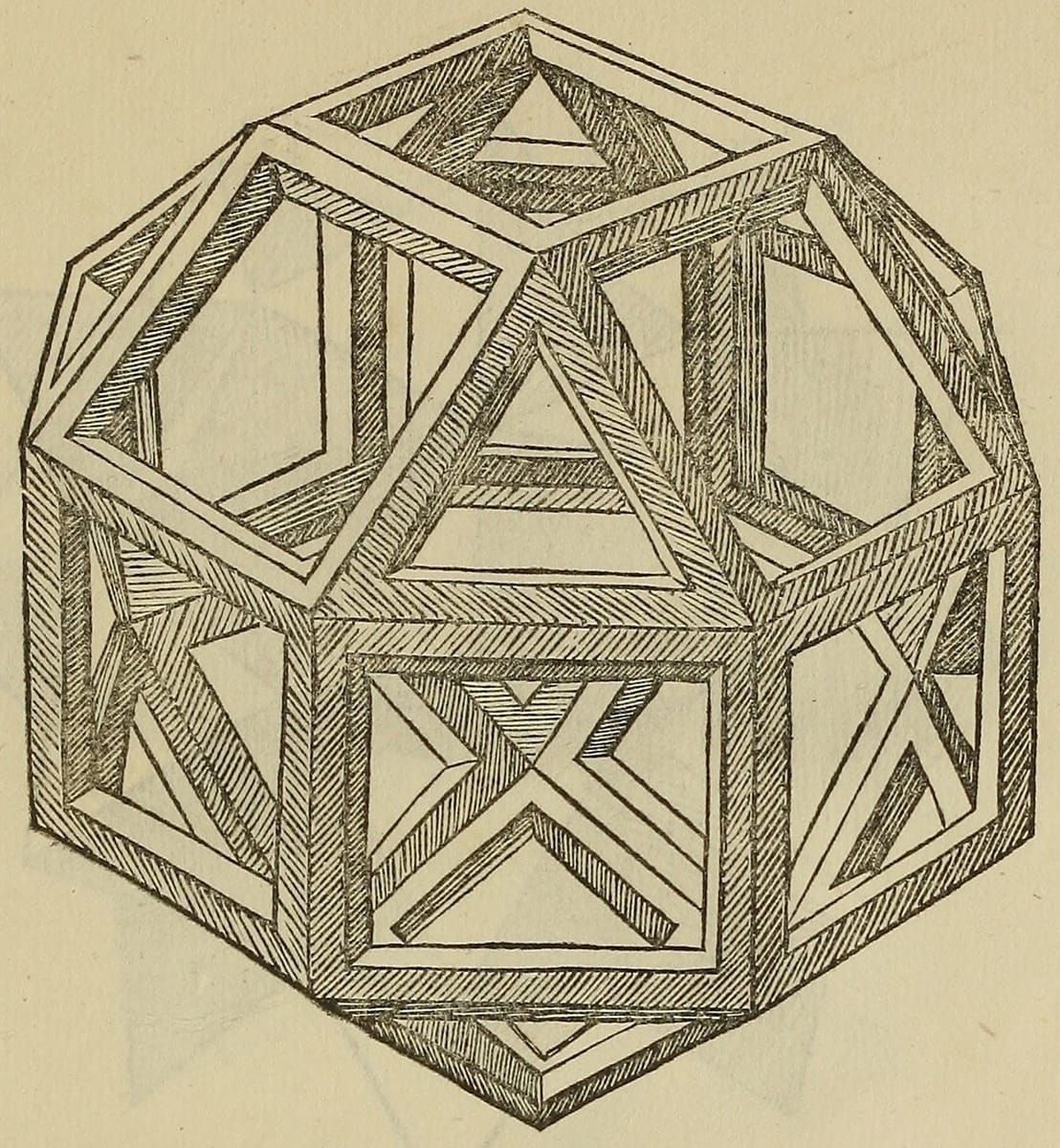
이 작품은 르네상스 시기 천재 거장 레오나르도 다 빈치(Leonardo da Vinci, 1452–1519)가 1498년경 완성을 지휘한 유명한 기하학 목판화 유작 <속이 빈 마름모육팔면체 (Rhombicuboctahedron Vacuum / Polyhedron for De Divina Proportione)>로, 실제 규격은 가로 15cm, 세로 16.5cm 크기이며 현재 이탈리아 밀라노의 암브로시아나 도서관(Biblioteca Ambrosiana, Milan) 등에 원본 판화 서적으로 소장되어 있습니다. 종이 위에 펜과 잉크로 원화를 그리고 이를 목판화로 판각하여 26개의 면을 가진 아르키메데스 다면체(Rhombicuboctahedron)의 3차원 입체 프레임 구조를 극도로 정교하게 정립해 낸 수학 회화 명작입니다.
미술사학계 및 수학사학계의 도상학적 분석에 따르면, 레오나르도는 다면체의 각 면을 막힌 면이 아닌 속이 비어 있는 정교한 프레임(Vacuum) 형태로 고안했습니다. 8개의 정삼각형 면과 18개의 정사각형 면으로 구성된 이 기하학적 입체물은 내부의 프레임과 반대편 구조까지 투시되도록 정밀하게 계산되어 있습니다. 이러한 공간적 투시 표현은 신성한 기하학적 균형미와 우주의 질서를 상징하며, 3차원 입체 공간을 2차원 평면에 완벽하게 시각화한 르네상스 수학적 조형미의 정수를 보여줍니다.
이 화폭에는 르네상스 수학과 예술의 위대한 만남이 담긴 비하인드 스토리와 역사적 평가가 깃들어 있습니다. 이 삽화는 레오나르도 다 빈치가 자신의 절친한 친구이자 르네상스 대표 수학자인 루카 파치올리(Luca Pacioli) 신부가 집필한 저서 <신성한 비례에 관하여 (De Divina Proportione)>의 출판을 위해 직접 그려준 60여 개의 다면체 도면 중 하나입니다. 파치올리 신부는 서문에서 "그 누구도 따라올 수 없는 천재적인 예술가 레오나르도 다 빈치가 그린 기하학 도면 덕분에 책의 가치가 비약적으로 상승했다"라고 극찬을 남겼습니다. 후대 미술사학자들과 수학자들은 이 도판을 과학적 정밀성과 미술적 미학이 완벽하게 결합하여 서양 기하학 수사학을 바꾼 최고의 역사적 유산으로 평가합니다.
이 그림을 가만히 바라보고 있으면 보는 이의 무의식 속에서 은은한 방사형 입체 순환 구조가 부드럽게 작동합니다. 가장 먼저 화면 중앙의 선명한 정삼각형 프레임과 내부의 X자형 가로지름 뼈대에 시선이 끌려들어 간 뒤, 좌우 및 상단으로 확장되는 정사각형 모서리 프레임의 대각선 입체 라인으로 이동합니다. 이후 속이 들여다보이는 뒷면의 깊숙한 관통 프레임들을 거쳐 다시 정면 중앙의 정삼각형과 정사각형 마주침 면으로 되돌아오는 유연한 시선 흐름을 완성합니다. 이러한 시각적 순환 유도는 대뇌 인지 영역에서 찰나의 긴장감을 해쇄하고, 거장의 정교한 기하학적 질서 속에서 깊은 내면의 평온과 안식을 선사합니다.
This masterpiece, titled Rhombicuboctahedron Vacuum (from De Divina Proportione), was designed around 1498 by Renaissance genius Leonardo da Vinci (1452–1519). Measuring 15 cm in width by 16.5 cm in height, this detailed woodcut print on paper is currently preserved in the Biblioteca Ambrosiana in Milan, Italy. Depicting a 26-sided Archimedean solid with an openwork frame structure that allows viewers to look through its geometric interior, the illustration stands as a paramount triumph merging High Renaissance art with solid geometry.
Art and mathematical historical scholarship highlights the revolutionary spatial architecture embedded within the drawing. Leonardo departed from solid-faced polyhedra by designing open wooden frames (vacuum) that revealed the hidden structural mechanics, opposing faces, and internal spatial depth. Composed of 8 equilateral triangles and 18 squares, the drawing mathematically models divine proportion, cosmic order, and flawless linear perspective, demonstrating his matchless ability to render complex three-dimensional forms on a flat surface.
Fascinating historical backstories and glowing evaluations surround this iconic geometric illustration. Designed to illustrate the celebrated treatise De Divina Proportione (On Divine Proportion) authored by his close friend and mathematician Franciscan friar Luca Pacioli, Leonardo executed sixty intricate drawings for the project. Pacioli praised Leonardo in the preface, noting that the master's hand elevated mathematical science to unparalleled artistic splendor. Modern historians revere this woodcut series as a monumental milestone in technical illustration, celebrating its peerless synthesis of mathematical rigor, structural clarity, and timeless aesthetic beauty.
Gazing upon this intricate geometric figure gently awakens a subtle subconscious visual rhythm. The viewer’s eye originates at the central triangular frame and its internal X-shaped bracing, glides outward along the crisp, linear edges of the surrounding square facets, and sweeps through the see-through perspective lines of the interior back wall. The gaze then ascends fluidly back to the front-facing central facet, completing a soft, circular loop. This harmonious visual movement dissolves inner cognitive tension, inviting the mind into a quiet sanctuary of artistic wonder and serene contemplation.
본 리뷰에서 작품을 제외한 컨텐츠의 저작권은 팔렛트제주에 있습니다.
"퍼블릭도메인 고전명화"를 제외한 모든 창작 콘텐츠는 저작권법 제4조 및 제10조에 의거하여 보호됩니다. 무단 도용시 저작권법 제136조(벌칙)에 의거, 당사의 사전 서면 승인 없는 저작권 침해 행위를 금지합니다.