만선의 귀환 The Return of the Catch
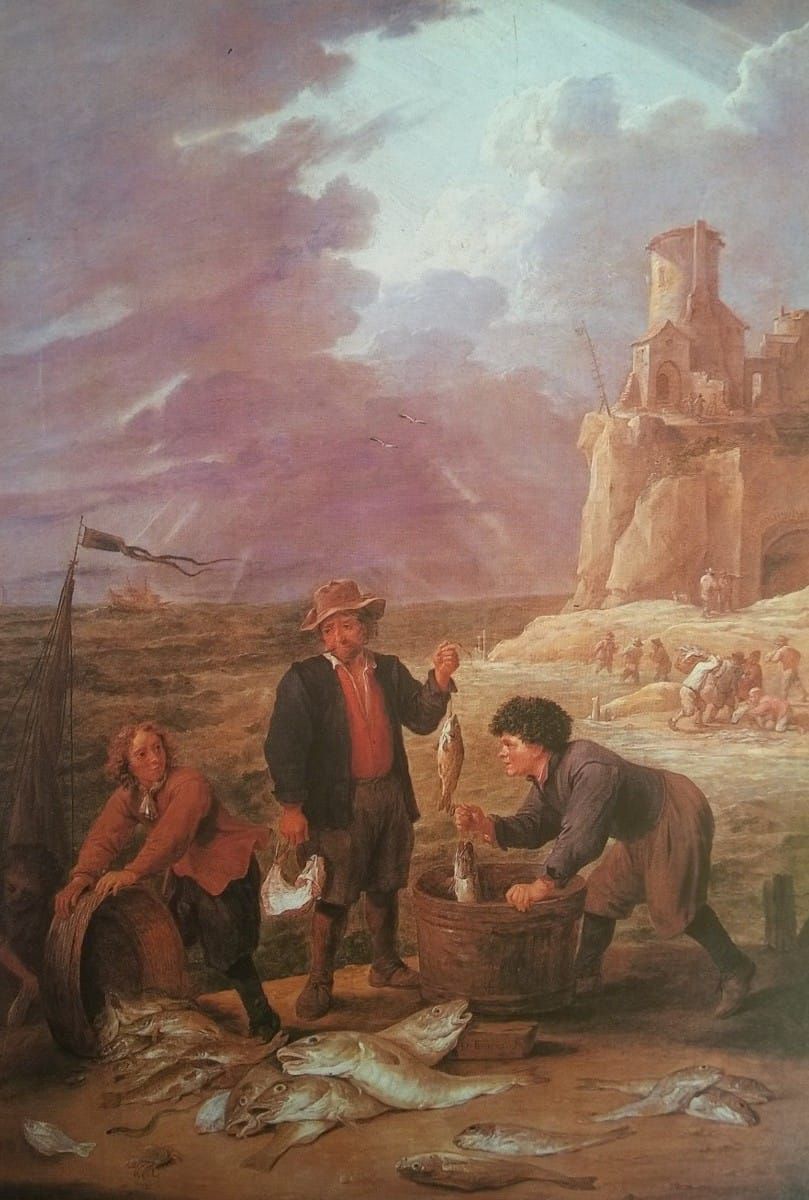
17세기 플랑드르 바로크 풍경화 및 해안 어부 풍속화의 거장 소 다비드 테니어르스(David Teniers le Jeune, 1610–1690)가 1640년대 중후반 안트베르펜과 브뤼셀 시기에 완성한 기념비적 해안 풍속 유화 만선의 귀환(The Return of the Catch, 또는 어획물을 분류하는 어부들, Fishermen on the Beach with their Catch, 프랑스어: Le retour de la pêche)은 54.0 cm × 37.0 cm 크기의 단정한 세로형 패널(목판)에 유채로 그린 대표적인 북유럽 해양 풍속 정물화 최고 걸작입니다.
유럽 유수의 명문 귀족 컬렉션을 거쳐 국제 미술계에서 높은 예술적 가치를 인정받았으며, 현재는 저명한 개인 소장처에 보존되어 있습니다.
거친 북해 바다와 정직한 노동의 결실을 향한 화가의 고뇌
1640년대 플랑드르 화단을 이끌던 삼십 대의 테니어르스는, 내륙의 농촌 주점 풍경을 넘어 거친 파도와 비바람에 맞서 목숨을 걸고 바다로 나가는 북해 어부들의 진솔한 삶에 주목했습니다.
화가는 남유럽 이탈리아 해안에서 볼 수 있는 웅장한 고대 암벽 요새의 낭만적인 정취와, 갓 잡아 올린 싱싱한 대구와 가자미를 모래사장에 쏟아놓고 크기별로 분류하는 어부들의 투박한 노동 현장을 어떻게 맑은 은빛 대기(Silvery manner) 속에 조화롭게 담아낼지 치열하게 번민했습니다.
화가는 보랏빛 비구름 사이로 한 줄기 햇살이 쏟아져 내리는 해안가에서, 만선의 기쁨을 안고 돌아와 부지런히 생선을 정리하는 어부들의 활기찬 순간을 화폭에 담았습니다.
화면 중앙에는 갈색 모자를 쓰고 붉은 셔츠에 겉옷을 걸친 선장 어부가 낚싯줄에 꿴 물고기를 들어 올리며 흡족한 표정으로 서 있고, 오른쪽에서는 곱슬머리 청년이 둥근 나무통 속에 손을 넣어 커다란 물고기를 꺼내 올리고 있습니다.
화면 왼쪽에서는 붉은 재킷을 입은 소년이 바구니를 통째로 엎어 바닥에 은빛 생선들을 쏟아붓고 있습니다.
모래사장 바닥에는 방금 펄떡이다 숨을 거둔 거대한 대구와 가자미, 게, 작은 조개들이 반짝이는 비늘을 뽐내며 사실적으로 널려 있습니다.
오른쪽 깎아지른 절벽 위에는 둥근 석조 망루 요새가 웅장하게 서 있고, 저 멀리 모래사장과 거친 파도 위에서 그물을 당기는 동료 어부들의 모습은 자연의 위대함과 정직한 땀방울이 빚어낸 숭고한 결실을 손에 잡힐 듯 생생하게 웅변합니다.
들어 올린 물고기에서 쏟아지는 은빛 대구와 절벽 위 망루로, 시선의 심리적 여정
그림을 마주하는 순간 관람객의 무의식적 시선은 화면 중앙에서 은은한 햇빛을 받아 선명하게 떠오르는 중앙 어부의 붉은 셔츠와 그의 손에 들린 은빛 물고기로 가장 먼저 빨려 들어갑니다.
손에 든 수확물을 만족스럽게 내려다보며 여유를 즐기는 어부의 다부진 모습은 보는 이에게 깊은 시각적 생동감과 함께 짭조름한 바다의 싱싱한 에너지를 선사합니다.
이어 시선은 바구니를 기울여 모래바닥에 생선을 쏟아붓는 왼쪽 소년의 붉은 재킷과, 나무통 속으로 손을 뻗어 큰 물고기를 건져 올리는 오른쪽 청년의 분주한 손놀림으로 이동합니다.
만선의 풍요로움 속에서 손발을 맞춰 빠르게 생선을 분류하는 어부들의 호흡을 확인하는 순간, 관람객은 파도 소리와 바닷바람이 귓가를 스치는 17세기 플랑드르 해변 한복판 속으로 온몸이 빨려 들어가게 됩니다.
마지막으로 시선은 모래바닥에 가지런히 널린 거대한 대구의 매끄러운 비늘 광택을 지나, 화면 오른쪽 절벽 위에 우뚝 솟은 고대 석조 망루 요새와 성문, 그리고 보랏빛 먹구름을 뚫고 쏟아지는 찬란한 은빛 하늘빛에 멈춥니다.
전면의 활기찬 어부 정물과 수직으로 당당하게 솟은 해안 요새가 빚어내는 완벽한 공간적 조화를 마주하며, 관람객은 거친 대자연 속에서 살아가는 인간의 당당한 생명력과 거장 테니어르스가 건네는 묵직한 서민적 위로를 가슴 깊이 마주하게 됩니다.
17세기 플랑드르 해양 풍속 정물화의 정점과 조형미, 미술계의 평가
미술계는 만선의 귀환을 테니어르스가 해안 풍경화와 인물 풍속화, 그리고 극사실적인 어류 정물화를 가장 완벽한 균형감으로 조화시켜 완성한 대표적인 최고봉 명작으로 평가합니다.
단순한 어촌 풍경을 넘어 대자연의 장엄한 드라마와 서민들의 성실한 노동을 완벽한 수직 구도 속에 결합했을 뿐만 아니라, 갓 잡은 대구 비늘의 축축한 광택, 나무통과 바구니의 거친 결, 깎아지른 절벽의 육중한 암석 질감, 보랏빛 먹구름 사이로 비치는 햇살의 투명한 공기감을 극도로 섬세한 북유럽 사실주의 유화 기법으로 완벽하게 구현했기 때문입니다.
어부들의 정직한 노동과 바다의 풍요를 가장 품격 높은 시각 교향곡으로 승화시킨 테니어르스의 이 걸작 화폭은, 오늘날까지도 전 세계 수많은 감상자들에게 깊은 감탄과 잊을 수 없는 시각적 전율을 전해주는 불멸의 명작으로 손꼽히고 있습니다.
The Return of the Catch
Painted in the mid-to-late 1640s by the master of Flemish Baroque genre and coastal landscape painting David Teniers the Younger (1610–1690), The Return of the Catch (also titled Fishermen on the Beach with their Catch, French: Le retour de la pêche) is a coastal genre masterpiece in oil on panel measuring 54.0 cm × 37.0 cm (21.3 in × 14.6 in).
Cherished across distinguished European aristocratic collections, it is preserved today in a prestigious private collection.
Northern Tides, Fisherfolk Labor, and the Master of Marine Light
During the mid-to-late 1640s, David Teniers the Younger expanded his repertoire beyond tavern interiors, turning his eye toward the rugged shores of the North Sea to celebrate the perilous livelihoods of local fishermen.
The master meditated deeply on how to unite the romantic, rocky watchtowers of Mediterranean coastline memories with the unvarnished realism of northern maritime labor, harmonizing the daily sorting of cod and flatfish under dramatic, storm-clearing skies bathed in silvery atmospheric daylight.
The composition stages a lively gathering of fishermen sorting their day's bountiful harvest upon a sandy beach bordered by turbulent waves and a fortified headland.
In the center foreground, a weathered fisherman in a broad-brimmed hat, vibrant scarlet shirt, and dark jacket holds up a freshly caught fish with quiet satisfaction.
To the right, a dark-haired youth reaches into a large wooden tub to hoist another sizable catch, while to the left, a boy in a rust-red jacket tips over a woven basket to spill glittering fish onto the sand.
Upon the ground lies an extraordinary, glistening still life of cod, flatfish, rays, and crabs, while upon the sheer rock cliff to the right rises a circular stone watchtower and arched sea gate, celebrating the timeless harmony and heroic labor of coastal life.
Subconscious Trajectory of the Gaze: From the Raised Fish to the Cliffside Watchtower
The observer's subconscious gaze is immediately magnetized by the central register, drawn to the luminous crimson shirt of the standing fisherman and the silvery, light-struck fish suspended from his hand.
His upright posture, steady gaze, and confident handling of the harvest establish an instant focal point of physical pride, rustic character, and narrative vitality.
The visual path then shifts toward the active figures flanking him, moving from the boy pouring the wicker basket to the companion leaning over the brimming wooden cask.
Taking in their coordinated teamwork and the unhurried rhythm of their shoreside task, the viewer directly experiences the authentic, salt-scented atmosphere of a 17th-century fishing landing.
Finally, the visual trajectory descends across the glistening, wet scales of the cod piled upon the foreground sand, before ascending past the distant surf to the monumental stone watchtower crowning the cliff and the luminous break in the violet storm clouds above.
Observing the harmonious equilibrium between focused vertical composition, marine chiaroscuro, and precise Netherlandish draftsmanship, the spectator perceives the timeless nobility of honest labor and the profound aesthetic solace Teniers embedded within the panel.
The Monument of Flemish Marine Genre: Critical Legacy
Art historians revere The Return of the Catch as an exceptional achievement in Teniers’s oeuvre, illustrating his consummate ability to unite still-life virtuosity, human characterization, and dramatic coastal atmosphere on an intimate panel.
By orchestrating delicate textural contrasts between wet fish scales, porous wooden casks, rough wicker weaves, weathered sandstone towers, and radiant moisture-filled clouds within a unified perspectival space, Teniers elevated a fisherman's chore into an exquisite aesthetic treatise on nature's bounty.
This grand historical panel endures as an inspiring testament to the master's creative fortitude, celebrating the quiet poetry of everyday existence and the transformative grace of living art.
본 컨텐트의 저작권은 팔렛트제주에 있습니다. 허가없는 무단전제를 금지합니다.
Copyright © Palette Jeju. All rights reserved. Unauthorized reproduction or redistribution is strictly prohibited.