맑은 샘물을 깨우는 풍요의 뿔과 숲의 요정, 샘의 님프 Quellnymphe
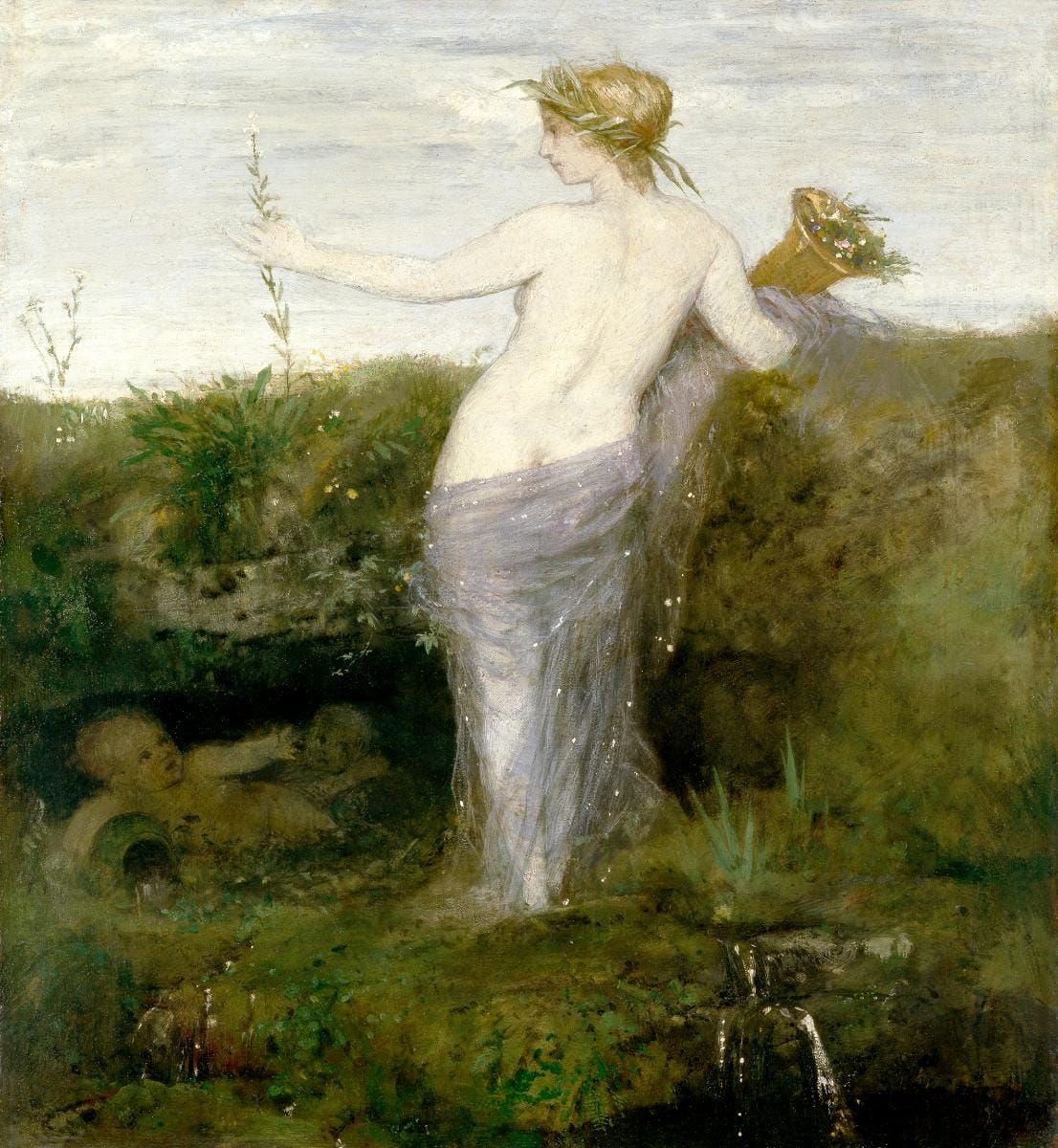
스위스 출신의 상징주의 거장 아놀드 뵈클린(Arnold Böcklin, 1827–1901)이 1866년에 스위스 바젤에서 완성한 유화 샘의 님프(Nymph of the Spring, 독일어: Quellnymphe)는 100.0 cm × 92.0 cm 크기의 캔버스에 유채로 그린 대표적인 초기 신화화 걸작입니다. 현재 스위스 취리히의 쿤스트하우스 취리히(Kunsthaus Zürich)에 소장되어 있습니다.
바젤 벽화 논란의 상처를 딛고 피워낸 자연의 생명력
1860년대 중반 뵈클린은 고향 바젤로 돌아와 바젤 미술관 계단 벽화 작업을 진행하며 지역 보수파 비평가들과 격렬한 갈등을 겪고 있었습니다. 당시 스위스 비평계는 그림이 엄격한 교훈을 주거나 역사의 장엄한 교훈을 전달해야 한다고 고집하며, 뵈클린의 자유분방한 상상력과 생명력 넘치는 신화적 인물들을 퇴폐적이라고 맹비난했습니다. 화가는 이러한 편협한 시선에 큰 마음의 상처를 입었지만, 아카데미의 형식주의에 굴복하는 대신 자연 그 자체가 품고 있는 순수한 생명력과 풍요로움을 화폭에 당당하게 펼쳐 보였습니다.
화면 속 풀밭 언덕 위에는 월계관을 쓴 아름다운 숲의 님프가 우아한 뒤태를 드러내며 서 있습니다. 님프는 한 손에 꽃과 열매가 가득 담긴 풍요의 뿔(코르누코피아)을 든 채, 다른 손으로는 막 피어나는 하얀 들꽃을 향해 부드럽게 손을 뻗고 있습니다. 그녀의 허리를 감싼 반투명한 보랏빛 베일 아래, 어두운 바위 동굴 속에서는 갓 태어난 아기 요정들이 항아리에서 맑은 샘물을 쏟아내며 장난을 치고 있고, 그 물은 작은 폭포수가 되어 아래로 졸졸 흘러내립니다. 뵈클린은 신화를 딱딱한 교훈의 수단이 아니라, 대지가 품은 물의 순환과 사계절의 풍요를 상징하는 살아 숨 쉬는 생명체로 그렸습니다. 비평가들의 냉담한 공격 속에서도 자연의 신성한 아름다움을 지켜내려 했던 화가의 굳은 신념이 이 눈부신 캔버스 위에 그대로 살아 숨 쉬고 있습니다.
눈부신 님프의 등선에서 어둠 속 아기 요정의 샘물로, 시선의 심리적 여정
그림을 마주하는 순간 관람객의 무의식적 시선은 화면 중앙에서 은은한 햇살을 받아 우윳빛으로 빛나는 님프의 매끄러운 등과 우아한 허리선으로 가장 먼저 이끌립니다. 월계관을 쓴 여인의 부드러운 옆모습과 바람에 날리는 얇은 보랏빛 옷자락은 보는 이에게 깊은 순수함과 맑은 해방감을 선사합니다.
이어 시선은 님프의 왼팔에 안긴 황금빛 풍요의 뿔과 그 안에 가득 담긴 색색의 꽃송이들을 지나, 그녀가 오른손으로 살며시 가리키고 있는 가녀린 하얀 들꽃 줄기로 이동합니다. 자연의 풍요로움과 생명의 탄생을 축복하는 요정의 섬세한 손짓을 확인하는 순간, 관람객은 따스한 봄바람이 스치는 숲속의 고요한 평화에 젖어들게 됩니다.
마지막으로 시선은 님프의 발치 아래 어두운 바위틈 동굴로 내려와, 물 항아리를 기울여 맑은 샘물을 쏟아내며 놀고 있는 통통한 아기 요정들과 바위 아래로 떨어지는 작은 폭포수에 멈춥니다. 밝은 대지 위의 님프와 어둠 속에서 솟아나는 생명의 근원인 샘물이 이루는 완벽한 조화를 마주하며, 관람객은 대자연이 품은 끝없는 생명력과 영혼을 맑게 씻어주는 순수한 휴식을 가슴 깊이 체감하게 됩니다.
신화와 자연주의의 서정적 결합, 미술계의 평가
미술계는 샘의 님프를 뵈클린이 고전 신화의 상징을 자연의 유기적인 생명력과 결합하여 자신만의 독창적인 상징주의 화풍을 확립한 중요한 대표작으로 평가합니다.
단순한 누드화의 관습을 벗어나, 물의 투명함과 흙의 질감, 그리고 인체에 닿는 부드러운 자연광의 변화를 섬세한 색채 조화로 구현했기 때문입니다. 고향의 삭막한 비판 속에서도 자연의 정령을 맑고 서정적인 시선으로 포착해 낸 뵈클린의 이 아름다운 화폭은 훗날 그가 남긴 수많은 신화 풍경화들의 소중한 모태가 되었습니다.
The Luminous Rebirth of the Forest Spring, Nymph of the Spring
Painted in 1866 in Basel by the preeminent Swiss Symbolist master Arnold Böcklin (1827–1901), Nymph of the Spring (German: Quellnymphe) is an early oil on canvas measuring 100.0 cm × 92.0 cm (39.4 in × 36.2 in), preserved in the permanent collection of the Kunsthaus Zürich in Zurich, Switzerland.
The Basel Mural Controversy and the Vital Spirit of Classical Myth
In the mid-1860s, Arnold Böcklin returned to his native Basel to execute monumental wall paintings for the municipal museum, only to face intense opposition from conservative local authorities. Traditional Swiss critics demanded sober historical allegories designed to impart moral lessons, dismissing Böcklin’s sensual mythological creatures and vibrant pagan motifs as disruptive novelties. Though wounded by these institutional disputes, the artist refused to conform to academic conservatism, seeking instead to visualize the uncorrupted fertility and regenerative rhythms of the natural earth.
Upon a sun-drenched grassy mound, a laurel-crowned nymph stands with her back gracefully turned toward the viewer. In her left arm she supports a gilded cornucopia brimming with seasonal blossoms, while her outstretched right hand reaches toward a slender white wildflower. Draped around her hips in translucent lilac gauze, she presides over a shadowy cavern below, where playful water sprites overturn an amphora to release a clear spring that cascades into a brook. Bypassing rigid moralizing conventions, Böcklin transformed classical myth into a living personification of botanical abundance and pure water. This luminous canvas stands as an enduring testament to the master's artistic independence and reverence for the sacred forces of nature.
Subconscious Trajectory of the Gaze: From Luminous Spine to the Subterranean Spring
The observer's subconscious gaze is immediately captivated by the radiant modeling of the nymph’s bare back and slender waist at the center, illuminated softly against the pale sky. The delicate tilt of her laurel-crowned profile and the sheer lilac fabric gathered about her hips establish an immediate atmosphere of classical grace and serene vitality.
The visual path then ascends to the cornucopia cradled in her left elbow, taking in the vibrant cluster of newly gathered wildflowers before following her right arm toward the solitary blossom rising from the grassy bank. Discovering this gentle gesture of communion with the earth, the viewer experiences a transition from classical stateliness to intimate pastoral warmth.
Finally, the trajectory descends past her feet into the dark rocky alcove below, discovering the chubby putti splashing beside the overturned vessel and the crystalline cascade spilling over the stone threshold. Observing the dynamic harmony between the sunlit maiden above and the shadowed wellspring beneath, the spectator perceives the eternal cycle of natural nourishment and the restorative peace of an uncorrupted landscape.
The Harmony of Myth and Naturalism: Critical Legacy
Art historians recognize Nymph of the Spring as a pivotal masterwork demonstrating Böcklin’s innovative ability to integrate classical allegorical motifs with atmospheric landscape painting.
By prioritizing subtle chiaroscuro, organic surface textures, and nuanced chromatic harmony over rigid academic outlines, Böcklin established an evocative modern visual language for Symbolist painting. This radiant canvas endures as an essential early milestone, celebrating the enduring fertility of the earth and the poetic nobility of the living cosmos.
본 컨텐트의 저작권은 팔렛트제주에 있습니다. 허가없는 무단전제를 금지합니다.
Copyright © Palette Jeju. All rights reserved. Unauthorized reproduction or redistribution is strictly prohibited.