마을을 습격한 약탈자들 Raid on a Village
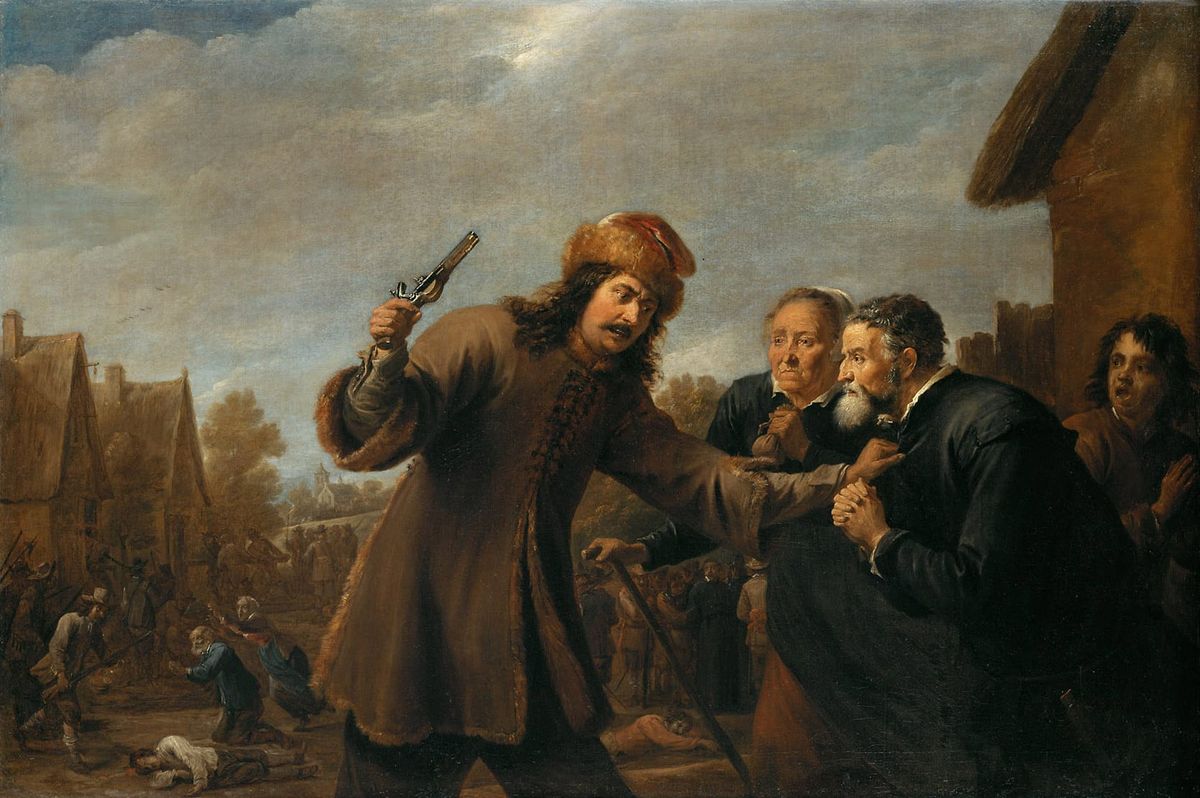
17세기 플랑드르 바로크 역사 풍속화 및 전쟁 비극화의 거장 소 다비드 테니어르스(David Teniers le Jeune, 1610–1690)가 1648년 안트베르펜 시기에 완성한 기념비적 역사 풍속 대작 유화 마을을 습격한 약탈자들(Raid on a Village, 또는 마을의 약탈, 군인들에게 위협받는 농민들, 독일어: Überfall auf ein Dorf, 네덜란드어: Plundering van een dorp)은 77.0 cm × 114.0 cm 크기의 웅장한 가로형 패널(목판)에 유채로 그린 대표적인 북유럽 전쟁 역사 풍속화 최고 걸작입니다.
유럽 유수의 명문 귀족 컬렉션을 거쳐 국제 미술계에서 높은 역사적 가치를 인정받았으며, 현재는 저명한 공공 미술관 및 개인 컬렉션에 소중히 보존되어 오고 있습니다.
30년 전쟁의 참상과 무고한 민초들의 고통을 향한 화가의 고뇌
1648년 유럽 전역을 피로 물들였던 30년 전쟁이 마침내 베스트팔렌 조약으로 막을 내리던 해, 테니어르스는 전쟁의 소용돌이 속에서 가장 큰 피해를 보았던 힘없는 시골 주민들의 비극적인 현실에 깊이 주목했습니다.
화가는 평화로운 전원 축제나 유쾌한 주점 풍경을 주로 그리던 평소의 화풍에서 벗어나, 무장한 용병들의 무자비한 약탈과 죽음의 공포 앞에서 울부짖는 노인들의 처절한 절규를 어떻게 극적인 은빛 대기(Silvery manner)와 긴박한 명암법 속에 담아낼지 치열하게 번민했습니다.
당시 북유럽 회화에서 전쟁 약탈 장면은 군대의 헛된 폭력성을 고발하고 평화의 소중함을 일깨우는 강력한 반전 메시지를 담고 있었습니다.
화가는 연기와 비명이 자욱한 시골 마을 어귀에서, 권총을 빼 들고 노인의 멱살을 잡은 채 금품을 요구하는 거친 용병 대장과 두 손을 모아 목숨을 구걸하는 노부부의 숨 막히는 대치 순간을 화폭에 담았습니다.
화면 중앙에는 모피 모자를 쓰고 긴 칼과 지팡이를 짚은 위협적인 외모의 약탈자가 오른손에 플린트락 권총을 치켜든 채, 분노에 찬 눈빛으로 앞을 가로막은 노인의 가슴팍을 거칠게 밀치고 있습니다.
그의 앞에 선 백발의 노인은 검은 옷을 입고 두 손을 모아 쥐며 공포에 질린 표정으로 자비를 애원하고 있고, 그 곁의 노파는 작은 돈주머니를 품에 안은 채 슬픔에 잠겨 있습니다.
오른쪽 구석에서는 입을 벌리고 기겁하며 도망치는 소년이 보이고, 왼쪽 뒤편 길가에는 쓰러져 피를 흘리는 시신과 무릎을 꿇고 살려달라 비는 또 다른 노인의 비극이 펼쳐집니다.
저 멀리 불타는 농가에서 피어오르는 회색 연기와 지평선 너머로 아련하게 솟은 교회 종탑은, 전쟁의 광기가 휩쓸고 간 참혹한 상처 속에서도 평화를 염원하는 민초들의 간절한 기도를 손에 잡힐 듯 생생하게 웅변합니다.
치켜든 권총과 용병의 서슬 퍼런 눈빛에서 애원하는 노인과 불타는 마을로, 시선의 심리적 여정
그림을 마주하는 순간 관람객의 무의식적 시선은 화면 중앙 짙은 흙먼지 속에서 은은한 하늘빛을 받아 번쩍이는 약탈자의 권총 총열과 그의 분노 서린 눈빛으로 가장 먼저 빨려 들어갑니다.
모피 모자 아래로 험상궂은 표정을 지으며 노인을 향해 팔을 뻗은 거한의 공격적인 자세는 보는 이에게 깊은 시각적 충격과 함께 일촉즉발의 위험한 긴장감을 선사합니다.
이어 시선은 용병의 거친 손끝이 닿아 있는 백발 노인의 주름진 얼굴과, 파르르 떨며 모아 쥔 두 손의 애절한 몸짓으로 이동합니다.
한평생 성실하게 일군 터전과 목숨을 지키기 위해 무력하게 빌고 있는 노인의 처절한 눈망울을 확인하는 순간, 관람객은 비명과 화약 연기가 뒤섞인 1648년 플랑드르 피란길 한복판 속으로 온몸이 빨려 들어가게 됩니다.
마지막으로 시선은 돈주머니를 쥔 노파와 경악하는 소년의 얼굴을 지나, 화면 왼쪽 바닥에 피를 흘리며 쓰러진 희생자들과 무릎 꿇은 이웃들, 그리고 마을 뒤편 언덕 위로 희미하게 서 있는 교회의 실루엣에 멈춥니다.
전면의 숨 막히는 폭력의 현장과 후면의 처절한 아비규환이 빚어내는 완벽한 공간적 깊이를 마주하며, 관람객은 무고한 생명을 짓밟는 전쟁의 잔혹함과 거장 테니어르스가 건네는 묵직한 인도주의적 울림을 가슴 깊이 마주하게 됩니다.
17세기 플랑드르 역사 비극 풍속화의 정점과 조형미, 미술계의 평가
미술계는 마을을 습격한 약탈자들을 테니어르스가 역동적인 인물 군상의 감정 폭발과 극적인 서사 구조를 가장 완벽한 기량으로 결합해 완성한 대표적인 최고봉 명작으로 평가합니다.
단순한 풍속 묘사를 넘어 전쟁의 참상과 인간 존엄의 위기를 완벽한 대각선 구도 속에 배치했을 뿐만 아니라, 권총 금속 부품의 정밀한 광채, 모피 깃과 털모자의 보송보송한 질감, 낡은 모직 옷의 주름, 연기에 휩싸인 하늘의 대기감을 극도로 섬세한 북유럽 사실주의 유화 기법으로 완벽하게 구현했기 때문입니다.
전쟁의 상흔 속에서 피어난 민초들의 아픔을 가장 품격 높은 시각 서사시로 승화시킨 테니어르스의 이 걸작 화폭은, 오늘날까지도 전 세계 수많은 감상자들에게 깊은 전율과 잊을 수 없는 역사적 교훈을 전해주는 불멸의 명작으로 손꼽히고 있습니다.
Raid on a Village
Painted in 1648 by the master of Flemish Baroque genre and historical narrative painting David Teniers the Younger (1610–1690), Raid on a Village (also titled Plundering of a Village, Peasants Threatened by Soldiers, German: Überfall auf ein Dorf, Dutch: Plundering van een dorp) is a monumental historical narrative masterpiece in oil on panel measuring 77.0 cm × 114.0 cm (30.3 in × 44.9 in).
Preserved across distinguished European aristocratic collections, it is housed today in a celebrated public gallery and private collection.
The Thirty Years' War, the Tragedy of the Peasantry, and Humanitarian Pathos
In 1648, as the devastating Thirty Years' War finally reached its conclusion with the Peace of Westphalia, David Teniers the Younger turned his brush to record the profound suffering endured by the defenseless rural population.
Moving beyond his familiar scenes of village festivities, the master meditated deeply on the ruthless predation of mercenary bands and the terror of vulnerable peasants, orchestrating the human tragedy beneath an expansive, smoke-tinged Flemish sky bathed in his celebrated silvery atmospheric light.
In Northern Netherlandish iconography, village plundering scenes served as potent anti-war manifestos, exposing the cruelty of lawless soldiers and pleading for the restoration of civic peace.
Teniers staged the harrowing confrontation at the entrance of a besieged farming hamlet.
In the center foreground, a menacing mercenary officer in a fur-trimmed cap and heavy traveling cloak raises a wheel-lock pistol in his right hand while aggressively thrusting his left arm against an elderly peasant's chest to extort valuables.
Before him, the white-bearded patriarch dressed in black folds his hands in desperate supplication, pleading for mercy alongside an aged woman who clutches a small purse to her chest.
To the right, a terrified youth flees with wide, gasping eyes, while across the left background, pillaging soldiers strike down villagers, leaving fallen bodies along the road beneath distant burning houses and a church steeple, celebrating the timeless dignity of innocent suffering and the yearning for peace.
Subconscious Trajectory of the Gaze: From the Raised Pistol to the Supplicating Patriarch
The observer's subconscious gaze is immediately magnetized by the central register, drawn to the gleaming steel barrel of the raised pistol and the menacing glare of the fur-capped mercenary.
His dominant stance, aggressive arm extension, and rugged leather attire establish an instant focal point of physical menace, explosive tension, and narrative gravity.
The visual path then shifts toward the right foreground, lingering over the pale, upturned profile of the elderly man with clasped hands.
Taking in his wrinkled brow, greying beard, and trembling plea for life beside his weeping companion, the viewer directly experiences the chilling vulnerability and moral horror of wartime plunder.
Finally, the visual trajectory moves toward the left background, following the violent skirmishes along the village road where fallen victims lie upon the dirt, before ascending toward the distant church spire silhouetted against the sunlit cumulus clouds above.
Observing the harmonious equilibrium between foreground psychological confrontation, deep panoramic perspective, and precise Netherlandish draftsmanship, the spectator perceives the tragic folly of war and the profound aesthetic brilliance Teniers embedded within the panel.
The Monument of Flemish Narrative Tragedy: Critical Legacy
Art historians revere Raid on a Village as an exceptional achievement in Teniers’s oeuvre, illustrating his consummate ability to unite multi-figure narrative drama, psychological intensity, and atmospheric landscape on a grand wooden panel.
By orchestrating delicate textural contrasts between polished steel weaponry, rough fur trim, coarse wool mantles, weathered thatch roofs, and billowing horizon smoke within a unified spatial enclosure, Teniers elevated a tragic chronicle into an exquisite aesthetic treatise on human vulnerability.
This poignant historical panel endures as an inspiring testament to the master's creative fortitude, celebrating the triumph of humanitarian conscience and the transformative grace of living art.
본 컨텐트의 저작권은 팔렛트제주에 있습니다. 허가없는 무단전제를 금지합니다.
Copyright © Palette Jeju. All rights reserved. Unauthorized reproduction or redistribution is strictly prohibited.