카네이션과 다른 꽃들이 있는 꽃병 - Vase with Carnations and other Flowers (Vase with Carnations)
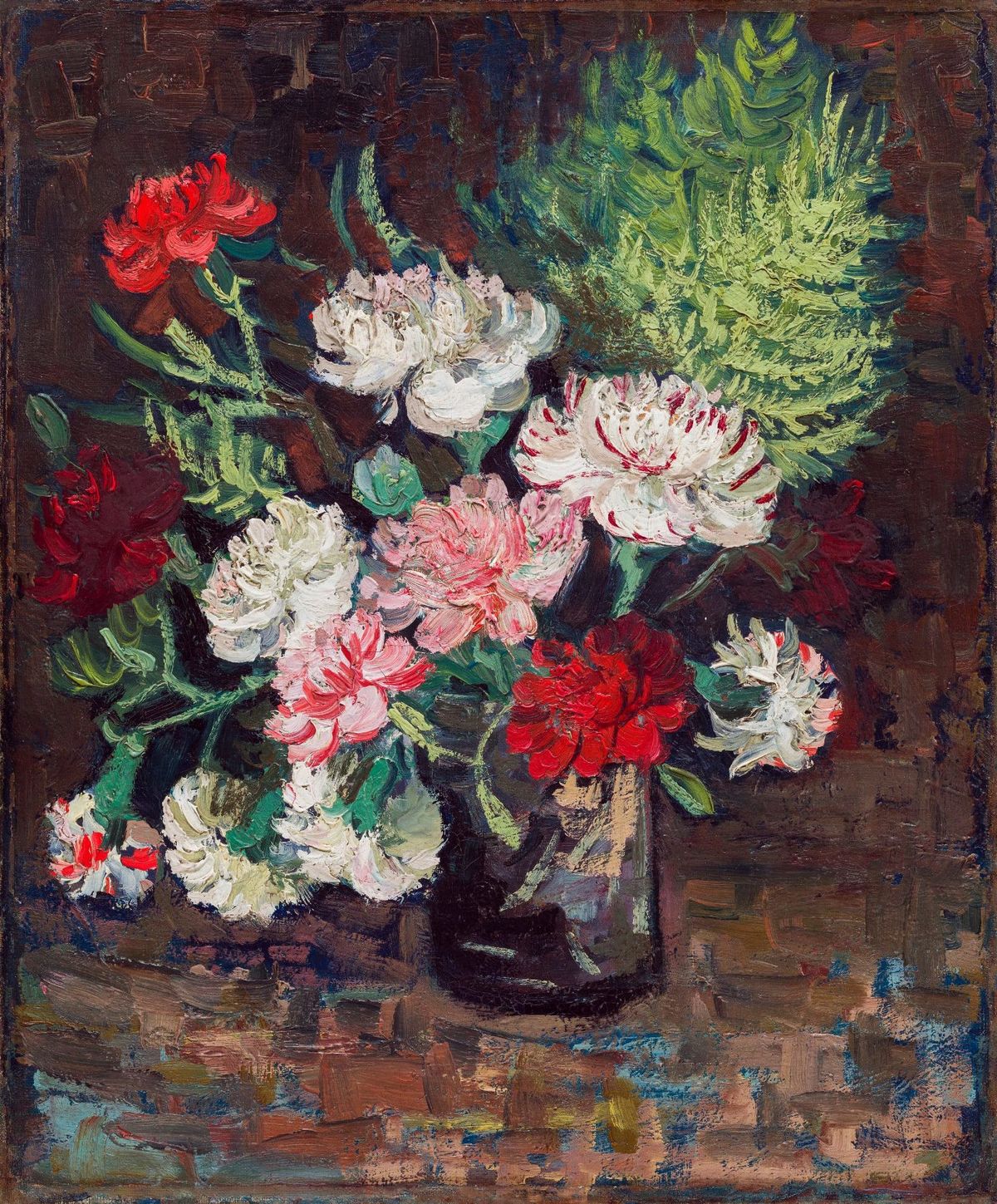
빈센트 반 고흐(Vincent van Gogh, 1853–1890)가 1886년 여름 프랑스 파리 체류 시절 완성한 '카네이션과 다른 꽃들이 있는 꽃병(Vase with Carnations and other Flowers)'은 캔버스에 유채(Oil on canvas)로 제작된 정물화입니다. 작품의 실제 규격은 세로 61.0cm, 가로 50.2cm이며, 현재 미국 워싱턴 D.C.의 국립미술관(National Gallery of Art, Washington, D.C.)에 영구 소장되어 있습니다.
고흐는 이 작품에서 깊고 묵직한 암갈색 배경 위에 선명한 진홍빛과 다홍빛 카네이션, 맑은 순백과 연분홍빛 꽃송이들, 그리고 우측 상단에 솟아오른 연둣빛 잎사귀들의 대비를 두터운 임파스토(Impasto) 기법으로 구현했습니다. 꽃잎 하나하나를 빚어내듯 굵직하게 얹어 올린 유화 물감의 조각적 질감과, 모자이크 직조 패턴처럼 경쾌하게 교차하는 테이블 위의 빗살무늬 붓 터치는 정형화된 고전 정물화의 틀을 깨고 생생한 유기적 생명력을 뿜어냅니다.
이 그림에는 파리에 상경한 직후 인상주의의 찬란한 원색에 눈을 뜨며 '색채의 연금술사'로 거듭나기 위해 치열하게 붓을 휘둘렀던 청년 고흐의 눈물겨운 열정과 흥미진진한 비하인드 스토리가 깃들어 있습니다. 1886년 봄, 네덜란드의 어둡고 칙칙한 갈색 톤을 벗어던지고자 파리 몽마르트르에 있던 동생 테오의 아파트에 합류한 고흐는, 파리 화단에서 마주한 인상주의 대가들의 눈부신 광채에 깊은 충격을 받았습니다. 그는 색채 이론을 완벽히 마스터하기를 갈망했으나, 지독한 가난 탓에 인물 모델을 고용할 돈이 단 한 푼도 없었습니다.
고흐의 딱한 사정을 알게 된 몽마르트르의 화방 주인들과 이웃 화가들, 그리고 동생 테오는 파리 꽃 시장에서 싱싱하고 다채로운 꽃다발을 사다 주었습니다. 고흐는 꽃들이 시들어 생기를 잃기 전에 찰나의 화려한 색채를 포착하기 위해, 1886년 여름 단 몇 달 동안 무려 30여 점이 넘는 꽃 정물화를 폭발적인 속도로 쏟아냈습니다.
당시 고흐는 영국인 화가 친구 호레이스 만 리븐스(Horace Mann Livens)에게 보낸 편지에서 "나는 지금 맹렬하게 꽃 정물화 연작을 그리고 있다. 붉은 카네이션, 푸른 수레국화, 흰 장미들을 그리며 보색의 충돌과 조화를 훈련하는 중이다. 꽃은 지독한 가난 속에서도 내게 색채의 순수한 환희를 가르쳐주는 가장 거룩한 스승이다"라고 고백했습니다. 좁은 방 안 가득 짙은 꽃향기와 유화 기름 냄새를 풍기며 온몸에 땀을 흘리고 붓을 휘두르던 붉은 수염의 고흐에게, 이 카네이션 작업은 훗날 아를 시대를 찬란하게 수놓을 불멸의 '해바라기 연작'을 낳은 가장 눈부신 회화적 산실이었습니다.
특히 이 작품은 훗날 현대 미술관의 정밀 X선(X-ray) 분석 및 보존 처리 과정에서 캔버스 아래에 이전 네덜란드 뉘넌 시절에 그렸던 인물 습작이 숨겨져 있는 것이 확인되었습니다. 새 캔버스를 살 돈이 없어 과거의 습작 위에 덧칠하며 새로운 색채 혁명을 실험해야 했던 무명 화가 고흐의 처절한 생활고와 꺾이지 않는 예술적 집념을 증명하는 가슴 뭉클한 물리적 흔적입니다.
후대의 미술사학자들과 평단은 이 워싱턴 국립미술관 소장본을 반 고흐가 네덜란드 전통 화풍의 무거운 명암법을 탈피하고 파리의 모더니즘 색채 감각을 완벽히 정복했음을 입증하는 결정적 전환기 걸작으로 평가합니다. 꽃의 외형을 정밀하게 모사하는 데 그치지 않고 두터운 물감의 양감과 원색의 강렬한 충돌을 통해 꽃에 영혼의 숨결을 불어넣은 이 조형적 성취는 20세기 표현주의 회화의 문을 연 위대한 이정표로 찬사를 받고 있습니다.
관람자의 시선은 가장 먼저 화면 중앙과 상단에서 만개한 순백색과 연분홍빛 카네이션의 두터운 크림빛 임파스토 질감과 화사한 볼륨감에 사로잡힙니다. 이어 좌측과 중앙 하단에서 강렬한 불꽃처럼 타오르는 진홍빛 카네이션들의 붉은 악센트를 거쳐, 우측 상단으로 풍성하게 뻗어 올라간 연둣빛 덤불 잎사귀들의 싱그러운 수직 동세로 이동합니다. 마지막으로 꽃병을 단단하게 받치고 있는 묵직한 유리 화병과 모자이크 직조 패턴처럼 진동하는 테이블 위의 붓 터치를 따라 화면 전체로 유려하게 순환하게 됩니다.
심리적으로 관람자는 짙은 어둠 속에서도 눈부시게 피어난 붉은 카네이션과 순백의 꽃잎들이 뿜어내는 생생한 생명력 속에서 깊은 정서적 정화와 따스한 위안을 경험하게 됩니다. 곤궁한 현실 속에서도 꽃을 통해 순수한 색채의 환희를 길어 올렸던 화가의 진솔한 열정은 현대인의 마음에 쌓인 피로와 공허함을 부드럽게 녹여주며, 지친 일상 속에서도 묵묵히 희망의 꽃을 피워내는 내면의 단단한 회복 탄력성과 깊은 평온을 풍성하게 채워줍니다.
Vase with Carnations and other Flowers (Vase with Carnations)
Painted by Vincent van Gogh (1853–1890) in Paris during the summer of 1886, Vase with Carnations and other Flowers is an iconic oil on canvas still life measuring 61.0 cm in height and 50.2 cm in width. This celebrated masterwork is permanently preserved in the prestigious collection of the National Gallery of Art in Washington, D.C., United States.
Van Gogh constructed the composition around an audacious chromatic dialogue, setting vibrant crimson and scarlet carnations alongside creamy-white blossoms against a dense, dark umber background. Working with vigorous, tactile impasto strokes, he sculpted the serrated edges of each petal with dimensional relief. The energetic plume of chartreuse foliage rising to the upper right and the woven, mosaic-like brushwork animating the tabletop establish a dynamic visual cadence, transforming a traditional floral bouquet into a pulsating celebration of natural vitality.
The canvas holds an intimate history of rapid artistic evolution and creative perseverance amidst profound Parisian poverty. Arriving in Montmartre in the spring of 1886 to live with his brother Theo, Van Gogh was utterly captivated by the optical brilliance of the Impressionists. Determined to master modern color harmonies but unable to afford live models, he threw himself into painting fresh floral arrangements brought to his studio by Theo and fellow painters.
Racing against the wilting petals, Van Gogh executed over thirty floral canvases in rapid succession during the summer of 1886. Writing to his English friend Horace Mann Livens, he described how these floral studies allowed him to systematically investigate chromatic contrasts and unleash the emotional power of complementary hues. Modern technical analysis later revealed that Van Gogh painted this vibrant arrangement directly over an earlier Dutch-period peasant portrait, physically documenting how the impoverished artist repurposed his somber past into a luminous foundation for modern rebirth.
Modern art historians celebrate this Washington masterpiece as a vital milestone in Van Gogh’s Parisian transformation. By replacing delicate salon realism with raw, sculptural impasto and visceral color harmonies, Van Gogh redefined the floral still life, directly laying the technical and expressive foundation for his celebrated sunflower masterpieces in the south of France.
A viewer’s gaze is instantaneously captured by the thick, sculptural white and pale-rose carnations blooming at the center of the bouquet. The eyes then traverse the fiery crimson blossoms anchoring the left and lower arrangements, before ascending along the textured, feathery green fronds in the upper right. Finally, the gaze descends to the reflective dark vase and circulates effortlessly through the woven, multicoloured strokes of the tabletop, encompassing the entire harmonious composition.
Psychologically, immersion in this rich contrast of pure white, fiery vermilion, and verdant greens induces an immediate sensation of emotional warmth, clarity, and inner resilience. The artist's triumphant capture of living light amidst material hardship dissolves modern fatigue and anxiety, enveloping the observer in an enduring atmosphere of creative optimism, steadfast joy, and restorative peace.
본 리뷰에서 작품을 제외한 컨텐츠의 저작권은 팔렛트제주에 있습니다.
"퍼블릭도메인 고전명화"를 제외한 모든 창작 콘텐츠는 저작권법 제4조 및 제10조에 의거하여 보호됩니다. 무단 도용시 저작권법 제136조(벌칙)에 의거, 당사의 사전 서면 승인 없는 저작권 침해 행위를 금지합니다.